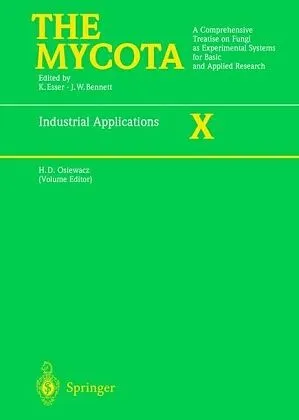
Industrial Applications
Beschreibung
This volume provides an overview of both the state of the art in the traditional fields of industrial mycology as well as of the evaluation of novel applications of fungi in agriculture, environmental biology, and medicine. The first section is devoted to the ...Format auswählen
- Kartonierter EinbandCHF 255.20
- Fester EinbandCHF 326.45
- E-Book (pdf)CHF 413.90

Wird oft zusammen gekauft
Andere Kunden kauften auch
Beschreibung
This volume provides an overview of both the state of the art in the traditional fields of industrial mycology as well as of the evaluation of novel applications of fungi in agriculture, environmental biology, and medicine. The first section is devoted to the traditional use of fungi in the production and processing of food and beverages. The second section deals with different fungal metabolites and enzymes. Here, both fungal substances, e.g. antibiotics, that are part of industrial production processes and those which have not yet been developed into commercial products, but bear important potentials, are introduced. The third section treats the ability of fungi to degrade organic substances or to absorb substrates, which can be used for the purification of contaminated sites and for recycling processes. The last part presents future developments and strategies to produce heterologous proteins. THE MYCOTA Esser Bennett (Eds.) The Series: The fungi represent a heterogeneous assemblage of eukaryotic microorganisms and have become favored organisms for research at the cellular and molecular level. Such research involvement has been stimulated by interest in the biotechnological application of fungi in processes related to industry, agriculture and ecology. Considering both yeasts and mycelial fungi, THE MYCOTA highlights developments in both basic and applied research and presents an overview of funggal systematics and cell structure. Foremost authorities in research mycology have been assembled to edit and contribute to the volumes. This Volume: Industrial Applications Osiewacz (Ed.) The tenth volume includes: Traditional Food and Beverage Fermentation, Metabolites and Enzymes, Conversion of Substrates and Recovery of Metals from Solutions, Recent Developments and Strategies.
From the reviews:" ... very good reference volume, which will prove of value to both mycologists and biotechnolgists." (Mycologist) "Having found a number of the volumes in this series very useful, I was looking forward to reading vol. 10 covering my particular area of interest. I have to say that I found the contents varied. All the chapters are readable and informative ." (J. Kelley, Bibliography of Systematic Mycology, Vol. 11 (5), April, 2003) "This volume of The Mycota contains 21 chapters reviewing the role of fungi in traditional and more recent biotechnologies. ... On the whole, the highly detailed chapters are amply illustrated with figures and tables and provided with detailed bibliographies, and are well written . will prove of value to both mycologists and biotechnologists." (Brian Flannigan, Mycologist, Vol. 17 (1), 2003) "The latest volume in this series provides an overview of both traditional and novel industrial applications of fungi from their role in the production of bread, cheese, fermented foods, beer and wines, to their potential in bioremediation. ... it represents a useful source of information for undergraduates as well as their teachers and researchers. Recommended for purchase by academic libraries." (Vicki Tariq, Microbiology Today, Vol. 29, August, 2002)
Klappentext
THE MYCOTA Esser Bennett (Eds.) The Series: The fungi represent a heterogeneous assemblage of eukaryotic microorganisms and have become favored organisms for research at the cellular and molecular level. Such research involvement has been stimulated by interest in the biotechnological application of fungi in processes related to industry, agriculture and ecology. Considering both yeasts and mycelial fungi, THE MYCOTA highlights developments in both basic and applied research and presents an overview of funggal systematics and cell structure. Foremost authorities in research mycology have been assembled to edit and contribute to the volumes. This Volume: Industrial Applications Osiewacz (Ed.) The tenth volume includes: Traditional Food and Beverage Fermentation, Metabolites and Enzymes, Conversion of Substrates and Recovery of Metals from Solutions, Recent Developments and Strategies.
Inhalt
Traditional Food and Beverage Fermentation: Production of Bread, Cheese, and Meet. Asian Fungal Fermented Food. Production of Beer and Wine.- Metabolites and Enzymes: ß-Lactam Antibiotics: Aspects of Manufacture and Therapy. Non-ß-Lactam Antibiotics. Insecticidal and Nematicidal Metabolites From Fungi. Immunosuppressants. Ergot Alkaloids. Biosynthesis, Biological Role and Application of Fungal Phytohormones. Production of Organic Acids by Fungi. Vitamins. Fungal Carotinoids. Plant Cell Wall Degrading Enzymes Produced by Aspergillus.- Conversion of Substrates and Recovery of Metals from Solutions: Industrial Biotransformation With Fungi. Biodegradation by White-Rot Fungi. Biodegradation by Brown Rot Fungi. Bioconversion of Coal by Fungi. Biosorption of Metals.- Recent Developments and Strategies: Genetic Improvement of Bioherbicides. Formulating Mycoherbicides. Heterologous Protein Production in Mycelial Fungi.