Haben Sie noch nichts passendes gefunden? Stöbern Sie durch unser komplettes Sortiment.
Oder melden Sie sich an bzw. registrieren Sie sich.


Beschreibung
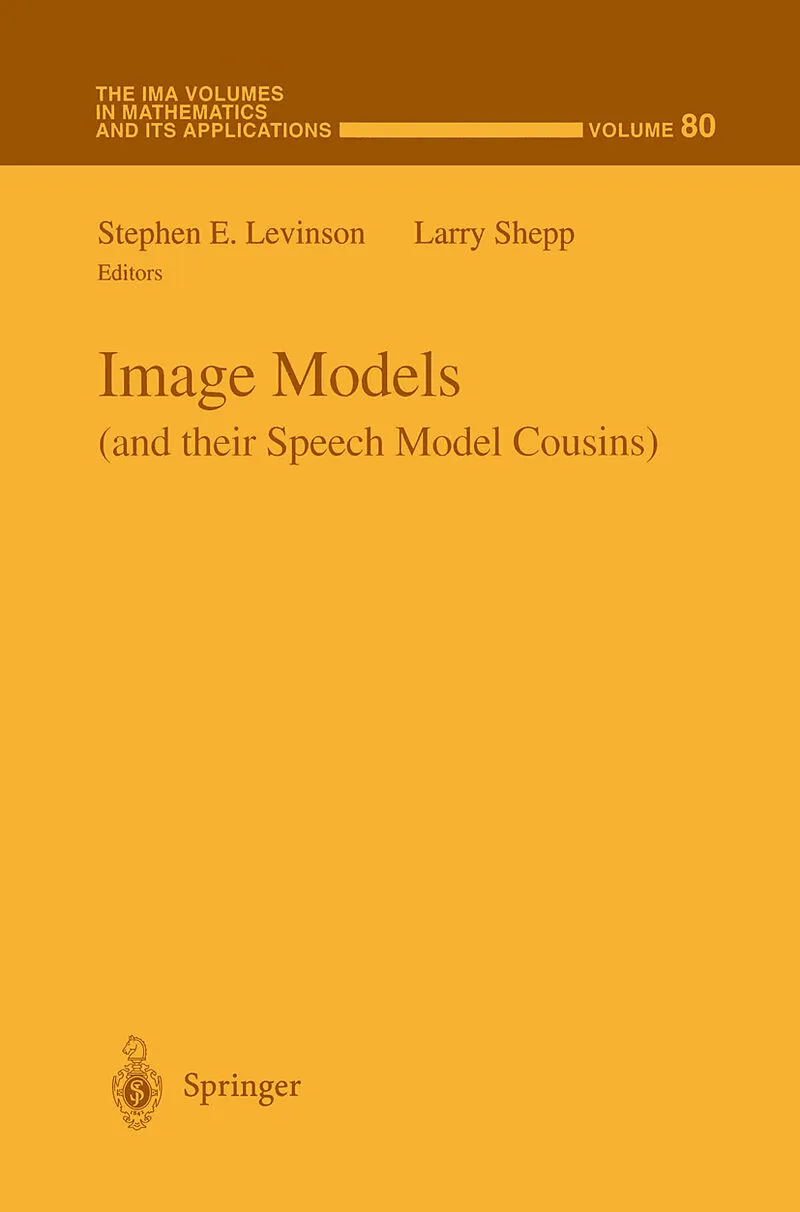
This IMA Volume in Mathematics and its Applications IMAGE MODELS (AND THEIR SPEECH MODEL COUSINS) is based on the proceedings of a workshop that was an integral part of the 1993-94 IMA program on "Emerging Applications of Probability." We thank Stephen E. Levi...This IMA Volume in Mathematics and its Applications IMAGE MODELS (AND THEIR SPEECH MODEL COUSINS) is based on the proceedings of a workshop that was an integral part of the 1993-94 IMA program on "Emerging Applications of Probability." We thank Stephen E. Levinson and Larry Shepp for organizing the workshop and for editing the proceedings. We also take this opportunity to thank the National Science Foundation, the Army Research Office, and the National Security Agency, whose financial support made the workshop possible. A vner Friedman Willard Miller, Jr. v PREFACE This volume is an attempt to explore the interface between two diverse areas of applied mathematics that are both "customers" of the maximum likelihood methodology: emission tomography (on the one hand) and hid den Markov models as an approach to speech understanding (on the other hand). There are other areas where maximum likelihood is used, some of which are represented in this volume: parsing of text (Jelinek), microstruc ture of materials (Ji), and DNA sequencing (Nelson). Most of the partici pants were in the main areas of speech or emission density reconstruction. Of course, there are many other areas where maximum likelihood is used that are not represented here.
Autorentext
Stephen E. Levinson received his Ph.D. in Electrical Engineering from the University of Rhode Island, Kingston, Rhode Island in 1974. From 1966 - 1969 he was a design engineer at Electric Boat Division of General Dynamics in Groton, Connecticut. From 1974-1976 he held a J. Willard Gibbs Instructorship in Computer Science at Yale University. In 1976, he joined the technical staff of Bell Laboratories in Murray Hill, NJ where he conducted research in the areas of speech recognition and understanding. In 1979, he was a visiting researcher at the NTT Musashino Electrical Communication Laboratory in Tokyo, Japan. He held a visiting fellowship in the Engineering Department at Cambridge University in 1984, and in 1990 he became head of the Linguistics Research Department at AT&T Bell Laboratories where he directed research in Speech Synthesis, Speech Recognition, and Spoken Language Translation. He joined the Department of Electrical and Computer Engineering of the University of Illinois at Urbana-Champaign in 1997, where he teaches courses in Speech and Language Processing and leads research projects in speech synthesis and automatic language acquisition. He is also a full-time faculty member of the Beckman Institute for Advanced Science and Technology where he serves as the head of the Artificial Intelligence group. Dr. Levinson is a member of the Association for Computing Machinery, a fellow of the Institute of Electrical and Electronic Engineers, and a fellow of the Acoustical Society of America. He is a founding editor of the journal Computer Speech and Language and a former member and chair of the Industrial Advisory Board of the CAIP Center at Rutgers University. He is the author of more than 100 technical papers and holds 7 patents. His book, published in 2005 by John Wiley and Sons, Ltd., is entitled Mathematical Models for Speech Technology.Donald W. Davis, Jr. received B. S., M. S., and Ph. D. degrees in Aeronautical Engineering from Purdue University in 1970, 1975, and 1981, respectively. Currently, he is a Staff Engineer at Electric Boat Corporation where he works in the area of computational fluid dynamics (CFD). His research interests include fluid mechanics, heat transfer, computational methods, and turbulence modeling. He is also involved in applying advanced CFD tools to large, complex, industrially relevant turbulent flow problems.Scot A. Slimon received a B.S. in Marine Engineering Systems from the United States Merchant Marine Academy, an M.S. in Mechanical Engineering from the Rensselaer Polytechnic Institute, and a Ph.D. in Mechanical Engineering from the University of Connecticut. Currently, he is a Principal Engineer at Electric Boat Corporation, where he is responsible for the development and application of a computational fluid dynamics solver. His current research involves preconditioning techniques, multiphase flow, hybrid turbulence modeling, and flow induced sound at low Mach numbers. He has applied this research to a number of large-scale external and internal flow problems supporting major Navy submarine platformsScot A. Slimon received a B.S. in Marine Engineering Systems from the United States Merchant Marine Academy, an M.S. in Mechanical Engineering from the Rensselaer Polytechnic Institute, and a Ph.D. in Mechanical Engineering from the University of Connecticut. Currently, he is a Principal Engineer at Electric Boat Corporation, where he is responsible for the development and application of a computational fluid dynamics solver. His current research involves preconditioning techniques, multiphase flow, hybrid turbulence modeling, and flow induced sound at low Mach numbers. He has applied this research to a number of large-scale external and internal flow problems supporting major Navy submarine platforms
Klappentext
This volume explores the interface between two diverse areas of applied mathematics which are both 'customers' of the maximum likelihood methodology; emission tomography and hidden Markov models as an approach to speech understanding. Other areas where maximum likelihood is used in this volume include parsing of text (Jelinek), microstructure of materials (Ji), DNA sequencing (Nelson). Most of the participants were in the main areas of speech or emission density reconstruction. TOC:BContents:/B Iterative reconstruction algorithms based on cross-entropy minimization.- Stop consonants discrimination and clustering using nonlinear transformations and wavelets.- Maximum a posteriori image reconstructions from projections.- Direct parsing of text.- Hierarchical modelling for microstructure of certain brittle materials.- Hidden Markov Models estimation via the most informative stopping times for Vitervi algorithm.- Constrained stochastic language models.- Recovering DNA sequences from electrophoresis data.- Image and speech and EM.- Non-stationary hidden Markov models for speech recognition.- Applications of the EM algorithm to linear inverse problems with positivity constraints.
Inhalt
Iterative reconstruction algorithms based on cross-entropy minimization.- Stop consonants discrimination and clustering using nonlinear transformations and wavelets.- Maximum a posteriori image reconstruction from projections.- Direct parsing of text.- Hierarchical modelling for microstructure of certain brittle materials.- Hidden Markov models estimation via the most informative stopping times for the Viterbi algorithm.- Constrained stochastic language models.- Recovering DNA sequences from electrophoresis data.- Image and speech and EM.- Non-stationary hidden Markov models for speech recognition.- Applications of the EM algorithm to linear inverse problems with positivity constraints.
Tief- preis