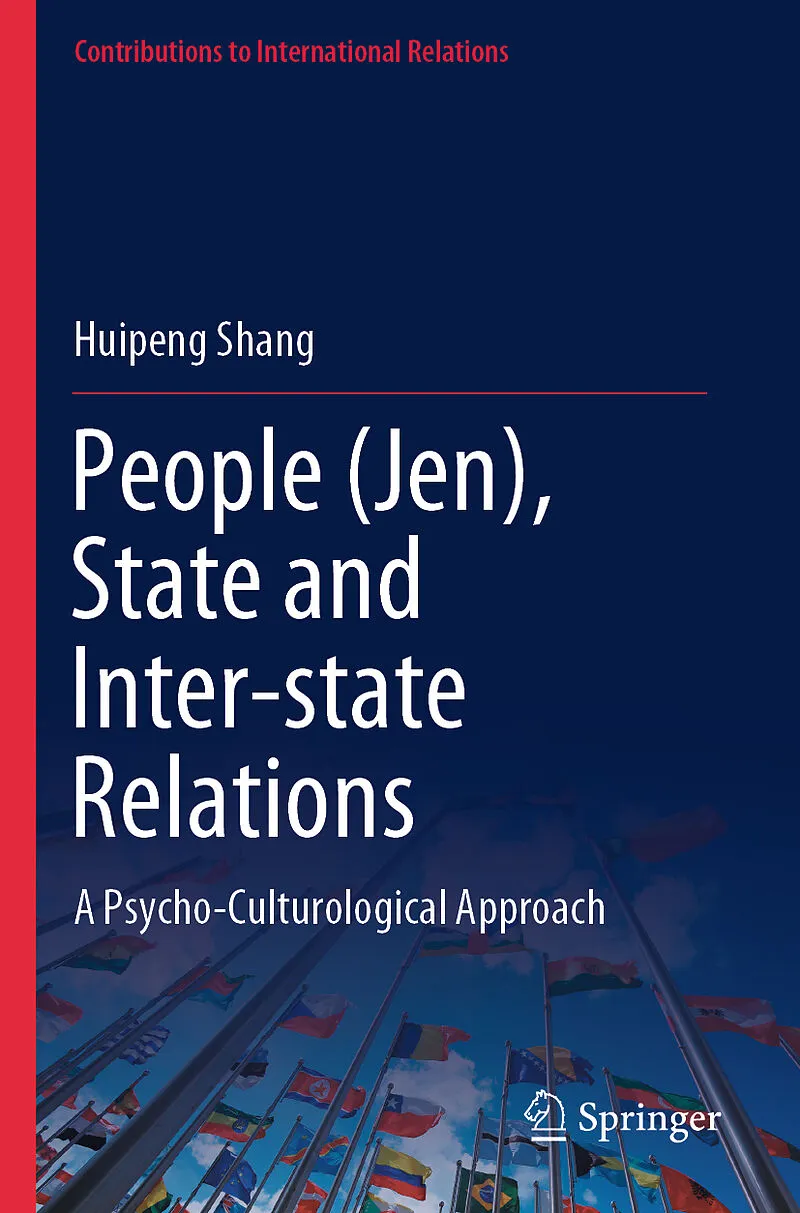
People (Jen), State and Inter-state Relations
Beschreibung
This book explores the relationship between the human constant (Jen) of the four large-scale civilizational societiesChina, the USA, Japan, and Indiaand their international behavior, response patterns, and interaction with the international system. The book a...
Format auswählen
- Kartonierter EinbandCHF 69.20
- Fester EinbandCHF 66.40

Wird oft zusammen gekauft
Andere Kunden kauften auch
Beschreibung
This book explores the relationship between the human constant (Jen) of the four large-scale civilizational societiesChina, the USA, Japan, and Indiaand their international behavior, response patterns, and interaction with the international system. The book analyzes the characteristics and limitations of the current international system, as well as the way it is related to the Western type of human constant. It also analyzes the challenges facing China in its integration into the international system. This book aims to explore international relations from the combined psychological and cultural perspective. The key concept of this book is Jen, which contains a distinct Chinese cultural experience, into the theory of international relations. Unlike other IR books to treat state as the main political actor, the book analyzes both the political aspects of state as an organizational entity and its civilizational aspects as a civilizational entity; hence, it proposes a new ontology of international relations. By integrating the concept of Jen based on the unique Chinese cultural experience into the theory of international relations, the book reveals the interactive nature of relationship between the international system and human constant. The book explains the causal relationship between state's behavior and its human constant, analyzes the cultural characteristics of state actors and the international system, and tries to provide a new theoretical framework for understanding culture and modernity.
Introduces the two new paradigms used in psycho-culturologyhuman constant (Jen) and psycho-social homeostasis Provides an analysis of international relations and the state from its civilizational aspect Discusses how China's unique cultural experience is integrated into the theory of international relations
Autorentext
Huipeng Shang, distinguished professor at Huaqiao University (a retired professor of Peking University) where he directs the Institute of Psycho- Culturological Studies. For many years he has been doing research on psycho-culturology, comparative studies of large-scale civilizational societies and theory of international relations. He has published many books, among which are "The Essentials of Psycho-Culturological Studies: Theories and Methods of Comparative Studies of Large-scale Civilizational Societies", "Caste and Hindu Society" (the winner of the first prize award at the 7th Beijing Outstanding Social Science Works contest), "Decoding the 'Cultural Genes' in China and Japan" (Volumes 1 and 2), etc.
Klappentext
This book explores the relationship between the human constant (Jen) of the four large-scale civilizational societies China, the USA, Japan, and Indiäand their international behavior, response patterns, and interaction with the international system. The book analyzes the characteristics and limitations of the current international system, as well as the way it is related to the Western type of human constant . It also analyzes the challenges facing China in its integration into the international system. This book aims to explore international relations from the combined psychological and cultural perspective. The key concept of this book is Jen , which contains a distinct Chinese cultural experience, into the theory of international relations. Unlike other IR books to treat state as the main political actor, the book analyzes both the political aspects of state as an organizational entity and its civilizational aspects as a civilizational entity ; hence, it proposes a new ontology of international relations. By integrating the concept of Jen based on the unique Chinese cultural experience into the theory of international relations, the book reveals the interactive nature of relationship between the international system and human constant . The book explains the causal relationship between state s behavior and its human constant , analyzes the cultural characteristics of state actors and the international system, and tries to provide a new theoretical framework for understanding culture and modernity.
Inhalt
Psycho-culturology and International Relations: Perspectives and Paradigms.- Mainstream Theories of International Relations and the Attempt to Create the "Chinese School".- Psycho-culturology: Core Concepts and Perspectives.- Human constant(Jen), the State and International Relations.- From International Politics to International Relations.- "Lun-jen" and the Outside World.- Lun-jen () and Fu-guo ().- Lun-jen and Tianxia (Tributary system).- Harmony and Lun-jen's Model of Psycho-Social Homeostasis.- China and the System of Nation-states: Approaches and Dilemmas.- The Individual Jen and Contemporary International Order.- The Individual Jen, the Individual State and the Modern International Order.- Peace and the Evolution of the International System.- The Ultimately Individual Jen: Analysis of the American Human Constant and its Psycho-Social Homeostasis.- The Outside World of the Ultimately Individual Jen.- Soft Power, the UltimateIndividualism and Americans' Human Constant.- State Forms of Japan and India and the International System.- The Japanese Human Constant and Japanese Diplomacy.- Sequence Consciousness and the "Greater East Asia Co-Prosperity Sphere": A Psycho-culturological Interpretation of the Japanese State Behavior during World War II.- Cultural Tradition and the Establishment of Western Political System in India.- The Ancient South Asia's International System: Features and Principles of the " Dharma System". <p


