Beschreibung
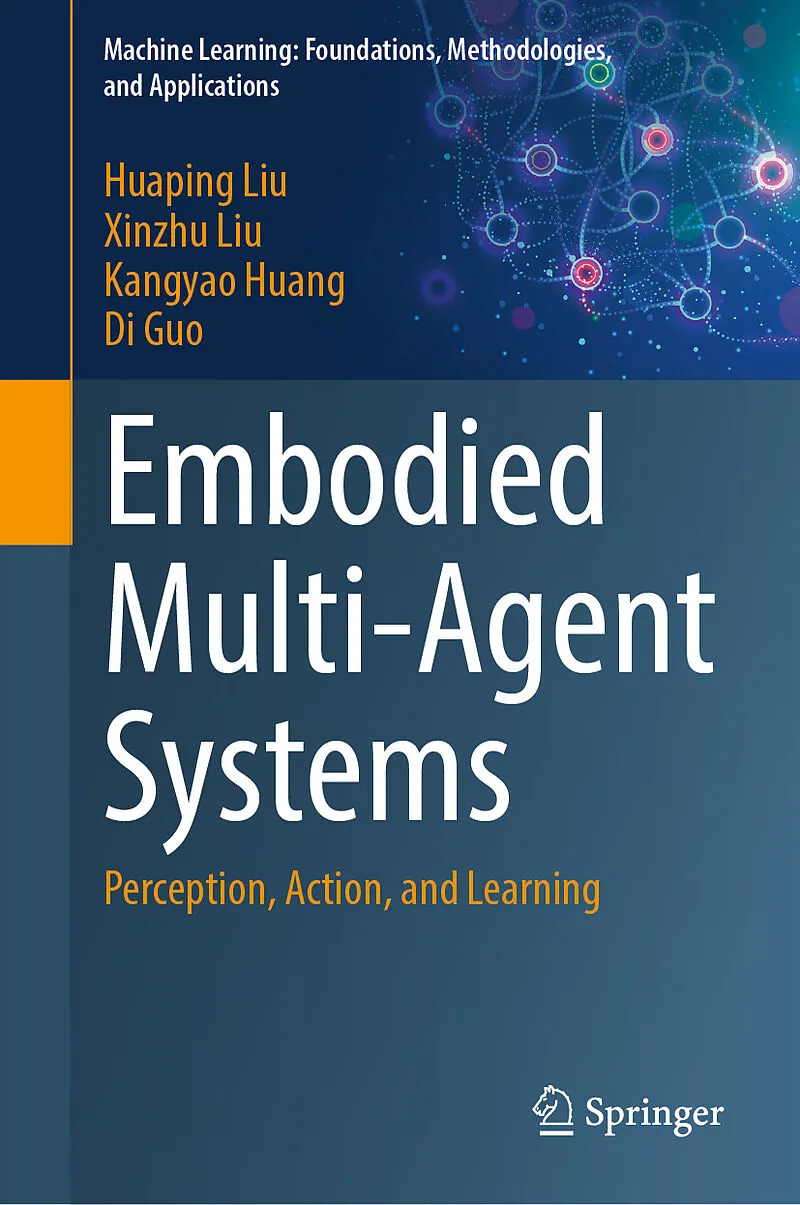
In recent years, embodied multi-agent systems, including multi-robots, have emerged as essential solution for demanding tasks such as search and rescue, environmental monitoring, and space exploration. Effective collaboration among these agents is crucial but...In recent years, embodied multi-agent systems, including multi-robots, have emerged as essential solution for demanding tasks such as search and rescue, environmental monitoring, and space exploration. Effective collaboration among these agents is crucial but presents significant challenges due to differences in morphology and capabilities, especially in heterogenous systems. While existing books address collaboration control, perception, and learning, there is a gap in focusing on active perception and interactive learning for embodied multi-agent systems.
This book aims to bridge this gap by establishing a unified framework for perception and learning in embodied multi-agent systems. It presents and discusses the perception-action-learning loop, offering systematic solutions for various types of agentshomogeneous, heterogeneous, and ad hoc. Beyond the popular reinforcement learning techniques, the book provides insights into using fundamental models to tackle complex collaboration problems.
By interchangeably utilizing constrained optimization, reinforcement learning, and fundamental models, this book offers a comprehensive toolkit for solving different types of embodied multi-agent problems. Readers will gain an understanding of the advantages and disadvantages of each method for various tasks. This book will be particularly valuable to graduate students and professional researchers in robotics and machine learning. It provides a robust learning framework for addressing practical challenges in embodied multi-agent systems and demonstrates the promising potential of fundamental models for scenario generation, policy learning, and planning in complex collaboration problems.
Provides unified framework for embodied multi-agent systems Presents collaboration active perception and interactive learning Demonstrates extensive case studies and application examples of embodied multi-agent systems
Autorentext
Prof. Xinyu Zhang is an associate professor at the School of Vehicle and Mobility, Tsinghua University. He was a research fellow at the University of Cambridge, UK, in 2008. Since 2014, he has served as Deputy Secretary General of the Chinese Association for Artificial Intelligence. As director of the Tsinghua Mengshi team, he invented the first amphibious autonomous flying car in China and proposed a new method of collaborative fusion for perception information and motion information in three-dimensional traffic. His research interests include multi-model fusion, unmanned ground vehicles, and flying cars. Prof. Jun Li is a professor at the School of Vehicle and Mobility, Tsinghua University. He is the President of the China Society of Automotive Engineers and is also an Academician of the Chinese Academy of Engineering. Relying on the Intelligent Vehicle Design and Safety Technology Research Center, he led the team to focus on the core technology of intelligent driving, mainly to carry out the system engineering research on the integration of smart city-smart transportation-smart vehicle (SCSTSV). He focuses on the research of cutting-edge technologies, such as intelligent shared vehicle design, safety of the intended functionality, 5G vehicle equipment, and fusion perception, to overcome the core problems of intelligent driving and improve the core competitiveness of intelligent networked vehicles. Dr. Zhiwei Li is a tutor of master's students in Beijing University of Chemical Technology. In 2020, he studied as a postdoctoral fellow with Academician Jun Li at Tsinghua University. His main research interests include computer vision, intelligent perception and autonomous driving, and robot system architecture. Prof. Huaping Liu is a professor at the Department of Computer Science and Technology, Tsinghua University. Heserves as an associate editor for various journals, including IEEE Transactions on Automation Science and Engineering, IEEE Transactions on Industrial Informatics, IEEE Robotics and Automation Letters, Neurocomputing, and Cognitive Computation. He has served as an associate editor for ICRA and IROS and on the IJCAI, RSS, and IJCNN Program Committees. His main research interests are robotic perception and learning. Mo Zhou is currently a doctoral candidate at the School of Vehicle and Mobility, Tsinghua University, supervised by Prof. Jun Li. She received MS degree in image and video communications and signal processing from the University of Bristol, Bristol, UK. Her research interests include intelligent vehicles, deep learning, environmental perception, and driving safety. Dr. Li Wang is a postdoctoral fellow in the State Key Laboratory of Automotive Safety and Energy, and the School of Vehicle and Mobility,Tsinghua University. He received his PhD degree in mechatronic engineering at the State Key Laboratory of Robotics and System, Harbin Institute of Technology, in 2020. He was a visiting scholar at Nanyang Technology of University for two years. He is the author of more than 20 SCI/EI articles. His research interests include autonomous-driving perception, 3D robot vision, and multi-modal fusion. Zhenhong Zou is an assistant researcher at the School of Vehicle and Mobility, Tsinghua University. He received his BS degree in Information and Computation Science from Beihang University and was subsequently a visiting student at the University of California, Los Angeles, USA, supervised by Prof. Deanna Needell. His research interests include autonomous driving and multi-sensor fusion.
Inhalt
Part I. Background .- Chapter 1. Embodied Intelligence.- Chapter 2. Embodied Multi-agent System.- Part II. Theory and Methods .- Chapter 3. Perception-Action Loop in Embodied Multi-agent System.- Chapter 4. Embodied Cooperation in Multi-agent System.- Chapter 5. Competitive Learning in Embodied Multi-agent System.- Chapter 6. Large Language Model for Embodied Multi-agent System.- Part III. Applications .- Chapter 7. Simulation Platform for Embodied Collaboration between Human and Robots.- Chapter 8. Application of Embodied Multi-agent System.- Part IV. Conlusions .- Chapter 9. Conclusions and Future Directions.