Haben Sie noch nichts passendes gefunden? Stöbern Sie durch unser komplettes Sortiment.
Oder melden Sie sich an bzw. registrieren Sie sich.


Beschreibung
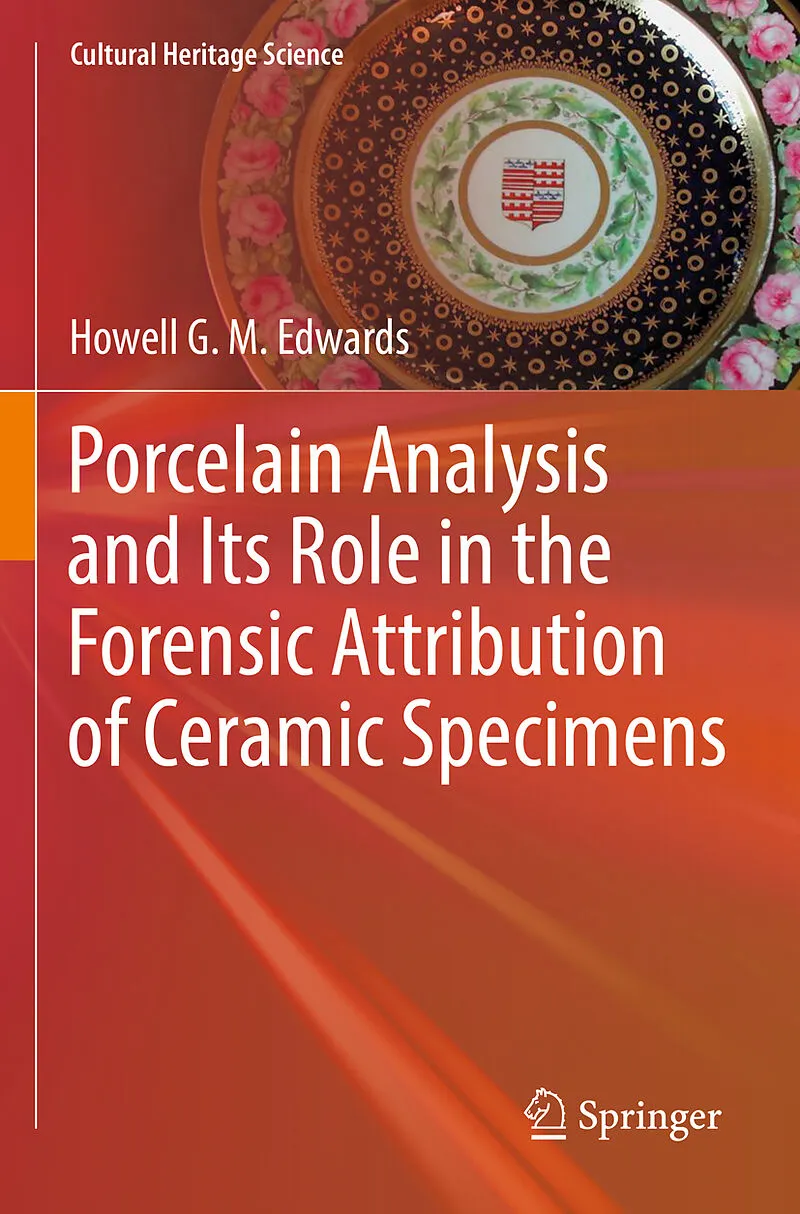
The material for this book arose from the author's research into porcelains over many years, as a collector in appreciation of their artistic beauty , as an analytical chemist in the scientific interrogation of their body paste, enamel pigments and glaze compo...The material for this book arose from the author's research into porcelains over many years, as a collector in appreciation of their artistic beauty , as an analytical chemist in the scientific interrogation of their body paste, enamel pigments and glaze compositions, and as a ceramic historian in the assessment of their manufactory foundations and their correlation with available documentation relating to their recipes and formulations. A discussion of the role of analysis in the framework of a holistic assessment of artworks and specifically the composition of porcelain, namely hard paste, soft paste, phosphatic, bone china and magnesian, is followed by its growth from its beginnings in China to its importation into Europe in the 16th Century. A survey of European porcelain manufactories in the 17th and 18th Centuries is followed by a description of the raw materials, minerals and recipes for porcelain manufacture and details of thechemistry of the high temperature firing processes involved therein. The historical backgrounds to several important European factories are considered, highlighting the imperfections in the written record that have been perpetuated through the ages. The analytical chemical information derived from the interrogation of specimens, from fragments, shards or perfect finished items, is reviewed and operational protocols established for the identification of a factory output from the data presented. Several case studies are examined in detail across several porcelain manufactories to indicate the role adopted by modern analytical science, with information provided at the quantitative elemental oxide and qualitative molecular spectroscopic levels, where applicable. The attribution of a specimen to a particular factory is either supported thereby or in some cases a potential reassessment of an earlier attribution is indicated. Overall, the information provided by analytical chemical data is seen to be extremely useful for porcelain identification and for its potential attribution in the context of a holistic forensic evaluation of hitherto unknown porcelain exemplars of questionable factory origins.
Describes the role of analytical science in the holistic forensic attribution of unknown porcelain specimens Includes protocols for the establishment of the definition of the classification of a porcelain body.
Autorentext
Professor Howell G.M. Edwards M.A., B.Sc., D. Phil., C.Chem., FRSC. Howell Edwards is Professor Emeritus of Molecular Spectroscopy at the University of Bradford. He read Chemistry at Jesus College in the University of Oxford and after completing his B.A. and B.Sc. degrees he studied for his doctorate in Raman spectroscopy at Oxford with Dr Leonard Woodward and then became aResearch Fellow at Jesus College, University of Cambridge. He joined the University of Bradford as a Lecturer in Structural and Inorganic Chemistry, becoming Head of the Department of Chemical and Forensic Sciences, and was awarded a Personal Chair in Molecular Spectroscopy in 1996. He has received several international awards (Sir Harold Thompson Award; Charles Mann Award; Emanuel Boricky Medal; Norman Sheppard Award) in a spectroscopic career which has resulted in the publication of over 1350 research papers in Raman spectroscopy and the characterisation of materials, along with six books on the application of this analytical technique to art, archaeology and forensic science. He has had a lifelong interest in porcelains and the industrial archaeology , excavation and the preservation of early porcelain manufactory sites , many of which have now disappeared in urban expansion .He has authored six major books on porcelains and has also produced several monographs on the manufactories at Swansea and Nantgarw and the people associated with them. Howell Edwards is Honorary Scientific Adviser to the de Brecy Trust on the scientific evaluation of their artworks and paintings. Professor Philippe Colomban, ENSCI engineer, M.Sc., Docteur es-Sciences Physiques. Philippe Colomban is CNRS Research Director Emeritus at Sorbonne Université. After an MSc in Ceramics, Glass & Cement Engineering (ENSCI-Sèvres) in 1975 and a MSc in Solid State Physics at Université Pierre-et-Marie Curie in 1976, Philippe Colomban obtained in 1979 the Ph.D. Hab. degree (Docteur es-Sciences Physiques) from the Université Pierre-et-Marie-Curie. He was one of the first in the world to develop Sol-Gel routes for advanced optoelectronic PLZT ceramics. He prepared single crystals, ceramics and studied their superionic conductors' structure and ion and proton mobility. From 1989 to 1993 he was in charge of the new projects at the Materials Department of ONERA, the French Establishment for Aerospace Research and Development (materials for rockets and missiles, aircraft engines, Sol-Gel routes, ceramic- or polymer-matrix composites, fibres, nanoparticle-based microwave absorbing materials and Functionally Graded composites...) and worked as Consultant at the ONERA for 10 further years. From 1994 to the present, as CNRS Research Professor his research interests include Materials Science and Raman, IR and neutron spectroscopy (in situ analysis, fuel cells, electrolysis, fibres/composites...). Attention is paid to the correlation between Raman parameters and mechanical and electrical (ionic, electronic) properties...as well to the identification of the technology used in ancient ceramics, glasses, paintings and buildings. Ph. Colomban has published two books, more than 500 peer-reviewed papers, many book chapters and has applied for 10 patents; he has presented more than 100 invited talks and was visiting professor in Japan, Korea, South Africa, and Tunisia. He is Associated Editor of the Journal of Raman Spectroscopy and member of several Editorial Boards of journals devoted to Spectroscopy, Materials Science or Archaeometry. Professor Peter Vandenabeele, is a professor at Ghent University and head of the Raman spectroscopy research group. He is a doctor in analytical chemistry and has performed research on applications of Raman spectroscopy in several research fields, including cultural heritage artefacts. He is member of the department of Archaeology at Ghent University and an associated member of the department of Chemistry at the same institution. His main research topics involve novel applic
Inhalt
Chapter 1: Introduction - Setting the Scene: Analytical Data and Connoisseurship for Attribution in Art.- Chapter 2 . Chinese Porcelains and Their Early European Competitors.- Chapter 3. Establishing the Historical Baseline Chronology for European Porcelains.- Chapter 4. Types of Porcelain and Their Elemental Oxide Compositions.- Chapter 5 . Analytical Science and Case Studies.- Chapter 6 . Case Studies I : Analytical Data Which Have Materially Contributed to the Attribution of Porcelain Specimens.- Chapter 7 .Case Studies II : Analytical Data Which Have Revealed That Significant Revision is Required to Historical Knowledge of Porcelain Manufactories ( Part A).- Chapter 8 . Case Studies III : Analytical Data Which Have Revealed That a Significant Revision is Required to Historical Knowledge of Porcelain Manufactories ( Part B ).- Chapter 9 . Case Studies IV : Challenges for Analytical Science.- Chapter 10. Assessment of the Role of Chemical Analysis inthe Holistic Attribution of Porcelains to Factory Sources, Their Characterisation and the Evaluation of their Chronology.- Appendix I: Lady Charlotte Schreiber ( 1812-1895).- Appendix II : The Bearded Tulip : Who Was de Junic and Can Analysis Unravel the Mystery Surrounding this Artist?.- Appendix III : Retailers of Porcelain A Source of Uncertainty for Analytical Attribution.- Appendix IV : The Importance of Establishing the Correct Chronology for Factory Operations in a Holistic Forensic Analytical Approach. Example : The Swansea and Nantgarw Manufactories,1814-1820.- Appendix V : Angela Georgina Burdett-Coutts…