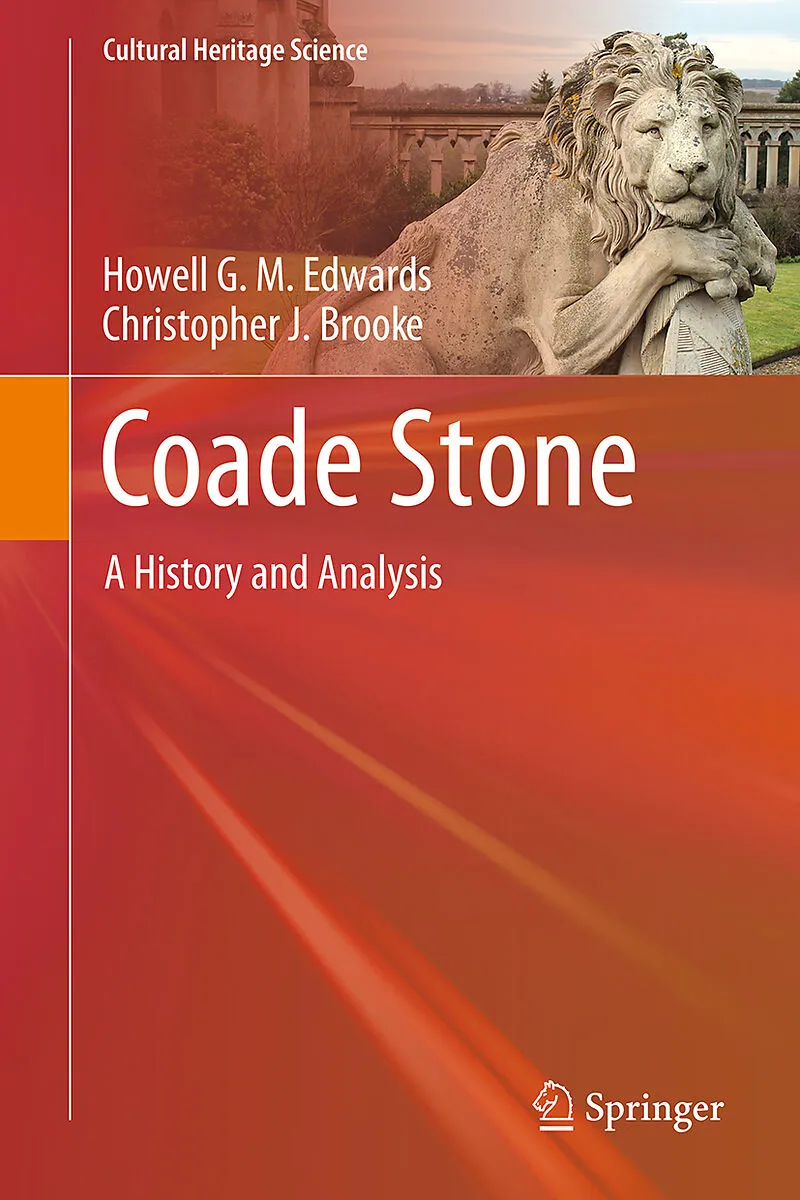
Coade Stone
Beschreibung
The history and nature of artificial stone for use in architecture is a subject still shrouded in myth and misconception. This book aims to lay bare those misconceptions and present a scientific and architectural account of these materials, and especially Coa...
Format auswählen
- Fester EinbandCHF 140.40
- E-Book (pdf)CHF 142.00
- Kartonierter EinbandCHF 140.40

Wird oft zusammen gekauft
Andere Kunden kauften auch
Beschreibung
The history and nature of artificial stone for use in architecture is a subject still shrouded in myth and misconception. This book aims to lay bare those misconceptions and present a scientific and architectural account of these materials, and especially Coade Stone, the most successful of all, which found great favour during the Georgian period. Many examples of Coade Stone cast sculpture still exist and several key examples are presented in context and as case studies . Eleanor Coade's artificial stone was so good that many observers could not distinguish it from the natural stone it replaced: the growth in replication of the neo-classical statuary and building adornment required in the late Georgian and Regency period was well satisfied by the use of Coade stone. A holistic evaluation of Coade stone artefacts is undertaken whereby the use of analytical data, historical documentation, invoices, company records, impressed marks and expert connoisseurship will establishthe attribution of Coade stone artefacts, some of which are currently in the unknown category. Several new scientific analyses are presented that demonstrate the true nature of high temperature fired ceramic Coade Stone and allow comparison with other forms of artificial stone, such as the cold cured cementitious variations, which eventually replaced it in the Victorian period.
Provides a modern, technical, and up-to-date analytical study of Coade stone and other historic artificial stones Fills a gap for conservators and architectural historians working in this field Appeals to all those interested in historic architecture
Autorentext
Professor Howell G.M. Edwards M.A., B.Sc., D. Phil., C.Chem., FRSC. Howell Edwards is Professor Emeritus of Molecular Spectroscopy at the University of Bradford. He read Chemistry at Jesus College in the University of Oxford and after completing his B.A. and B.Sc. degrees he studied for his doctorate in Raman spectroscopy at Oxford and then became a Research Fellow at Jesus College, University of Cambridge. He joined the University of Bradford as a Lecturer in Structural and Inorganic Chemistry, becoming Head of the Department of Chemical and Forensic Sciences, and was awarded a Personal Chair in Molecular Spectroscopy in 1996. He has received several international awards (Sir Harold Thompson Award; Charles Mann Award; Emanuel Boricky Medal; Norman Sheppard Award) in a spectroscopic career which has resulted in the publication of 1400 research papers in Raman spectroscopy and the characterisation of materials, along with six books on the application of this analytical technique to art, archaeology and forensic science. He has had a lifelong interest in the porcelains of William Billingsley, especially those from the Derby, Nantgarw and Swansea factories and has authored eight books on porcelain: Swansea and Nantgarw Porcelains: A Scientific Reappraisal, Nantgarw and Swansea Porcelains: An Analytical Perspective, Porcelain to Silica Bricks: The Extreme Ceramics of William Weston Young, 1776-1847, 18th and 19th Century Porcelain Analysis: A Forensic Provenancing Assessment, Porcelain Analysis and Its Role in the Forensic Attribution of Ceramic Specimens, "Raman Spectroscopy in Cultural Heritage Preservation" ( with Philippe Colomban and Peter Vandenabeele ,) , Armorial Porcelain : The Genesis ( with Rachel and Morgan Denyer ) and Welsh Armorial Porcelains: Nantgarw and Swansea Crested China, published by Springer Publishing, Dordrecht, The Netherlands and two specialist texts , namely : " The Pendock-Barry Porcelain Service : A Forensic Evaluation" (with R Denyer and M Denyer ) and "The Farnley Hall Service : A Unique Survivor in Nantgarw Porcelain". He has also produced several monographs: William Billingsley - The Enigmatic Porcelain Artist, Decorator and Manufacturer; Nantgarw Porcelain ( with M.D. Denyer ) - The Pursuit of Perfection; Swansea Porcelain - the Duck-Egg Translucent Vision of Lewis Dillwyn and Derby Porcelain: The Golden Years, 1780-1830. Howell Edwards is Honorary Scientific Adviser to the de Brecy Trust on the scientific evaluation of their artworks and paintings. Professor Philippe Colomban MSc, Ph.D. Philippe Colomban is CNRS Research Professor Emeritus (Directeur de Recherche CNRS émérite) since 2018 at the Sorbonne Université (Laboratory UMR SU-CNRS 8233: from molecule to nano-objects: Reactivity, Interactions and Spectroscopy). After an MSc in Ceramics, Glass & Cement Engineering (ENSCI-Sèvres) in 1975 and a MSc in Solid State Physics (DEA) in 1976, Philippe Colomban obtained in 1979 his Ph.D. Hab. degree (Docteur es-Sciences Physiques) from the Université Pierre-et-Marie-Curie (now part of Sorbonne Université). He was one of the first in the world to develop Sol-Gel routes for advanced optoelectronic PLZT ceramics. He studied then the structure of superionic conductors and ion mobility at different scales for battery design. From 1989 to 1993 he was responsible for new projects at the Materials Department of ONERA, the French Establishment for Aerospace Research and Development (materials for rockets and missiles, aircraft engines, sol-gel routes, ceramic- and polymer-matrix composites, fibres, nanoparticle-based microwave absorbing materials and functionally graded composites ) and worked as a Consultant at ONERA for 10 additional years. From 1994 to present, as CNRS Research Professor, and as director of the UMR7075 Laboratory from 2002 to 2010, his research interests include materials science and spectroscopy (XRF, Raman, IR and neutron
Inhalt
Chapter 1.Coade Artificial Stone and Its Marks.- Chapter 2.Factors That Influenced the Success of Coade Stone.- Chapter 3.The Precursors Contemporaries and Later Variations of Coade Stone.- Chapter 4.Historical Myths and Anomalies Associated with Coade Stone.- Chapter 5.The Mineralogy of Fired Ceramics.- Chapter 6.The Analysis of Coade Stone Artefacts.- Chapter 7.Case Studies.- Chapter 8.Conclusions.


