Haben Sie noch nichts passendes gefunden? Stöbern Sie durch unser komplettes Sortiment.
Oder melden Sie sich an bzw. registrieren Sie sich.


Beschreibung
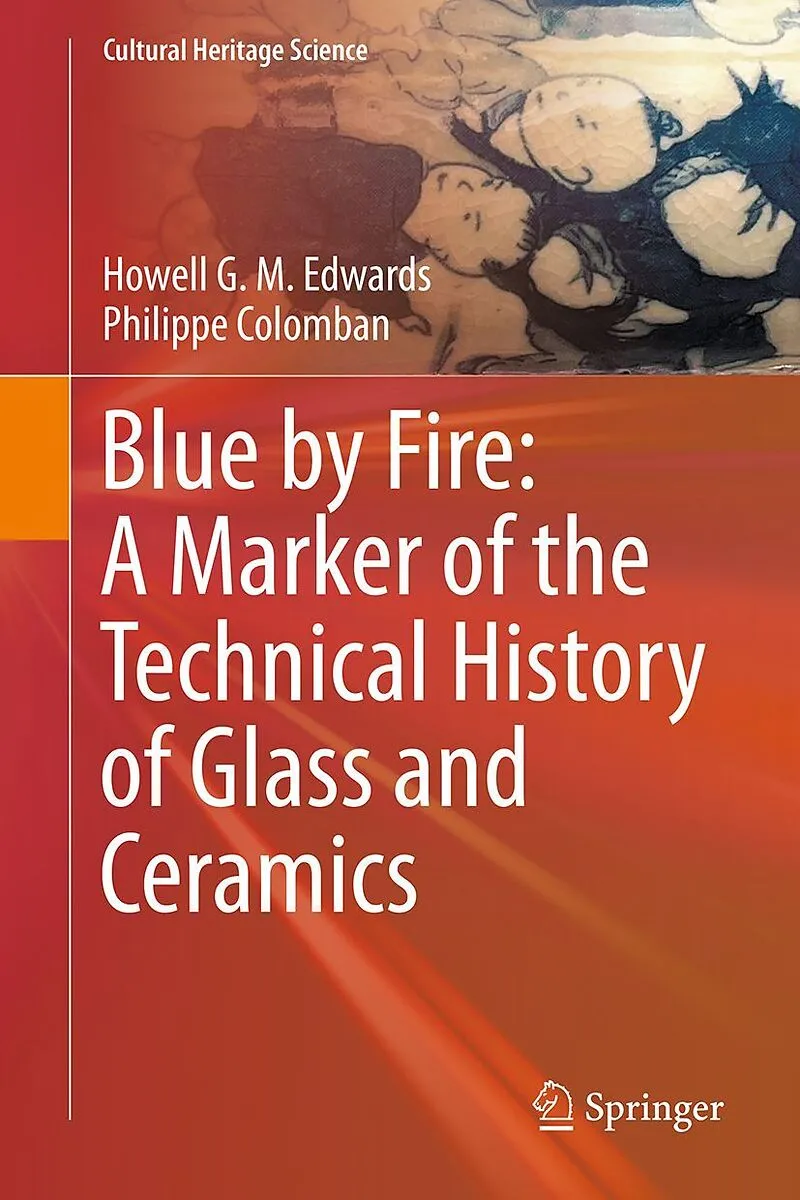
The use of natural mineral and synthetic blue pigments in antiquity for wall paintings and illuminated manuscript historiation evolved into the most suitable blue pigments for the decoration of glazed and enamelled wares (ceramics, glass and metal) which requ...
The use of natural mineral and synthetic blue pigments in antiquity for wall paintings and illuminated manuscript historiation evolved into the most suitable blue pigments for the decoration of glazed and enamelled wares (ceramics, glass and metal) which required a stability at the high temperatures of the kilns used for glazing and firing. Historic literature is often vague regarding the blue pigments used for this purpose. The generic term cobalt blue covers a wide range of pigments that were actually used for the decoration of faience, majolica, stonewares, earthenwares and porcelains.
This book addresses the application of elemental and molecular spectroscopic analytical techniques to a range of diverse problems which arise for decorated ceramics, glass and enamels and related artefacts: a history of techniques, provenance and authentication. The text contains an introduction to the important analytical techniques that are used in destructive and nondestructive analytical measurements and highlights potential future applications based upon novel miniaturised instrumentation for in-situ studies. The book is co-authored by two international experts with many years' experience in the application of analysis to artworks and archaeological artefacts and in the investigation of materials and sites for cultural heritage preservation. Among 19 chapters one is devoted to an evaluation of the analytical techniques that are used and the pitfalls which can arise in the interpretation of the data. The approach conveys the detailed information which has become available from the adoption of analytical techniques to diverse problems through the scientific interrogation of ceramic and related artefacts. Examples are given of how the pigment analysis and sourcing can provide unique information about ancient trade routes and pigment sourcing historically. A classic instance is provided by the transfer of European enamelling technologies carried out at the beginning of the 17th century in Japan (Arita) and at the turn of the 17th-18th centuries in China by the Jesuits established at the Court of, respectively, the Kyushu island of Daymios and the Chinese Qing Empero Kangxi. It has hence been demonstrated that some of the most beautiful porcelains emanating from Japan and China in this period incorporate blue decoration with pigments supplied from Europe. The interpretation of the analytical data can assist museum curators, archaeologists, art dealers/experts and cultural heritage historians in the preservation and conservation of ancient materials which have applied blue pigment decoration.
Engagement of a holistic approach towards scientific data interpretation Analytical scientific applications over a diverse range of ceramics , glass and enamels Includes up-to-date examples and special case studies to illustrate the potential of analytical data interpretation
Autorentext
Professor Howell G.M. Edwards M.A., B.Sc., D. Phil., C.Chem., FRSC. Howell Edwards is Professor Emeritus of Molecular Spectroscopy at the University of Bradford. He read Chemistry at Jesus College in the University of Oxford and after completing his B.A. and B.Sc. degrees he studied for his doctorate in Raman spectroscopy at Oxford with Dr Leonard Woodward and then became aResearch Fellow at Jesus College, University of Cambridge. He joined the University of Bradford as a Lecturer in Structural and Inorganic Chemistry, becoming Head of the Department of Chemical and Forensic Sciences, and was awarded a Personal Chair in Molecular Spectroscopy in 1996. He has received several international awards (Sir Harold Thompson Award; Charles Mann Award; Emanuel Boricky Medal; Norman Sheppard Award) in a spectroscopic career which has resulted in the publication of over 1350 research papers in Raman spectroscopy and the characterisation of materials, along with six books on the application of this analytical technique to art, archaeology and forensic science. He has had a lifelong interest in porcelains and the industrial archaeology , excavation and the preservation of early porcelain manufactory sites , many of which have now disappeared in urban expansion .He has authored six major books on porcelains and has also produced several monographs on the manufactories at Swansea and Nantgarw and the people associated with them. Howell Edwards is Honorary Scientific Adviser to the de Brecy Trust on the scientific evaluation of their artworks and paintings. Professor Philippe Colomban, ENSCI engineer, M.Sc., Docteur es-Sciences Physiques. Philippe Colomban is CNRS Research Director Emeritus at Sorbonne Université. After an MSc in Ceramics, Glass & Cement Engineering (ENSCI-Sèvres) in 1975 and a MSc in Solid State Physics at Université Pierre-et-Marie Curie in 1976, Philippe Colomban obtained in 1979 the Ph.D. Hab. degree (Docteur es-Sciences Physiques) from the Université Pierre-et-Marie-Curie. He was one of the first in the world to develop Sol-Gel routes for advanced optoelectronic PLZT ceramics. He prepared single crystals, ceramics and studied their superionic conductors' structure and ion and proton mobility. From 1989 to 1993 he was in charge of the new projects at the Materials Department of ONERA, the French Establishment for Aerospace Research and Development (materials for rockets and missiles, aircraft engines, Sol-Gel routes, ceramic- or polymer-matrix composites, fibres, nanoparticle-based microwave absorbing materials and Functionally Graded composites...) and worked as Consultant at the ONERA for 10 further years. From 1994 to the present, as CNRS Research Professor his research interests include Materials Science and Raman, IR and neutron spectroscopy (in situ analysis, fuel cells, electrolysis, fibres/composites...). Attention is paid to the correlation between Raman parameters and mechanical and electrical (ionic, electronic) properties...as well to the identification of the technology used in ancient ceramics, glasses, paintings and buildings. Ph. Colomban has published two books, more than 500 peer-reviewed papers, many book chapters and has applied for 10 patents; he has presented more than 100 invited talks and was visiting professor in Japan, Korea, South Africa, and Tunisia. He is Associated Editor of the Journal of Raman Spectroscopy and member of several Editorial Boards of journals devoted to Spectroscopy, Materials Science or Archaeometry. Professor Peter Vandenabeele, is a professor at Ghent University and head of the Raman spectroscopy research group. He is a doctor in analytical chemistry and has performed research on applications of Raman spectroscopy in several research fields, including cultural heritage artefacts. He is member of the department of Archaeology at Ghent University and an associated member of the department of Chemistry at the same institution. His main research topics involve novel applic
Inhalt
Chapter 1 : Introduction.- Chapter 2 : Blue Minerals.- Chapter 3 : Blue Pigments in Antiquity.- Chapter 4 : Blue Pigments in the Renaissance and Afterwards.- Chapter 5 : Analytical Methods.- Chapter 6 : The Role of Analysis in the Holistic Provenancing of Ceramics.- Chapter 7 : Egyptian Blue the first synthetic blue pigment.- Chapter 8 : The Cobalt Blues : Smalt , Cerulean Blue , Bristol Blue , Cobalt Blue.- Chapter 9 : Lapis Lazuli in Glass and Enamels.- Chapter 10 : Islamic Ceramics and Glass.-Chapter 11 : French Faience and Italian Majolica.- Chapter 12 : European Glass Manufacture.- Chapter 13 : Asian Stonewares and Porcelains.- Chapter 14 : Delftwares and Kraak porcelains.- Chapter 15 : European ( Continental) Porcelains.- Chapter 16 : English , Welsh , Scottish and USA Porcelains.- Chapter 17 : Summary and Conclusions.