
IHR WARENKORB IST AKTUELL LEER.
Haben Sie noch nichts passendes gefunden? Stöbern Sie durch unser komplettes Sortiment.
Oder melden Sie sich an bzw. registrieren Sie sich.
- Kostenlose Lieferung
- Kauf auf Rechnung
- Ex Libris Tiefpreis
- Filiallieferung und 650+ Abholorte
- Rabatt-Bons als Club-Mitglied
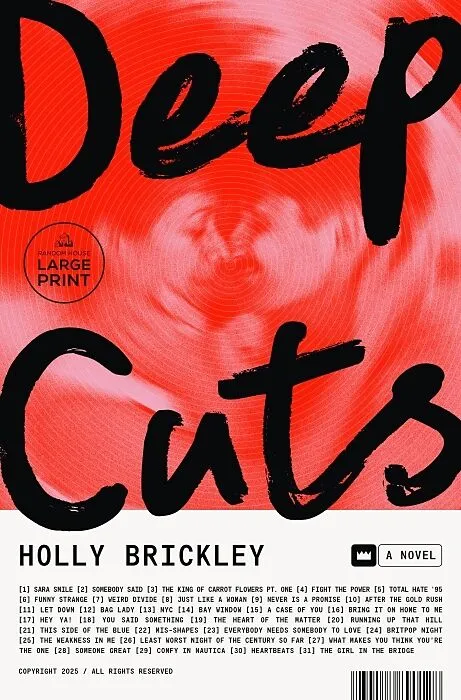
Deep Cuts
Beschreibung
The incredibly buzzy debut that everyone is talking about -- a love story about two people pulled apart by the same force that draws them together: music. It’s a Friday night in a campus bar in Berkeley, fall of 2000, and Percy Marks is pontificating abo...Format auswählen
- Kartonierter EinbandCHF 32.30

Wird oft zusammen gekauft
Andere Kunden kauften auch
Beschreibung
The incredibly buzzy debut that everyone is talking about -- a love story about two people pulled apart by the same force that draws them together: music. It’s a Friday night in a campus bar in Berkeley, fall of 2000, and Percy Marks is pontificating about music again. Hall and Oates is on the jukebox, and Percy--who has no talent for music, just lots of opinions about it--can’t stop herself from overanalyzing the song, indulging what she knows to be her most annoying habit. But something is different tonight. The guy beside her at the bar, fellow student Joe Morrow, is a songwriter. And he could listen to Percy talk all night. Joe asks Percy for feedback on one of his songs--and the results kick off a partnership that will span years, ignite new passions in them both, and set Joe on a path to indie-rock stardom. But it also bruises Joe’s ego, and traps Percy in a role she resents. How long can Percy ignore the roars of her heart, and of her own unique talent, to protect their thrilling collaboration? Moving from Brooklyn bars to San Francisco dancefloors, <Deep Cuts< examines the nature of talent, obsession, belonging, and above all, our need to be heard.
Autorentext
Holly Brickley studied English at UC Berkeley and received an MFA in fiction from Columbia University. Originally from Hope, British Columbia, she now lives in Portland, Oregon, with her husband and their two daughters. Deep Cuts is her first novel.
Klappentext
**NATIONAL BESTSELLER • “Tender as a ballad and pleasurable as a pop song, Deep Cuts is both a romp into the indie sleaze era of the early aughts and a timeless love story.”—Coco Mellors, New York Times bestselling author of Blue Sisters
SOON TO BE A MAJOR MOTION PICTURE FROM A24 • A BOOK RIOT BEST BOOK OF THE YEAR
**
**“Warm, nostalgic, totally engrossing. I loved this novel.”—Liz Moore, New York Times bestselling author of The God of the Woods
**
It was the love story of a decade. Or it should have been.
It’s a Friday night in a campus bar in Berkeley, fall of 2000, and Percy Marks is pontificating about music again. Hall and Oates is on the jukebox, and Percy—who has no talent for music, just lots of opinions about it—can’t stop herself from overanalyzing the song, indulging what she knows to be her most annoying habit. But something is different tonight. The guy beside her at the bar, fellow student Joe Morrow, is a songwriter. And he could listen to Percy talk all night.
Joe asks Percy for feedback on one of his songs—and their instant chemistry kicks off a partnership that will span years, ignite new passions in them both, and crush their egos again and again. Will they ever take the leap beyond “just friends”? Or is their collaboration holding Percy back from finding her own voice?
As Percy and Joe circle each other from Brooklyn bars to San Francisco dance floors, Deep Cuts examines the nature of connection, obsession, belonging, and above all, our need to be heard by the people we love.
Leseprobe
Sara Smile
He caught me singing along to some garbage song. It was the year 2000 so you can take your pick of soulless hits—probably a boy band, or a teenage girl in a crop top, or a muscular man with restricted nasal airflow. I was waiting for a drink at a bar, spaced out; I didn’t realize I’d been singing until his smile floated into the periphery of my vision and I felt impaled by humiliation.
“Terrible song,” I said, forcing a casual tone. “But it’s an earworm.”
We knew each other in that vague way you can know people in college, without ever having been introduced or had a conversation. Joey, they called him, though I decided in that moment the diminutive did not suit him; he was too tall, for one. He put an elbow on the bar and said, “Is an earworm ever terrible, though, if it’s truly an earworm?”
“Yes.”
“But it’s doing what it set out to do,” he said. “It’s effective. It’s catchy.”
“Dick Cheney is effective,” I said. “Nazis were catchy.”
The grin spread again.
The bartender slid me a beer and I took it gratefully, holding the cold pint glass against my cheekbone. The song ended and a clash of bar sounds filled its void: ice shaking in tin, shuffleboard pucks clacking, a couple seated at the bar hollering in dismay at a TV suspended above the bartender’s head. Joe ordered a drink and began pulling crumpled bills from his jeans pocket. I was about to walk back to my booth when “Sara Smile” by Hall and Oates began to play, and he let out a moan.
“What a perfect song.” His hand shot into the tall dark pile of curls atop his head, then clawed its way down his cheek as he listened.
Hall and Oates! I loved Hall and Oates! They were a rare jukebox selection for the time—a band whose ‘80s sound was seen as cheesy by most people I knew, too recent to be recycled, though that wouldn’t last much longer. I leaned against the bar next to him and listened to the gorgeous, sultry first verse.
“Actually,” I said, unable to stop myself, “I would call this a perfect track, a perfect recording. Not a perfect song.” I could tell he already halfway understood but I explained anyway, with a level of detail befitting an idea of far greater complexity: “A perfect song has stronger bones. Lyrics, chords, melody. It can be played differently, produced differently, and it will almost always be great. Take ‘Both Sides, Now,’ if you’ll excuse me being that girl in a bar talking about Joni Mitchell—any singer who doesn’t completely suck can cover that song and you’ll be drowning in goosebumps, right?”
It was a leap of faith that he’d even know the song, but he gave a swift nod. “Totally.”
I ducked to avoid being swallowed by the armpit of a tall guy receiving a drink from the bartender. Joe’s eyes stayed on me, focused like spotlights, so I kept going. “Now, ‘Sara Smile’—can you imagine anyone besides Daryl Hall singing this, exactly as he sang it on this particular day?”
Joe cocked his ear. Daryl Hall responded with a long, elegant riff.
I jabbed my finger in the air, tracing the melody. “See? The most beautiful part of the verse is just him riffing. A great song—and I’m talking about the pop-rock world here, obviously—can be improved by riffing, or ruined by riffing. But it cannot rely on riffing.”
Joe didn’t look smug or bored, which were the reactions these kinds of tangents had historically won me. He didn’t give me a lecture about relativism while air-quoting the phrase “good music.” He just lifted his bottle of Budweiser, paused it at his lips, and took a drink.
The tall guy beside us smacked his shoulder and Joe’s eyes lit up with recognition, so it seemed we were done. But before I could leave, he turned back. “What’s your name again?” He squinted at me rather severely, like I was a splinter he was trying to tweeze.
“Percy,” I said. “Bye.”
I walked back to the booth where my roommate and her boyfriend were planning a party I didn’t want to have. “Finally,” Megan said as I scooted in across from them on the honey wood bench. “Do you think one of those jugs of SKYY is enough? Plus mixers and a keg?” She showed me a Post-it inserted into her day planner. “That would be fifty each. Unless the mixer is Red Bull.”
Megan was an art history major but seemed happiest when doing simple math. I tolerated …