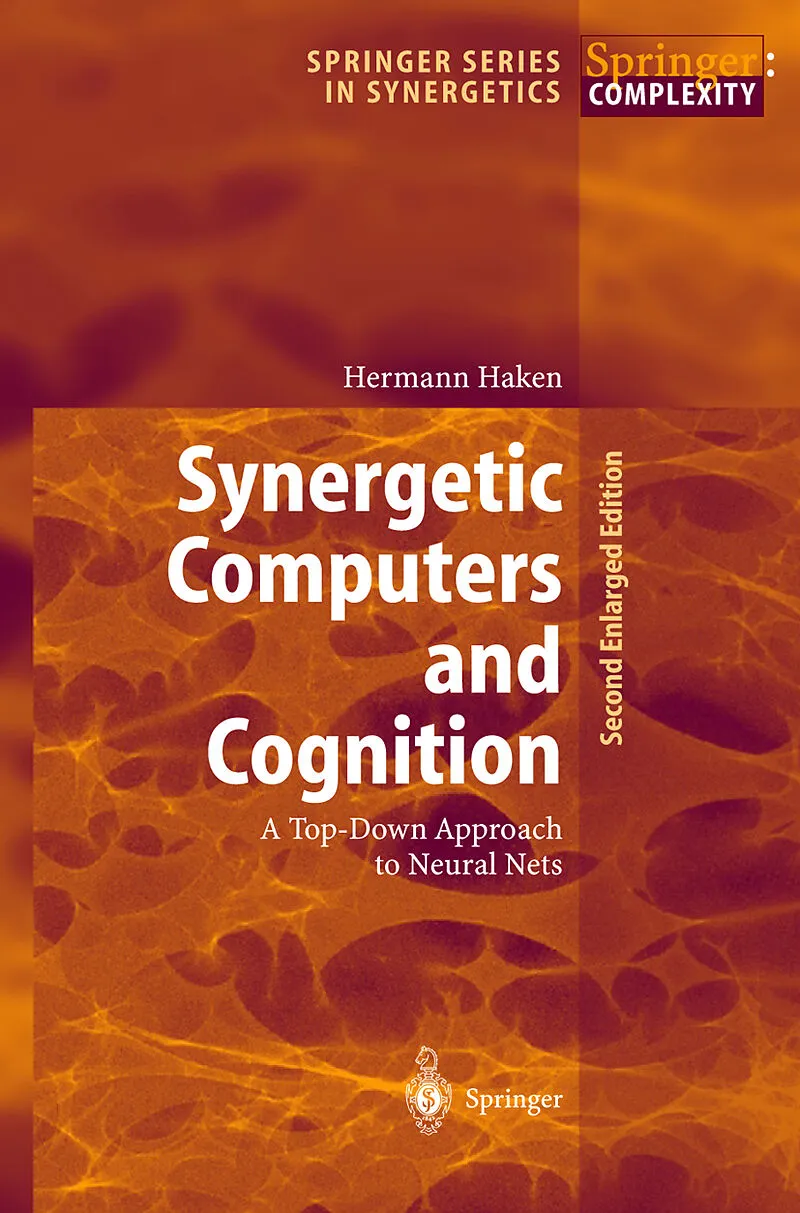
Beschreibung
Ein neuartiger Zugang zu neuronalen Netzen, der auf der Analogie zwischen Mustererkennung und Musterbildung beruht, wird hier dargestellt. Diese Analogie führt zum Konzept des synergetischen Computers, der in der Lage ist, komplexe Szenen zu erkennen. Der Ver...Ein neuartiger Zugang zu neuronalen Netzen, der auf der Analogie zwischen Mustererkennung und Musterbildung beruht, wird hier dargestellt. Diese Analogie führt zum Konzept des synergetischen Computers, der in der Lage ist, komplexe Szenen zu erkennen. Der Vergleich zwischen der Wahrnehmungsfähigkeit von Menschen und der des synergetischen Computers weist neue Wege bei der Entwicklung möglicher Modelle mentaler Prozesse.
The first edition of this book has found great interest among scientists and en gineers dealing with pattern recognition and among psychologists working on psychophysics or Gestalt psychology. This book also proved highly useful for graduate students of informatics. The concept of the synergetic computer offers an important alternative to the by now more traditional neural nets. I just mention a few advantages: There are no ghost states so that time-consuming methods such as simulated annealing can be avoided; the synaptic strengths are explicitly determined by the prototype patterns to be stored, but they can equally well be learned, and the learning procedure allows a classification. Also a precise meaning and function can be attributed to "hidden variables". The synergetic computer has found a number of important practical applications in industry. I use the opportunity of this second edition to include a new section on transfor mation properties of the equations of the synergetic computer and on the invariance properties of its order parameter equations. A new section is devoted to the problem of stereopsis that is dealt with by the basic concept of the synergetic computer. Finally, attention is paid to a recent de velopment, namely to the use of pulse-coupled neural nets for pattern recognition.
The synergetic computer has found many applications. This book is the classical text by Haken who invented this concept
Autorentext
Hermann Haken is Professor of the Institute for Theoretical Physics at the University of Stuttgart. He is known as the founder of synergetics. His research has been in nonlinear optics (in particular laser physics), solid state physics, statistical physics, and group theory. After the implementation of the first laser in 1960, Professor Haken developed his institute to an international center for laser theory. The interpretation of the laser principles as self organization of non equilibrium systems paved the way to the development of synergetics, of which Haken is recognized as the founder. Hermann Haken has been visiting professor or guest scientist in England, France, Japan, USA, Russia, and China. He is the author of some 23 textbooks and monographs that cover an impressive number of topics from laser physics to synergetics, and editor of a book series in synergetics. For his pathbreaking work and his influence on academic research, he has been awarded many-times. Among others, he is member of the Order "Pour le merite" and received the Max Planck Medal in 1990.
Klappentext
This book presents a novel approach to neural nets and thus offers a genuine alternative to the hitherto known neuro-computers. This approach is based on the author's discovery of the profound analogy between pattern recognition and pattern formation in open systems far from equilibrium. Thus the mathematical and conceptual tools of synergetics can be exploited, and the concept of the synergetic computer formulated. A complete and rigorous theory of pattern recognition and learning is presented. The resulting algorithm can be implemented on serial computers or realized by fully parallel nets whereby no spurious states occur. Explicit examples (recognition of faces and city maps) are provided. The recognition process is made invariant with respect to simultaneous translation, rotation, and scaling, and allows the recognition of complex scenes. Oscillations and hysteresis in the perception of ambiguous patterns are treated, as well as the recognition of movement patterns. A comparison between the recognition abilities of humans and the synergetic computer sheds new light on possible models of mental processes. The synergetic computer can also perform logical steps such as the XOR operation. The new edition includes a section on transformation properties of the equations of the synergetic computer and on the invariance properties of the order parameter equations. Further additions are a new section on stereopsis and recent developments in the use of pulse-coupled neural nets for pattern recognition.
Inhalt
10%