
IHR WARENKORB IST AKTUELL LEER.
Haben Sie noch nichts passendes gefunden? Stöbern Sie durch unser komplettes Sortiment.
Oder melden Sie sich an bzw. registrieren Sie sich.
- Kostenlose Lieferung
- Kauf auf Rechnung
- Ex Libris Tiefpreis
- Filiallieferung und 650+ Abholorte
- Rabatt-Bons als Club-Mitglied
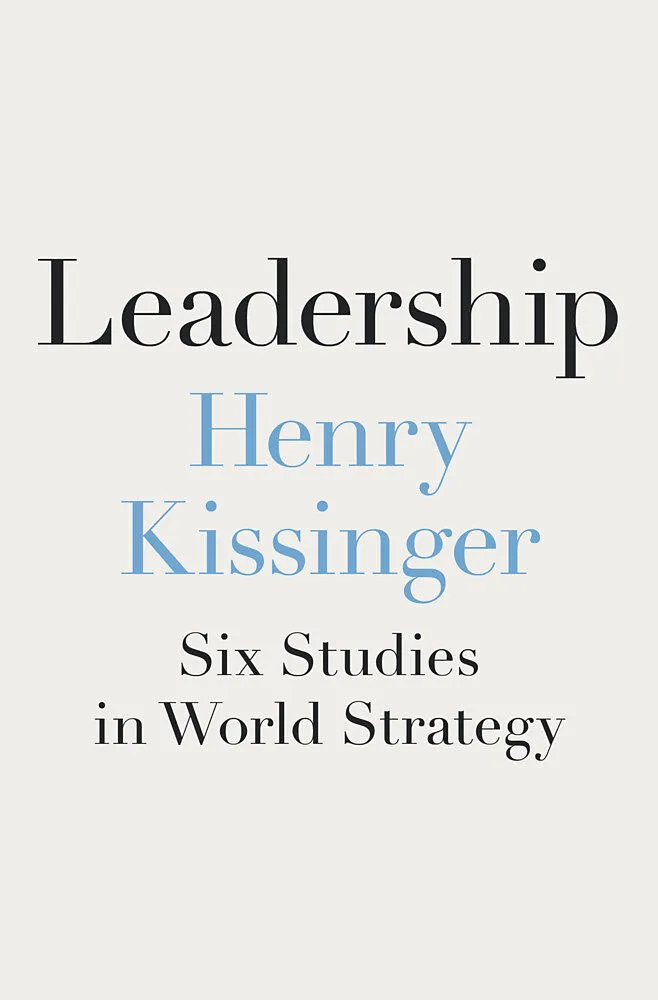
Leadership
Beschreibung
The New York Times bestseller An extraordinary book. The Wall Street Journal Kissinger is the genuine article, and worth listening to. Financial Times A must read. . . . His books including this one will hopefully be read well into the future. New York Journal...Format auswählen
- Fester EinbandCHF 32.30
- Kartonierter EinbandCHF 20.00

Wird oft zusammen gekauft
Andere Kunden kauften auch
Beschreibung
**The New York Times bestseller
An extraordinary book. The Wall Street Journal
Kissinger is the genuine article, and worth listening to. Financial Times
A must read. . . . His books including this one will hopefully be read well into the future. New York Journal of Books
Henry Kissinger, consummate diplomat and statesman, examines the strategies of six great twentieth-century figures and brings to life a unifying theory of leadership and diplomacy
** Leaders, writes Henry Kissinger in this compelling book, think and act at the intersection of two axes: the first, between the past and the future; the second, between the abiding values and aspirations of those they lead. They must balance what they know, which is necessarily drawn from the past, with what they intuit about the future, which is inherently conjectural and uncertain. It is this intuitive grasp of direction that enables leaders to set objectives and lay down a strategy.
In Leadership, Kissinger analyses the lives of six extraordinary leaders - Konrad Adenauer, Charles de Gaulle, Richard Nixon, Anwar Sadat, Lee Kuan Yew, and Margaret Thatcher - through the distinctive strategies of statecraft that he believes they embodied. To each of these studies, Kissinger brings historical perception, public experience and, because he knew each of the subjects and participated in many of the events he describes, personal knowledge. Leadership is enriched by insights and judgements that only Kissinger could make and concludes with his reflections on world order and the indispensability of leadership today.
Autorentext
Henry Kissinger
Klappentext
Henry Kissinger, monumental diplomat and statesman, examines the strategies of five great twentieth century figures and brings to a life of unifying theory of leadership and diplomacy
In Leadership, Henry Kissinger presents a deeply insightful study of five impactful leaders in modern history: Charles de Gaulle, Konrad Adenauer, Margaret Thatcher, Richard Nixon, and Lee Kuan Yew. Grounded not only in his deep study of history, but distinguished career in government, Kissinger - who himself transformed American diplomacy as we know it - pulls back the curtain to expose the true politics and masterful strategies of these great geopolitical minds. What results is a brilliant and complex portrait of leadership, refracted through the lives of very different subjects.
Looking far beyond their most well-known victories and defeats, Kissinger contextualizes their strategies over the scope of their lives - from their rise to power to controversies and detractors, to contemporary challenges and greater reckonings over their global positions. From Kissinger's unique vantage point, and through his personal relationships with his subjects,we see not only the impact of these far-sighted statesmen during their period in power, but the aftermath.
Throughout, Kissinger offers invaluable lessons on leadership in times of war and peace, and reveals the inner workings of modern diplomatic tug-of-war. Essential reading for all hoping to understand and engage with our current and future global challenges, Leadership is a stunning meditation on leadership itself, from one of our most legendary statesmen.
Zusammenfassung
**The New York Times bestseller
“An extraordinary book.” —The Wall Street Journal
“Kissinger is the genuine article, and worth listening to.” —Financial Times
“A must read. . . . His books—including this one—will hopefully be read well into the future.” —New York Journal of Books
Henry Kissinger, consummate diplomat and statesman, examines the strategies of six great twentieth-century figures and brings to life a unifying theory of leadership and diplomacy
**“Leaders,” writes Henry Kissinger in this compelling book, “think and act at the intersection of two axes: the first, between the past and the future; the second, between the abiding values and aspirations of those they lead. They must balance what they know, which is necessarily drawn from the past, with what they intuit about the future, which is inherently conjectural and uncertain. It is this intuitive grasp of direction that enables leaders to set objectives and lay down a strategy.”
In Leadership, Kissinger analyses the lives of six extraordinary leaders - Konrad Adenauer, Charles de Gaulle, Richard Nixon, Anwar Sadat, Lee Kuan Yew, and Margaret Thatcher - through the distinctive strategies of statecraft that he believes they embodied. To each of these studies, Kissinger brings historical perception, public experience and, because he knew each of the subjects and participated in many of the events he describes, personal knowledge. Leadership is enriched by insights and judgements that only Kissinger could make and concludes with his reflections on world order and the indispensability of leadership today.
Leseprobe
1
Konrad Adenauer:
The Strategy of Humility
The Necessity of Renewal
In January 1943, at the Casablanca Conference, the Allies proclaimed that they would accept nothing less than the 'unconditional surrender' of the Axis powers. US President Franklin Delano Roosevelt, who was the driving force behind the announcement, sought to deprive any successor government to Hitler of the ability to claim that it had been deluded into surrender by unfulfilled promises. Germany's complete military defeat, together with its total loss of moral and international legitimacy, led inexorably to the progressive disintegration of the German civil structure.
I observed this process as part of the 84th Infantry Division of the US army as it moved from the German border near the industrial Ruhr territory to the Elbe River near Magdeburg - just 100 miles away from the then-raging Battle of Berlin. As the division was crossing the German border, I was transferred to a unit responsible for security and prevention of the guerrilla activity that Hitler had ordered.
For a person like me, whose family had fled the small Bavarian city of FŸrth six years earlier to escape racial persecution, no greater contrast with the Germany of my youth could have been imagined. Then, Hitler had just annexed Austria and was in the process of dismembering Czechoslovakia. The dominant attitude of the German people verged on the overbearing.
Now, white sheets hung from many windows to signify the surrender of the population. The Germans, who a few years earlier had celebrated the prospect of dominating Europe from the English Channel to the Volga River, were cowed and bewildered. Thousands of displaced persons - deported from Eastern Europe as forced labor during the war - crowded the streets in quest of food and shelter and the possibility of returning home.
It was a desperate period in German history. Food shortages were severe. Many starved, and infant mortality was twice that of the rest of Western Europe. The established exchange of goods and services collapsed; black markets took its place. Mail service ranged from impaired to nonexistent. Rail service was sporadic and transport by road made extremely difficult by the ravages of war and the shortage of gasoline.
In the spring of 1945, the task of occupying forces was to institute some kind of civil order until trained military government personnel could replace combat troops. This occurred around the time of the Potsdam conference in July and August (of Churchill/Attlee, Truman and Stalin). At that summit, the Allies divided Germany into four occupation zones: for the United States, a southern portion containing Bavaria; for Britain, the industrial northern Rhineland and Ruhr Valley; for France, the southern Rhineland and territory along the Alsatian border; and for the Soviets, a z…