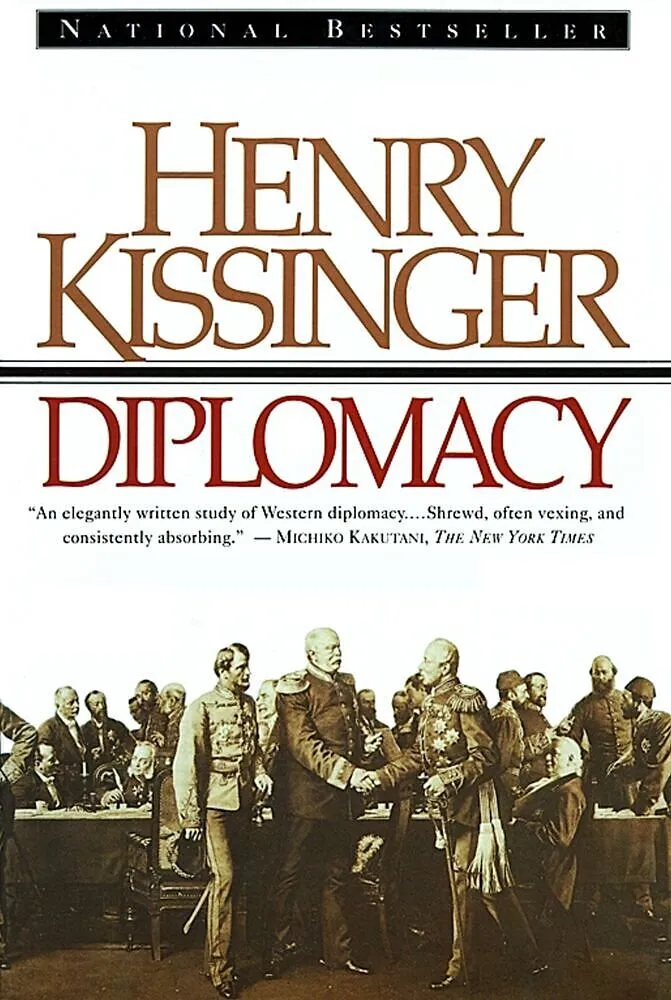
Diplomacy
Beschreibung
The classic history of international relations, by the former Secretary of State and winner of the Nobel Peace Prize. 'Kissinger's absorbing book tackles head-on some of the toughest questions of our time ...Its pages sparkle with insight' Simon Schama in the ...Format auswählen
- BroschiertCHF 32.80
Wird oft zusammen gekauft
Andere Kunden kauften auch
Beschreibung
The classic history of international relations, by the former Secretary of State and winner of the Nobel Peace Prize.
'Kissinger's absorbing book tackles head-on some of the toughest questions of our time ...Its pages sparkle with insight' Simon Schama in the NEW YORKER Spanning more than three centuries, from Cardinal Richelieu to the fragility of the 'New World Order', DIPLOMACY is the now-classic history of international relations by the former Secretary of State and winner of the Nobel Peace Prize. Kissinger's intimate portraits of world leaders, many from personal experience, provide the reader with a unique insight into what really goes on -- and why -- behind the closed doors of the corridors of power. 'Budding diplomats and politicians should read it as avidly as their predecessors read Machiavelli' Douglas Hurd in the DAILY TELEGRAPH 'If you want to pay someone a compliment, give them Henry Kissinger's DIPLOMACY ...It is certainly one of the best, and most enjoyable [books] on international relations past and present ...DIPLOMACY should be read for the sheer historical sweep, the characterisations, the story-telling, the ability to look at large parts of the world as a whole' Malcolm Rutherford in the FINANCIAL TIMES
Walter Laqueur Chairman, International Research Council, Center for Strategic and International Studies The most important work on diplomacy for thirty years.
Autorentext
Henry Kissinger was the fifty-sixth Secretary of State. Born in Germany, Dr. Kissinger came to the United States in 1938 and was naturalized a US citizen in 1943. He served in the US Army in Europe in World War Two and attended Harvard University on a scholarship, where he later became a member of the faculty. Among the awards he has received are the Nobel Peace Prize, the Presidential Medal of Freedom, and the Medal of Liberty. He passed away in 2023 at the age of 100 at his home in Connecticut.
Klappentext
In a brilliant, controversial, and profoundly incisive book, former Secretary of State Henry Kissinger explains the art of diplomacy and reveals why Americans have historically repudiated both the style and substance of diplomacy as it is practiced throughout the world. 30 pages of photos. QBPC Alternate.
Zusammenfassung
Offering a panoramic view of history and a description of firsthand diplomatic encounters, the former Secretary of State describes his ideas about diplomacy and power balances, showing how national negotiating styles influence outcomes.
Leseprobe
CHAPTER ONE
The New World Order
Almost as if according to some natural law, in every century there seems to emerge a country with the power, the will, and the intellectual and moral impetus to shape the entire international system in accordance with its own values. In the seventeenth century, France under Cardinal Richelieu introduced the modern approach to international relations, based on the nation-state and motivated by national interest as its ultimate purpose. In the eighteenth century, Great Britain elaborated the concept of the balance of power, which dominated European diplomacy for the next 200 years. In the nineteenth century, Metternich's Austria reconstructed the Concert of Europe and Bismarck's Germany dismantled it, reshaping European diplomacy into a cold-blooded game of power politics.
In the twentieth century, no country has influenced international relations as decisively and at the same time as ambivalently as the United States. No society has more firmly insisted on the inadmissibility of intervention in the domestic affairs of other states, or more passionately asserted that its own values were universally applicable. No nation has been more pragmatic in the day-to-day conduct of its diplomacy, or more ideological in the pursuit of its historic moral convictions. No country has been more reluctant to engage itself abroad even while undertaking alliances and commitments of unprecedented reach and scope.
The singularities that America has ascribed to itself throughout its history have produced two contradictory attitudes toward foreign policy. The first is that America serves its values best by perfecting democracy at home, thereby acting as a beacon for the rest of mankind; the second, that America's values impose on it an obligation to crusade for them around the world. Torn between nostalgia for a pristine past and yearning for a perfect future, American thought has oscillated between isolationism and commitment, though, since the end of the Second World War, the realities of interdependence have predominated.
Both schools of thought -- of America as beacon and of America as crusader -- envision as normal a global international order based on democracy, free commerce, and international law. Since no such system has ever existed, its evocation often appears to other societies as utopian, if not naïve. Still, foreign skepticism never dimmed the idealism of Woodrow Wilson, Franklin Roosevelt, or Ronald Reagan, or indeed of all other twentieth-century American presidents. If anything, it has spurred America's faith that history can be overcome and that if the world truly wants peace, it needs to apply America's moral prescriptions.
Both schools of thought were products of the American experience. Though other republics have existed, none had been consciously created to vindicate the idea of liberty. No other country's population had chosen to head for a new continent and tame its wilderness in the name of freedom and prosperity for all. Thus the two approaches, the isolationist and the missionary, so contradictory on the surface, reflected a common underlying faith: that the United States possessed the world's best system of government, and that the rest of mankind could attain peace and prosperity by abandoning traditional diplomacy and adopting America's reverence for international law and democracy.
America's journey through international politics has been a triumph of faith over experience. Since the time America entered the arena of world politics in 1917, it has been so preponderant in strength and so convinced of the rightness of its ideals that this century's major international agreements have been embodiments of American values -- from the League of Nations and the Kellogg-Briand Pact to the United Nations Charter and the Helsinki Final Act. The collapse of Soviet communism marked the intellectual vindication of American ideals and, ironically, brought America face to face with the kind of world it had been seeking to escape throughout its history. In the emerging international order, nationalism has gained a new lease on life. Nations have pursued self-interest more frequently than high-minded principle, and have competed more than they have cooperated. There is little evidence to suggest that this age-old mode of behavior has changed, or that it is likely to change in the decades ahead.
What is new about the emerging world order is that, for the first time, the United States can neither withdraw from the world nor dominate it. America cannot change the way it has perceived its role throughout its history, not should it want to. When America entered the international arena, it was young and robust and had the power to make the world conform to its vision of international relations. By the end of the Second World War in 1945, the United States was so powerful (at one point about 35 percent of the world's entire economic production was American) that it seemed as if it was destined to shape the world according to its preferences.
John F. Kennedy declared confidently in 1961 that America was strong enough to "pay any price, bear any burden" to ensure the success of liberty. Three decades later, the United States is in less of a position to insist on the immediate realization of all its desires. Other countries have grown into Great Power status. The Un…