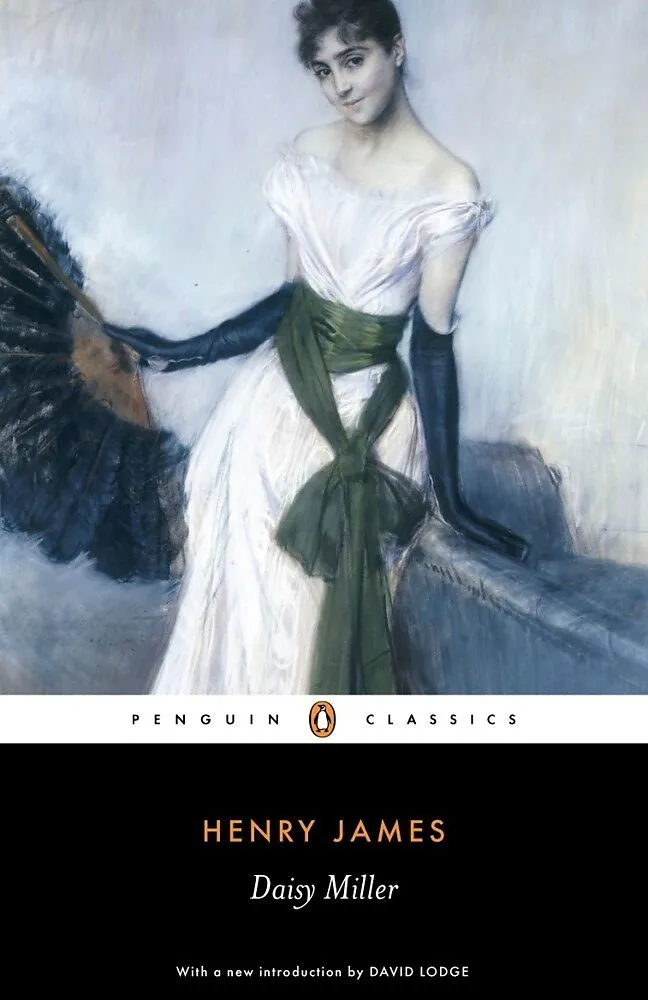

Daisy Miller
Beschreibung
Zusatztext The critical faculty hesitates before the magnitude of Mr. Henry James's work. Joseph Conrad Informationen zum Autor Henry James was born in 1843 in New York and died in London in 1916. In addition to many short stories, plays, books of criticism, a...Format auswählen
- Kartonierter EinbandCHF 13.00

Wird oft zusammen gekauft
Andere Kunden kauften auch
Beschreibung
Zusatztext The critical faculty hesitates before the magnitude of Mr. Henry James's work. Joseph Conrad Informationen zum Autor Henry James was born in 1843 in New York and died in London in 1916. In addition to many short stories, plays, books of criticism, autobiography and travel, he wrote some twenty novels, the first published being Roderick Hudson (1875). They include The Europeans , Washington Square , The Portrait of a Lady , The Bostonians , The Princess Casamassima , The Tragic Muse , The Spoils of Poynton , The Awkward Age , The Wings of the Dove , The Ambassadors and The Golden Bowl . Klappentext Travelling in Europe with her family, Daisy Miller, an exquisitely beautiful young American woman, presents her fellow-countryman Winterbourne with a dilemma he cannot resolve. Is she deliberately flouting social convention in the outspoken way she talks and acts, or is she simply ignorant of those conventions? When she strikes up an intimate friendship with an urbane young Italian, her flat refusal to observe the codes of respectable behaviour leave her perilously exposed. In Daisy Miller James created his first great portrait of the enigmatic and dangerously independent American woman, a figure who would come to dominate his later masterpieces. For more than seventy years, Penguin has been the leading publisher of classic literature in the English-speaking world. With more than 1,700 titles, Penguin Classics represents a global bookshelf of the best works throughout history and across genres and disciplines. Readers trust the series to provide authoritative texts enhanced by introductions and notes by distinguished scholars and contemporary authors, as well as up-to-date translations by award-winning translators. Chapter I At the little town of Vevey, in Switzerland, there is a particularly comfortable hotel; there are indeed many hotels, since the entertainment of tourists is the business of the place, which, as many travellers will remember, is seated upon the edge of a remarkably blue lake a lake that it behoves every tourist to visit. The shore of the lake presents an unbroken array of establishments of this order, of every category, from the grand hotel of the newest fashion, with a chalk-white front, a hundred balconies, and a dozen flags flying from its roof, to the small Swiss pension of an elder day, with its name inscribed in German-looking lettering upon a pink or yellow wall and an awkward summer-house in the angle of the garden. One of the hotels at Vevey, however, is famous, even classical, being distinguished from many of its upstart neighbours by an air both of luxury and of maturity. In this region, through the month of June, American travellers are extremely numerous; it may be said indeed that Vevey assumes at that time some of the characteristics of an American watering-place. There are sights and sounds that evoke a vision, an echo, of Newport and Saratoga. There is a flitting hither and thither of stylish young girls, a rustling of muslin flounces, a rattle of dance-music in the morning hours, a sound of high-pitched voices at all times. You receive an impression of these things at the excellent inn of the Trois Couronnes, and are transported in fancy to the Ocean House or to Congress Hall. But at the Trois Couronnes, it must be added, there are other features much at variance with these suggestions: neat German waiters who look like secretaries of legation; Russian princesses sitting in the garden; little Polish boys walking about, held by the hand, with their governors; a view of the snowy crest of the Dent du Midi and the picturesque towers of the Castle of Chillon. I hardly know whether it was the analogies or the differences that were uppermost in the mind of a young American, who, two or three years ago, sat in the garden...
#8220;The critical faculty hesitates before the magnitude of Mr. Henry James’s work.”—Joseph Conrad
Autorentext
Henry James was born in 1843 in New York and died in London in 1916. In addition to many short stories, plays, books of criticism, autobiography and travel, he wrote some twenty novels, the first published being Roderick Hudson (1875). They include The Europeans, Washington Square, The Portrait of a Lady, The Bostonians, The Princess Casamassima, The Tragic Muse, The Spoils of Poynton, The Awkward Age, The Wings of the Dove, The Ambassadors and The Golden Bowl.
Klappentext
Travelling in Europe with her family, Daisy Miller, an exquisitely beautiful young American woman, presents her fellow-countryman Winterbourne with a dilemma he cannot resolve. Is she deliberately flouting social convention in the outspoken way she talks and acts, or is she simply ignorant of those conventions? When she strikes up an intimate friendship with an urbane young Italian, her flat refusal to observe the codes of respectable behaviour leave her perilously exposed. In Daisy Miller James created his first great portrait of the enigmatic and dangerously independent American woman, a figure who would come to dominate his later masterpieces.
For more than seventy years, Penguin has been the leading publisher of classic literature in the English-speaking world. With more than 1,700 titles, Penguin Classics represents a global bookshelf of the best works throughout history and across genres and disciplines. Readers trust the series to provide authoritative texts enhanced by introductions and notes by distinguished scholars and contemporary authors, as well as up-to-date translations by award-winning translators.
Leseprobe
Chapter I
At the little town of Vevey, in Switzerland, there is a particularly comfortable hotel; there are indeed many hotels, since the entertainment of tourists is the business of the place, which, as many travellers will remember, is seated upon the edge of a remarkably blue lake —a lake that it behoves every tourist to visit. The shore of the lake presents an unbroken array of establishments of this order, of every category, from the “grand hotel” of the newest fashion, with a chalk-white front, a hundred balconies, and a dozen flags flying from its roof, to the small Swiss pension of an elder day, with its name inscribed in German-looking lettering upon a pink or yellow wall and an awkward summer-house in the angle of the garden. One of the hotels at Vevey, however, is famous, even classical, being distinguished from many of its upstart neighbours by an air both of luxury and of maturity. In this region, through the month of June, American travellers are extremely numerous; it may be said indeed that Vevey assumes at that time some of the characteristics of an American watering-place. There are sights and sounds that evoke a vision, an echo, of Newport and Saratoga. There is a flitting hither and thither of “stylish” young girls, a rustling of muslin flounces, a rattle of dance-music in the morning hours, a sound of high-pitched voices at all times. You receive an impression of these things at the excellent inn of the “Trois Couronnes,” and are transported in fancy to the Ocean House or to Congress Hall. But at the “Trois Couronnes,” it must be added, there are other features much at variance with these suggestions: neat German waiters who look like secretaries of legation; Russian princesses sitting in the garden; little Polish boys walking about, held by the hand, with their governors; a view of the snowy crest of the Dent du Midi and the picturesque towers of the Castle of Chillon.
I hardly know whether it was the analogies or the differences that were uppermost in the mind of a young American, who, two or three years ago, sat in the garden of the “Trois Couronnes,” looking about him rather idly at some of the graceful objects I have mentioned. It was a beautiful summer morning, and in whatever fashion the young A…