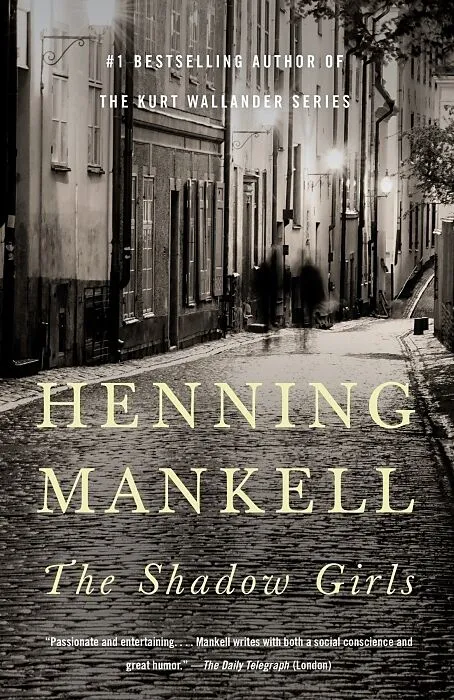

The Shadow Girls
Beschreibung
From the dean of Scandinavian noirand the internationally bestselling and universally acclaimed Kurt Wallander series, comes this moving and profound literary novel about three refugee women and the poet they befriend. Jesper Humlin is a mildly famous author a...Format auswählen
- Kartonierter EinbandCHF 19.20
Wird oft zusammen gekauft
Andere Kunden kauften auch
Beschreibung
From the dean of Scandinavian noirand the internationally bestselling and universally acclaimed Kurt Wallander series, comes this moving and profound literary novel about three refugee women and the poet they befriend. Jesper Humlin is a mildly famous author and poet with lackluster book sales. Not even his editor will support his artistic vision, suggesting instead that he start writing crime novels in the place of poetry. In his travels, Humlin encounters three women who will change his worldview. All three have fled their home countries and settled in Sweden: Leyla from Iran, Tanya from Russia, and Tea-Bag from Nigeria. The women look to Humlin for guidance in telling their stories, learning how to shape the tales of their journeys and sacrifices. Both social comedy and social tragedy ensue from these efforts, but in the end Humlin, Leyla, Tanya and Tea-Bag all find that they have helped change one another. The Shadow Girls is an absorbing tale of how a diverse society changes--and is changed by--its citizens, whoever they are
ldquo;At once darkly absurd, funny, passionate, wrenching and deeply socially aware. . . . [And] a heartfelt reminder of the many people whose struggles are never known.”
     —The Plain Dealer
“Passionate and entertaining. . . . Mankell writes with both a social conscience and great humor.”
     —The Daily Telegraph (London)
“A serious novel with a lot of heart.” 
     —Bookreporter
“Mankell is giving a voice to those who do not possess one.” 
     —The Independent (London)
 
“Henning Mankell works . . . astounding magic. . . . He brings us the distinctive but overlapping voices of three perceptive young women who, once their harrowing, poetic floods of pain are released, can never again be ignored.”
     —Washington Independent Review of Books
Autorentext
Henning Mankell
Klappentext
A poet of middling acclaim who is saddled by his underwhelming book sales, an exasperated girlfriend, a demanding mother, and a rapidly fading tan starts an unlikely writing group that requires more of him than he first imagined in this humorous and heartbreaking work.
Zusammenfassung
From the dean of Scandinavian noirand the internationally bestselling and universally acclaimed Kurt Wallander series, comes this moving and profound literary novel about three refugee women and the poet they befriend.
Jesper Humlin is a mildly famous author and poet with lackluster book sales. Not even his editor will support his artistic vision, suggesting instead that he start writing crime novels in the place of poetry. In his travels, Humlin encounters three women who will change his worldview. All three have fled their home countries and settled in Sweden: Leyla from Iran, Tanya from Russia, and Tea-Bag from Nigeria. The women look to Humlin for guidance in telling their stories, learning how to shape the tales of their journeys and sacrifices. Both social comedy and social tragedy ensue from these efforts, but in the end Humlin, Leyla, Tanya and Tea-Bag all find that they have helped change one another.
 
The Shadow Girls is an absorbing tale of how a diverse society changes—and is changed by—its citizens, whoever they are
Leseprobe
*Excerpted from Chapter One
-
CHAPTER ONE
it was one of the last days of the twentieth century.
The girl with the big smile was awakened by the sound of raindrops hitting the tent cover above her head. as long as she kept her eyes closed she could imagine that she was still back in the village by the cold, clear river that spilled down the side of the mountain. But as soon as she opened her eyes she was thrown out into an empty and unfathomable world, one in which nothing of her past remained except disjointed images of her escape. She lay still and slowly let herself float up into consciousness, trying not to leave her dreams without preparing herself. These first few minutes of the morning often determined the way her day would turn out. during the three months in the refugee camp she had developed a morning ritual that helped her avoid being overcome with sudden panic. The most important thing was not to rush up from her uncomfortable cot with the misguided notion that something momentous was about to occur. By now she knew that nothing ever happened here. This was the first lesson she learned after she had dragged herself onto the rocky european beach and been greeted by guard dogs and armed Spanish border guards.
Being a refugee meant being lonely. This was something that was true for them all, regardless of what country they had come from or what circumstances had forced them to flee. She didn’t expect her loneliness to leave her soon, in fact she had prepared herself to live with it for a long time.
As she lay with her eyes closed she searched for a foothold in the confusion of all that had happened since her arrival. She was being held in a refugee camp in southern Spain, lucky to be one of the few survivors from that mouldering ship from africa. She could still remember the air of expectation aboard. Freedom has a scent, she thought, which only grew more overpowering as land approached. Freedom, security, these were what they wanted. a life where fear, hunger, and hopelessness were not the only reality.
It had been a cargo-hold of hope, she thought; although it was perhaps more correct to call it a cargo-hold of illusions. everyone who had been waiting on the Moroccan beach that night and who had placed their lives in the hands of the ruthless human smugglers had been ferried over to the waiting ship. Sailors who were little more than shadows had forced them down into the cargo area, as if they were modern-day slaves.
But there had been no iron chains around their ankles. what had ensnared them were their dreams, their desperation, all the fear that had driven them to break up from various hells-on- earth in order to make their way to freedom. They had been so close to their goal when the ship hit a reef and the Greek sailors had left in lifeboats, leaving the people in the cargo hold to save themselves.
Europe let us down before we even arrived, she thought. i will never forget that, whatever happens to me in the future. She didn’t know how many people had drowned, nor would she ever find out. The cries for help still pulsated like a pain in her head. at first she had been surrounded by these cries, then one by one they had fallen silent. when she hit land she had praised her luck. She had survived; she had arrived. But for what? She had quickly tried to forget her dreams. Nothing had turned out as she had imagined.
A harsh spotlight had picked her out as she lay on the cold and wet Spanish beach. The dogs had run up to her and then the soldiers surrounded her with their shiny weapons. She had survived. But that was all. afterwards she had been placed in the refugee camp with its barracks and tents, leaky showers and dirty toilets. on the other side of the wire fence she could see the ocean that had released her, but nothing else, none of the future she had imagined.
The people in the refugee camp, so varied in their language, dress and terrible experiences – imparted through a look or sometimes words – had only this in common: nothing to look forward to. Some had been there for many years. No country was willing to admit them and all of their energies were devoted to avoiding being sent back. one day, as she had been waiting in line for her daily rations, she spoke with a young man from iran – or was it iraq? it was often hard to know where people came from since they invariably lied about it in…