Health Information Processing
Beschreibung
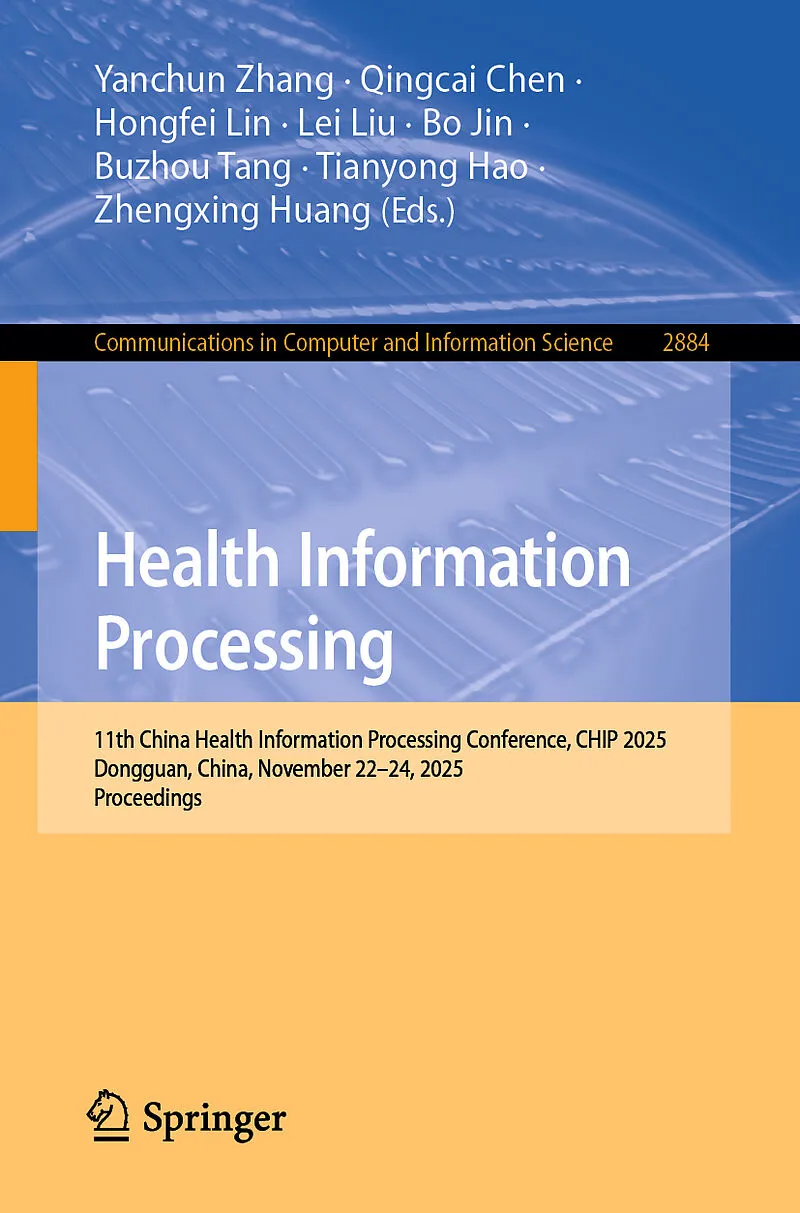
This book CCIS 2884 constitutes the refereed proceedings of the 11th China Health Information Processing Conference, CHIP 2025, held in Dongguan, China, during November 22-24, 2025. The 37 full papers included in this book were carefully reviewed and selected...
Format auswählen
- Kartonierter EinbandCHF 121.20

Wird oft zusammen gekauft
Andere Kunden kauften auch
Beschreibung
This book CCIS 2884 constitutes the refereed proceedings of the 11th China Health Information Processing Conference, CHIP 2025, held in Dongguan, China, during November 22-24, 2025.
The 37 full papers included in this book were carefully reviewed and selected from 66 submissions. These papers have been categorized into 3 main topics: Biomedical data processing and model application, Mental health and disease prediction, and Drug prediction and Knowledge map.
Inhalt
Biomedical data processing and model application.- Breast-Rehab: A Postoperative Breast Cancer Rehabilitation Training Assessment System Based on Human Action Recognition.- KD4FIRE: A Knowledge Distillation Approach for Fine-grained Medical Relation Extraction in Low-Resource Settings.- Zero-Shot Knowledge Distillation for Chinese Clinical Diagnosis: Enhancing Small LLMs via Prompting and Loss-based Filtering.- CausalMPT: Causal Multimodal Prompt Tuning for Healthcare MIE.- Enabling AI Scientists to Recognize Innovation: A Domain-Agnostic Algorithm for Assessing Novelty.- Iterative Dynamic Routing Framework for Medical Question Answering.- CDMFuse: A Multi-Modal Fusion Framework for Skin Lesion Classification.- DMSNet: Dual-Channel Interactive Attention Deep Classification Network for Mass Spectrometry Data.- Composite Inflammatory Indices from Peripheral Blood Tests for Early Prediction of EBV-Associated He-mophagocytic Lymphohistiocytosis in Children.- Knowledge-Augmented Multimodal Learning for Breast Cancer Diagnosis.- Retrieval-Augmented Relation Extraction for Medical Knowledge Graphs.- A Verification-Enhanced Large Model Framework for Diabetes Knowledge Graph Construction.- A Deep Learning-Based TCM Deficiency-Excess Syndrome Differentiation Framework for Spectrum Analysis of PPG Pulse Wave.- Cross-Type Biomedical Named Entity Recognition Method Based on Knowledge Distillation.- Meta-Learning Enhance the Influenza Surveillance across Spatio-temporal Heterogeneous Scenario by Recommending suitable Statistical Models.- Construction of the Text Sentiment Analysis Model for College Students' Mental Health.- A Review of Multimodal Large-ModelDriven Intelligent Tongue, Pulse, and Facial Diagnosis in Traditional Chinese Medicine.- Domain-Adapted Large Language Models for Schema-Consistent Medical Record Generation from DoctorPatient Dialogues.- ECU-BRE: NLI-based Biomedical Relation Extraction with EC Supervision and Uncertainty-aware Inference.- Application of Computer Vision and Deep Learning in Medical Imaging.- Magic-OR: A Multi-dimensional Geometric Alignment Framework for Precise Occlusal Registration Using Intraoral Scans.- Mental health and disease prediction.- Breast-Rehab: A Postoperative Breast Cancer Rehabilitation.- A Multi-Modal Fusion Framework for Skin Lesion Classification.- Composite Inflammatory Indices from Peripheral Blood Tests for Early Prediction of EBV-Associated He-mophagocytic Lymphohistiocytosis in Children.- A Verification-Enhanced Large Model Framework for Diabetes.- Meta-Learning Enhance the Influenza Surveillance across Spatio-temporal Heterogeneous Scenario by Recommending suitable Statistical Models.- Construction of the Text Sentiment Analysis Model for College Students' Mental Health.- A Review of Multimodal Large-ModelDriven Intelligent Tongue, Pulse, and Facial Diagnosis in Traditional Chinese Medicine.- Drug prediction and Knowledge map.- KD4FIRE: A Knowledge Distillation Approach for Fine-grained Medical Relation Extraction in Low-Resource Settings.- Zero-Shot Knowledge Distillation for Chinese Clinical Diagnosis: Enhancing Small LLMs via Prompting and Loss-based Filtering.- Enabling AI Scientists to Recognize Innovation: A Domain-Agnostic Algorithm for Assessing Novelty.- Knowledge-Augmented Multimodal Learning for Breast Cancer Diagnosis.- Retrieval-Augmented Relation Extraction for Medical Knowledge Graphs.- Cross-Type Biomedical Named Entity Recognition Method Based on Knowledge Distillation.- Shared task 1.- Overview of the Content Quality Control Task for Admission Records in Inpatient Electronic Medical Records in CHIP 2025.- Privacy-Preserving EMR QC with Rule Sharding and Multi-Agent Collaboration.- Dual Enhancement with In-Context Learning and Chain-of- Thought: Large Language Model-Driven Intelligent Connotation Quality Control of Medical Records.- Semantic Quallty Control of EMR Admission Notes:Integrating Rule Guidance, Prompt Optimization, and RAG.- Leveraging Phased Training and Multi-Granularity Prompting with Large Language Models for Few-Shot Quality Control of Electronic Medical Records.- M3-MedQC: A Method for Inherent Quality Control of Electronic Medical Records Based on Large Language Models and Multi-Granularity Evaluation.- Quality Control of Electronic Medical Records Content Based on Q-LoRA FIne-tuning and a Hybrid Model-Rule Approach.- Shared task 2.- Overview of CHIP 2025 Shared Task 2: Discharge Medication Recommendation for Metabolic Diseases Based on Chinese Electronic Health Records.- Towards Discharge Medication Recommendation via Multi-Scale Model Training and Multi-Dimensional Feature Enhancement.- DP-EMR: A Chinese Medication Recommendation Methodfor Metabolic Diseases based on Two-stage Ensemble Learning.- LoRA-Fine-Tuned LLMs for Discharge Medication Recommendation on Chinese EHRs.- Multi-Format Fine-Tuning and Optimized Voting Ensemble for Robust Medication Recommendation in Chinese EMRs.- Shared task 3.- Overview of Medical NLP Code Generation with FHIR for Clinical Trial Screening.- A Large Language Model-based System or Automatic Medical NLP Code Generation.- An Iterative Code Generation and Optimization Framework Based on Dynamic Few-Shot Learning for Medical Information Processing.- Prompt-Driven Program Synthesis for Clinical Trial Screening Criteria: From Natural Language to Executable FHIR Code Generation.


