
IHR WARENKORB IST AKTUELL LEER.
Haben Sie noch nichts passendes gefunden? Stöbern Sie durch unser komplettes Sortiment.
Oder melden Sie sich an bzw. registrieren Sie sich.
- Kostenlose Lieferung
- Kauf auf Rechnung
- Ex Libris Tiefpreis
- Filiallieferung und 650+ Abholorte
- Rabatt-Bons als Club-Mitglied
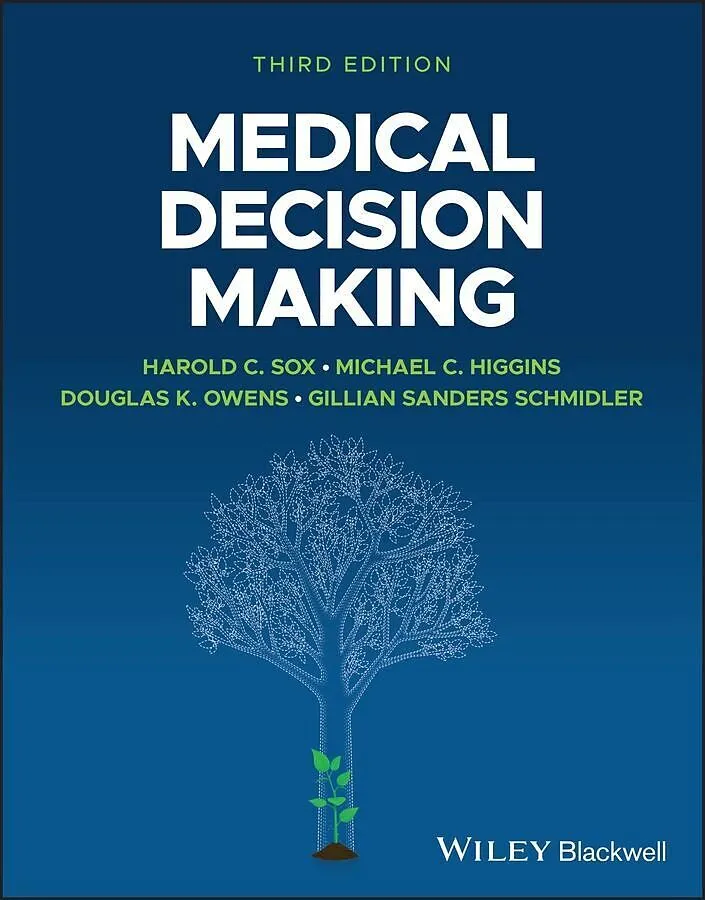
Medical Decision Making
Beschreibung
Informationen zum Autor Harold C. Sox is Emeritus Professor of Medicine and of the Dartmouth Institute at Geisel School of Medicine at Dartmouth, USA. Michael C. Higgins is Adjunct Professor at the Stanford Center for Biomedical Informatics Research, Stanford ...Format auswählen
- Kartonierter EinbandCHF 66.40
Wird oft zusammen gekauft
Andere Kunden kauften auch
Beschreibung
Informationen zum Autor Harold C. Sox is Emeritus Professor of Medicine and of the Dartmouth Institute at Geisel School of Medicine at Dartmouth, USA. Michael C. Higgins is Adjunct Professor at the Stanford Center for Biomedical Informatics Research, Stanford University, USA. Douglas K. Owens is a general internist and Professor and Chair of the Department of Health Policy, School of Medicine, and Director of Stanford Health Policy, Freeman-Spogli Institute for International Studies, Stanford University, USA. Gillian Sanders Schmidler is Professor of Population Health Sciences and Medicine at Duke University and Deputy Director of the Duke-Margolis Institute for Health Policy, Durham, USA. Klappentext Detailed resource showing how to best make medical decisions while incorporating clinical practice guidelines and decision support systems Sir William Osler, a legendary physician of an earlier era, once said, "Medicine is a science of uncertainty and an art of probability." In Osler's day, and now, decisions about treatment often cannot wait until the diagnosis is certain. Medical Decision Making is about how to make the best possible decision given that uncertainty. The book shows how to tailor decisions under uncertainty to achieve the best outcome based on published evidence, features of a patient's illness, and the patient's preferences. Medical Decision Making describes a powerful framework for helping clinicians and their patients reach decisions that lead to outcomes that the patient prefers. That framework contains the key principles of patient-centered decision-making in clinical practice. Since the first edition of Medical Decision Making in 1988, the authors have focused on explaining key concepts and illustrating them with clinical examples. For the Third Edition, every chapter has been revised and updated. Written by four distinguished and highly qualified authors, Medical Decision Making includes information on: How to consider the possible causes of a patient's illness and decide on the probability of the most important diagnoses. How to measure the accuracy of a diagnostic test. How to help patients express their concerns about the risks that they face and how an illness may affect their lives. How to describe uncertainty about how an illness may change over time. How to construct and analyze decision trees. How to identify the threshold for doing a test or starting treatment How to apply these concepts to the design of practice guidelines and medical policy making. Medical Decision Making is a valuable resource for clinicians, medical trainees, and students of decision analysis who wish to fully understand and apply the principles of decision making to clinical practice. Zusammenfassung MEDICAL DECISION MAKINGDetailed resource showing how to best make medical decisions while incorporating clinical practice guidelines and decision support systemsSir William Osler, a legendary physician of an earlier era, once said, "Medicine is a science of uncertainty and an art of probability." In Osler's day, and now, decisions about treatment often cannot wait until the diagnosis is certain. Medical Decision Making is about how to make the best possible decision given that uncertainty. The book shows how to tailor decisions under uncertainty to achieve the best outcome based on published evidence, features of a patient's illness, and the patient's preferences.Medical Decision Making describes a powerful framework for helping clinicians and their patients reach decisions that lead to outcomes that the patient prefers. That framework contains the key principles of patient-centered decision-making in clinical practice.Since the first edition of Medical Decision Making in 1988, the authors have focused on explaining key concepts and illustrating them with clinical examples. For the Third Editio...
Autorentext
Harold C. Sox is Emeritus Professor of Medicine and of the Dartmouth Institute at Geisel School of Medicine at Dartmouth, USA. Michael C. Higgins is Adjunct Professor at the Stanford Center for Biomedical Informatics Research, Stanford University, USA. Douglas K. Owens is a general internist and Professor and Chair of the Department of Health Policy, School of Medicine, and Director of Stanford Health Policy, Freeman-Spogli Institute for International Studies, Stanford University, USA. Gillian Sanders Schmidler is Professor of Population Health Sciences and Medicine at Duke University and Deputy Director of the Duke-Margolis Institute for Health Policy, Durham, USA.
Klappentext
Detailed resource showing how to best make medical decisions while incorporating clinical practice guidelines and decision support systems Medical Decision Making provides clinicians with a powerful framework for helping patients make decisions that increase the likelihood that they will have the outcomes that are most consistent with their preferences. The text provides a thorough understanding of the key decision-making infrastructure of clinical practice and explains the principles of medical decision making for both individual patients and the wider healthcare arena. It shows how to make the best clinical decisions based on the available evidence and how to use clinical guidelines and decision support systems in electronic medical records to shape practice guidelines and policies. This newly revised and updated Third Edition includes updates throughout the text, especially concerning new developments in big data. Theory on writing guidelines is included as a practical tool for practitioners in the field. Written by three distinguished and highly qualified authors, Medical Decision Making includes information on: * How to be consider possible causes of a patient's problems, and how to characterize information gathered during medical interviews and physical examinations * Bayes' theorem, covering its assumption, using it to interpret a sequence of tests, and using it when many diseases are under consideration * How to describe test results (abnormal and normal, positive and negative), and measuring a test's capability to reveal the patient's true state * Decisions trees, selecting a decision maker, quantifying uncertainty, expected value calculations, and sensitivity analysis Medical Decision Making is a valuable resource for a wide range of general practitioners and clinicians, as well as medical trainees at intermediate and advanced levels, who wish to fully understand and apply decision modeling, enhance their practice, and improve patient outcomes.
Inhalt
Foreword xi
Preface xiii
1 Introduction 1
1.1 How may I be thorough yet efficient when considering the possible causes of my patient's problems? 1
1.2 How do I characterize the information I have gathered during the medical interview and physical examination? 1
1.3 How do I interpret new diagnostic information? 3
1.4 How do I select the appropriate diagnostic test? 4
1.5 How do I choose among several risky treatment alternatives? 4
2 Differential diagnosis 5
2.1 An introduction 5
2.2 How clinicians make a diagnosis 5
2.3 The principles of hypothesis- driven differential diagnosis 8
2.4 An extended example 14
Bibliography 16
3 Probability: quantifying uncertainty 18
3.1 Uncertainty and probability in medicine 18
3.2 How to determine a probability 21
3.3 Sources of error in using personal experience to estimate the probability 23
3.4 The role of empirical evidence in quantifying uncertainty 30
3.5 Limitations of published studies of disease prevalence 35
3.6 Taking the special characteristics of the patient into account when determining probabilities 36
Bibliography 37
4 Interpreting new information: Bayes' theorem 38
4.1 Introduction 38
4.2 Conditional probability defined 40
4.3 Bayes' theorem 41
4.4 The odds ratio form of Bayes' theorem 45
4.5 Lessons to be learned from using Bayes' theorem …