Haben Sie noch nichts passendes gefunden? Stöbern Sie durch unser komplettes Sortiment.
Oder melden Sie sich an bzw. registrieren Sie sich.


Beschreibung
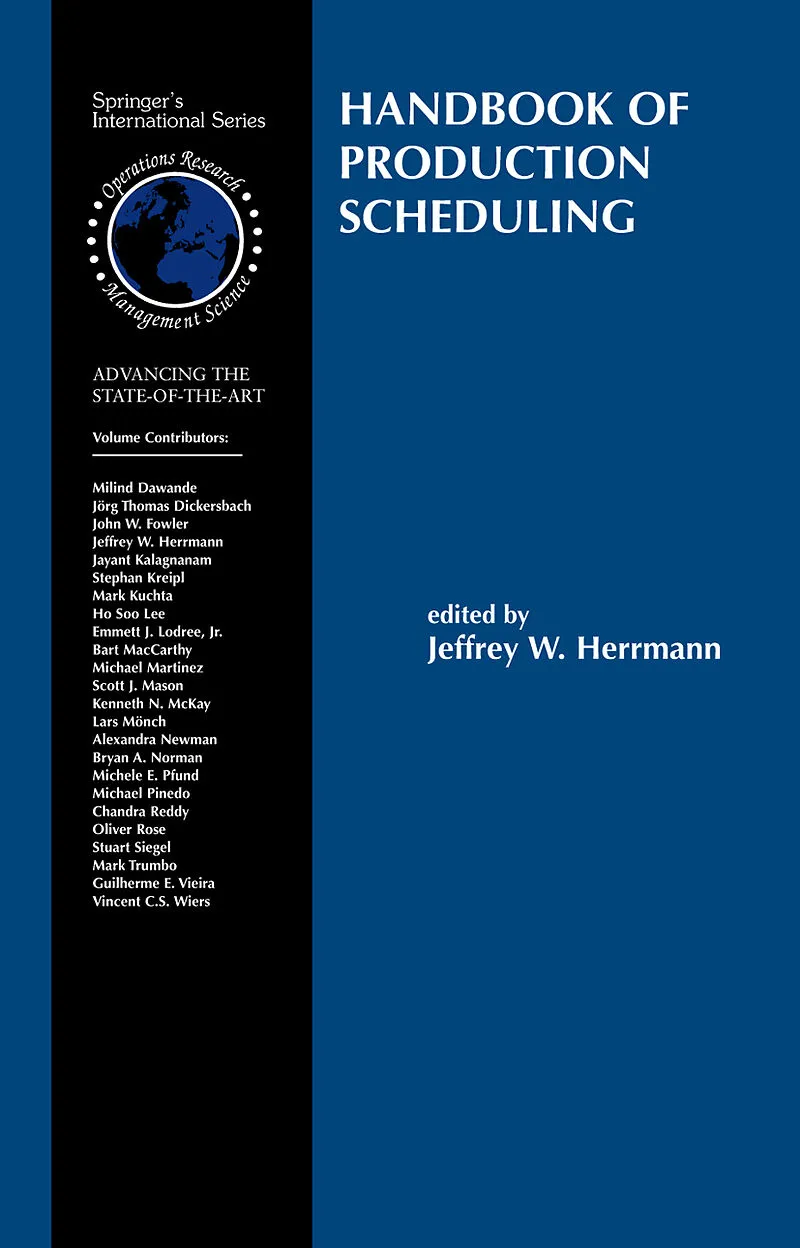
This book concentrates on real-world production scheduling in factories and industrial settings. It includes industry case studies that use innovative techniques as well as academic research results that can be used to improve production scheduling. Its purpo...
This book concentrates on real-world production scheduling in factories and industrial settings. It includes industry case studies that use innovative techniques as well as academic research results that can be used to improve production scheduling. Its purpose is to present scheduling principles, advanced tools, and examples of innovative scheduling systems to persons who could use this information to improve their own production scheduling. The intended audience includes: production and plant managers, industrial engineers, operations research practitioners, advanced undergraduate/ graduate students and faculty studying and doing research in operations research and industrial engineering.
Scheduling is a basic core research stream in OR that is applied across a variety of discipline domains including Engineering, Computer Science, Production Operations, Manufacturing, and other areas. The handbook's emphasis on "real world" problems and practice will be its key selling point There are a variety of scheduling texts and handbooks that stress the theoretical and mathematical models of scheduling, including Michael Pinedo's Scheduling textbook and Joseph Leung's Handbook of Scheduling. This book will stress the results from real-world scheduling, case studies of innovative scheduling practice and techniques, etc. Outlines four important roles for simulation when improving production scheduling: generating schedules, evaluating parameter settings, emulating a scheduling system, and evaluating deterministic scheduling approaches System-level issues are discussed that are relevant to production scheduling as well as their importance in modern manufacturing organizations Of specific interest is the state-of-the-art in production scheduling of semiconductor wafer fabrication facilities and the difficulty of their complex flow processes Includes supplementary material: sn.pub/extras
Autorentext
Jeffrey W. Herrmann, PhD., is a Professor at the University of Maryland, where he holds a joint appointment with the Department of Mechanical Engineering and the Institute for Systems Research. He is a member of Society of Catholic Scientists, IISE, ASME, and the Design Society. He is an associate editor for the ASME Journal of Autonomous Vehicles and Systems. In 2012 he and Gino Lim were the conference chairs for the Industrial and Systems Engineering Research Conference.Dr. Herrmann earned his B.S. in applied mathematics from Georgia Institute of Technology. As a National Science Foundation Graduate Research Fellow from 1990 to 1993, he received his Ph.D. in industrial and systems engineering from the University of Florida. His dissertation investigated production scheduling problems motivated by semiconductor manufacturing. He held a post-doctoral research position in the Institute for Systems Research from 1993 to 1995.Dr. Herrmann's research, service, and teaching activities have established him as a leader in the following areas: (1) developing novel mathematical models to improve public health preparedness, (2) describing and modeling engineering design decision-making processes, and (3) using risk-based techniques to improve path planning for autonomous systems. Through February 2023, he has published over 140 journal papers and refereed conference papers and fifteen book chapters, co-authored an engineering design textbook, edited two handbooks, and authored a textbook on engineering decision making and risk management. Dr. Herrmann and his colleagues have been awarded over $34 million in research contracts and grants, including research awards from NSF, Amazon, the Naval Air Warfare Center, the Air Force Research Laboratory, and the Army Research Laboratory. He has advised over 50 Ph.D. dissertations and M.S. theses. In 2003, Dr. Herrmann received the Society of Manufacturing Engineers Jiri Tlusty Outstanding Young Manufacturing Engineer Award; in 2013, he was named a Diplomate of the Society for Health Systems. In 2016, his textbook won the IIE/Joint Publishers Book of the Year award.
Klappentext
The HANDBOOK OF PRODUCTION SCHEDULING concentrates on real-world production scheduling in factories and industrial settings. It includes industry case studies that use innovative techniques as well as academic research results that can be used to improve real-world production scheduling. Its purpose is to present scheduling principles, advanced tools, and examples of innovative scheduling systems to persons who could use this information to improve production scheduling in their own organization. The intended audience includes: production and plant managers, industrial engineers, operations research practitioners, advanced undergraduate/ graduate students and faculty studying and doing research in operations research and industrial engineering. The handbook provides a range and variety of real-world scheduling issues and analyses. Some of the areas covered are as follows: production scheduling processes as complex decision-making systems; the key concepts in master production scheduling and the techniques that are useful for finding better solutions; practical approaches to important supply chain scheduling problems; the use of mathematical programming to solve large production scheduling problems at one of the world's largest mines; guidelines for work-rest scheduling, personnel scheduling, job rotation scheduling, cross-training, as well as group and team work. The motivation for this book is the desire to bridge the gap between scheduling theory and practice. Therefore, these practical analyses are provided to help researchers and students solve scheduling problems by focusing on real world scheduling systems that will benefit from improvement.
Inhalt
A History of Production Scheduling.- The Human Factor in Planning and Scheduling.- Organizational, Systems and Human Issues in Production Planning, Scheduling and Control.- Decision-Making Systems in Production Scheduling.- Scheduling and Simulation.- Rescheduling Strategies, Policies, and Methods.- A Practical View of the Complexity in Developing Master Production Schedules: Fundamentals, Examples, and Implementation.- Coordination Issues in Supply Chain Planning and Scheduling.- Semiconductor Manufacturing Scheduling and Dispatching.- The Slab Design Problem in the Steel Industry.- A Review of Long- and Short-Term Production Scheduling at Lkab's Kiruna Mine.- Scheduling Models for Optimizing Human Performance and Well-Being.
Tief- preis