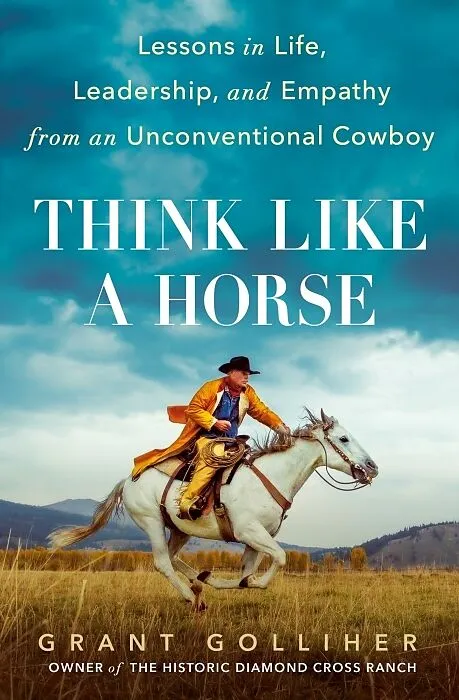
Think Like a Horse
Beschreibung
“Watching Grant at his horse whispering demonstration for nearly an hour was an extraordinary and mesmerizing experience. I was deeply touched spiritually and it moved me for days afterward.” —Kathie Lee Gifford “Grant Golliher’s ...Format auswählen
- Fester EinbandCHF 35.60
Wird oft zusammen gekauft
Andere Kunden kauften auch
Beschreibung
“Watching Grant at his horse whispering demonstration for nearly an hour was an extraordinary and mesmerizing experience. I was deeply touched spiritually and it moved me for days afterward.” —Kathie Lee Gifford
“Grant Golliher’s example and the lessons captured in this masterful collection of stories have produced a profound impact in my life. Over the years, his wisdom has inspired me to become a better family member, a more effective business executive and a committed servant leader in higher education. The culmination of these lessons have been brilliantly brought to life in this book, and offer the potential to every reader to find a better version of themselves waiting to be discovered.” —Brad D. Smith, President, Marshall University and former CEO, Intuit
“Executives can read about the principles of good leadership and team building. They can attend conferences or hire coaches. But spending an hour watching a horse whisperer bond with and gain the cooperation of a wild, 1,000-pound horse can bring home important leadership lessons in an immediate, profound way.” *—Jeanne Sahadi, CNN Business*
Autorentext
Grant Golliher is a horseman and proprietor of the historic Diamond Cross Ranch in Jackson Hole, Wyoming, where he has shown corporate executives, coaches, celebrities, and families from all around the world the skills necessary to tame troubled horses and become leaders and better people.
Klappentext
In Think Like a Horse, veteran "horse whisperer" and communication expert Grant Golliher applies his hard-won horse sense to teach invaluable lessons anyone can use to live a fuller, more successful life.
Grant Golliher is what some would call a "horse whisperer," able to get a wild horse to calmly accept a saddle and a rider in just hours without the use of force. Through training thousands of horses, many traumatized or abused, Golliher was able to learn essential lessons about communication, boundaries, fairness, trust, and respect to foster more fulfilled relationships, and in turn, create a richer life. It's why celebrities, Fortune 500 executives, professional coaches, supreme court justices, and even ordinary families from around the world flock to his Wyoming ranch every year to take part in "the most transformational experience" they have ever encountered.
Horse whispering may sound like magic, but as Grant explains in Think Like a Horse, it's not really all that mysterious. The lessons he shares are as fundamental and ageless as the relationship between horses, the people who ride them, and the beauty of the West. In fact, it's an approach that anyone can learn, and should learn, in order to better understand our common humanity, overcome trauma, and unlock our untapped potential in virtually every aspect of our lives. All you have to do, is think like a horse.
Zusammenfassung
In Think Like a Horse, veteran “horse whisperer” and leadership expert Grant Golliher applies his hard-won horse sense to teach invaluable lessons anyone can use to live a fuller, more successful life.
Grant Golliher is what some would call a “horse whisperer,” able to get a wild horse to calmly accept a saddle and a rider without the use of force. Through training thousands of horses, many traumatized or abused, Golliher was able to learn essential lessons about communication, boundaries, fairness, trust, and respect—lessons that apply not just to horses but to humans as well. It’s why celebrities, Fortune 500 executives, professional coaches, supreme court justices, and even ordinary families from around the world flock to his Wyoming ranch every year to take part in what one CEO called “the most transformational experience I have ever encountered.”
Horse whispering may sound like magic, but as Grant explains in Think Like a Horse, it’s not really all that mysterious. The lessons he shares are as fundamental and ageless as the relationship between horses, the people who ride them, and the beauty of the West. In fact, it’s an approach that anyone can learn, and should learn, in order to better understand our common humanity, overcome trauma, foster more fulfilled relationships, and unlock untapped potential in virtually every aspect of our lives. All you have to do is think like a horse.
Leseprobe
CHAPTER ONE
 
You Can't Lie to a Horse
 
No philosophers so thoroughly comprehend us as dogs and horses.
 
They see through us at a glance.
 
-Herman Melville
 
The galloping hoofbeats slowed and came to a halt. The frightened young horse had stopped running around the pen and turned toward the middle, where I stood. I could hear his heavy breathing and smell the sweat that streaked his rich chestnut coat-the inspiration for the name we'd given him, Wildfire. Not long ago, he'd been living wild with a herd of mustangs, never touched by a human hand. Now it was up to me to teach him how to live and work with people so that he could be adopted into a good home.
 
"He's considering that maybe I'm not so scary after all," I told the group of people watching from the fence. "I can't force him to trust me; he has to decide to do that for himself. I want him to choose to face his fear, rather than fleeing. So what I'm doing is making the right thing easy and the wrong thing difficult. Running away is hard work. Coming to be with me is easy. He can rest here in the middle."
 
The horse hadn't quite realized this yet, but I noted that his expression had changed. His wild eyes were softening, and he was lowering his head, a sign of submission. Soon, I could tell, he'd be ready to walk slowly toward me, and I'd feel his warm breath as he reached out his head to sniff me. I knelt down in the dirt, making myself as small and unthreatening as possible. He'd shown respect to me, so now it was time for me to show humility to him, to release the pressure and indicate that I was not a predator.
 
As I waited for the colt to take those first tentative steps of trust, something on the other side of the pen caught my attention. Standing by the fence was a young cowboy, tears streaming down his handsome face.
 
Jeremy Morris was our first employee at Diamond Cross Ranch, and at that point he'd been working for us for just a couple of weeks-or rather, as my wife, Jane, and I liked to joke, we'd been working for him. A born leader with natural confidence and charisma, Jeremy was the kind of guy people loved to be around and were quick to follow. But he didn't take direction easily. Not long after he began working for us, I asked him to ride a horse I'd recently gotten in a trade.
 
"Don't tie him up tight," I warned. I'd already learned that this triggered panic in the horse. He would pull back violently, fighting the rope and risking injury to himself and anyone around him. But Jeremy didn't listen, and that horse freaked out. He reared up, breaking the rope, and then flipped over backward, scuffing up Jeremy's saddle. Luckily no one was hurt, but they could have been.
 
Jeremy was good at his job, but he'd always push the boundaries. He'd show up tired for work because he'd been out partying the night before. Still, he was talented with the horses and cows (and great with our corporate clients, who thought he looked like a Western movie star in his buckaroo outfit and silk necktie). The other ranch hands liked him, and our kids adored him. So we tried to make it work. Jane and I were inexperienced leaders ourselves at that time, so I'm sure we made our share of mistakes.
 
Jeremy had been around horses his whole life and had come to us because he wanted to learn my training methods. Like me, he'd b…