Beschreibung
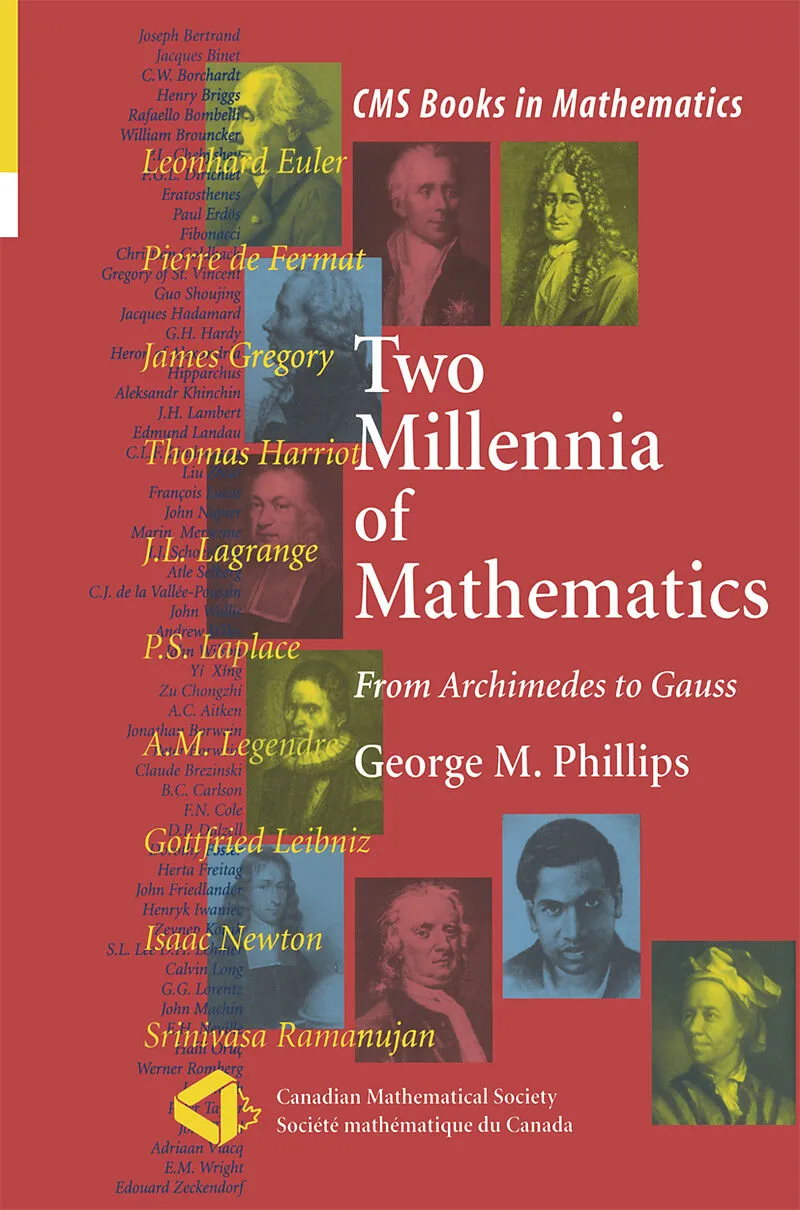
A collection of inter-connected topics in areas of mathematics which particularly interest the author, ranging over the two millennia from the work of Archimedes to the "Werke" of Gauss. The book is intended for those who love mathematics, including ...A collection of inter-connected topics in areas of mathematics which particularly interest the author, ranging over the two millennia from the work of Archimedes to the "Werke" of Gauss. The book is intended for those who love mathematics, including undergraduate students of mathematics, more experienced students and the vast unseen host of amateur mathematicians. It is equally a useful source of material for those who teach mathematics.
This book is intended for those who love mathematics, including under graduate students of mathematics, more experienced students, and the vast number of amateurs, in the literal sense of those who do something for the love of it. I hope it will also be a useful source of material for those who teach mathematics. It is a collection of loosely connected topics in areas of mathematics that particularly interest me, ranging over the two millennia from the work of Archimedes, who died in the year 212 Be, to the Werke of Gauss, who was born in 1777, although there are some references outside this period. In view of its title, I must emphasize that this book is certainly not pretending to be a comprehensive history of the mathematics of this period, or even a complete account of the topics discussed. However, every chapter is written with the history of its topic in mind. It is fascinating, for example, to follow how both Napier and Briggs constructed their log arithms before many of the most relevant mathematical ideas had been discovered. Do I really mean "discovered"? There is an old question, "Is mathematics created or discovered?" Sometimes it seems a shame not to use the word "create" in praise of the first mathematician to write down some outstanding result. Yet the inner harmony that sings out from the best of mathematics seems to demand the word "discover.
Autorentext
George Phillips has lectured and researched in mathematics at the University of St. Andrews, Scotland. His most recent book, Two Millenia of Mathematics: From Archimedes to Gauss (Springer 2000), received enthusiastic reviews in the USA, Britain and Canada. He is well known for his clarity of writing and his many contributions as a researcher in approximation theory.
Zusammenfassung
The book is intended for those who love mathematics, including undergraduate students of mathematics, more experienced students and the vast unseen host of amateur mathematicians.
Inhalt
1 From Archimedes to Gauss.- 1.1 Archimedes and Pi.- 1.2 Variations on a Theme.- 1.3 Playing a Mean Game.- 1.4 Gauss and the AGM.- 2 Logarithms.- 2.1 Exponential Functions.- 2.2 Logarithmic Functions.- 2.3 Napier and Briggs.- 2.4 The Logarithm as an Area.- 2.5 Further Historical Notes.- 3 Interpolation.- 3.1 The Interpolating Polynomial.- 3.2 Newton's Divided Differences.- 3.3 Finite Differences.- 3.4 Other Differences.- 3.5 Multivariate Interpolation.- 3.6 The Neville-Aitken Algorithm.- 3.7 Historical Notes.- 4 Continued Fractions.- 4.1 The Euclidean Algorithm.- 4.2 Linear Recurrence Relations.- 4.3 Fibonacci Numbers.- 4.4 Continued Fractions.- 4.5 Historical Notes.- 5 More Number Theory.- 5.1 The Prime Numbers.- 5.2 Congruences.- 5.3 Quadratic Residues.- 5.4 Diophantine Equations.- 5.5 Algebraic Integers.- 5.6 The equation x3 + y3 = z3.- 5.7 Euler and Sums of Cubes.- References.