Beschreibung
There have been many books on Dynamical Astronomy up to now. Many are devoted to Celestial Mechanics, but there are also several books on Stellar and Galactic Dynamics. The first books on stellar dynamics dealt mainly with the statistics of stellar motions (e....There have been many books on Dynamical Astronomy up to now. Many are devoted to Celestial Mechanics, but there are also several books on Stellar and Galactic Dynamics. The first books on stellar dynamics dealt mainly with the statistics of stellar motions (e. g. Smart's "Stellar Dynamics" (1938), or Trumpler and Weaver's "Statistical Astronomy" (1953)). A classical book in this field is Chandrasekhar's "Principles of Stellar Dynamics" (1942) that dealt mainly with the time of relaxation, the solutions of Liouville's equation, and the dynamics of clusters. In the Dover edition of this book (1960) an extended Appendix was added, containing the statistical mechanics of stellar systems, a quite "modern" subject at that time. The need for a classroom book was covered for several years by the book of Mihalas and Routly "Galactic Astronomy" (1969). But the most complete book in this field is Binney and Tremaine's "Galactic Dynamics" (1987). This book covers well the classical topics of stellar dynamics, and many subjects of current interest. Another classical book in dynamical astronomy is the extensive 4-Volume treatise of Hagihara "Celestial Mechanics" (1970, 1972, 1974, 1975). In more recent years much progress has been made on new topics that are of vital interest for stellar and galactic dynamics. The main new topic is Chaos. The progress of the theory of chaos has influenced considerably the area of stellar and galactic dynamics. The study of order and chaos has provided a new dimension in dynamics.
Comprehensive book on galactic dynamics and the application of the concepts of dynamical systems theory to astrophysics since more than a decade Includes supplementary material: sn.pub/extras
Klappentext
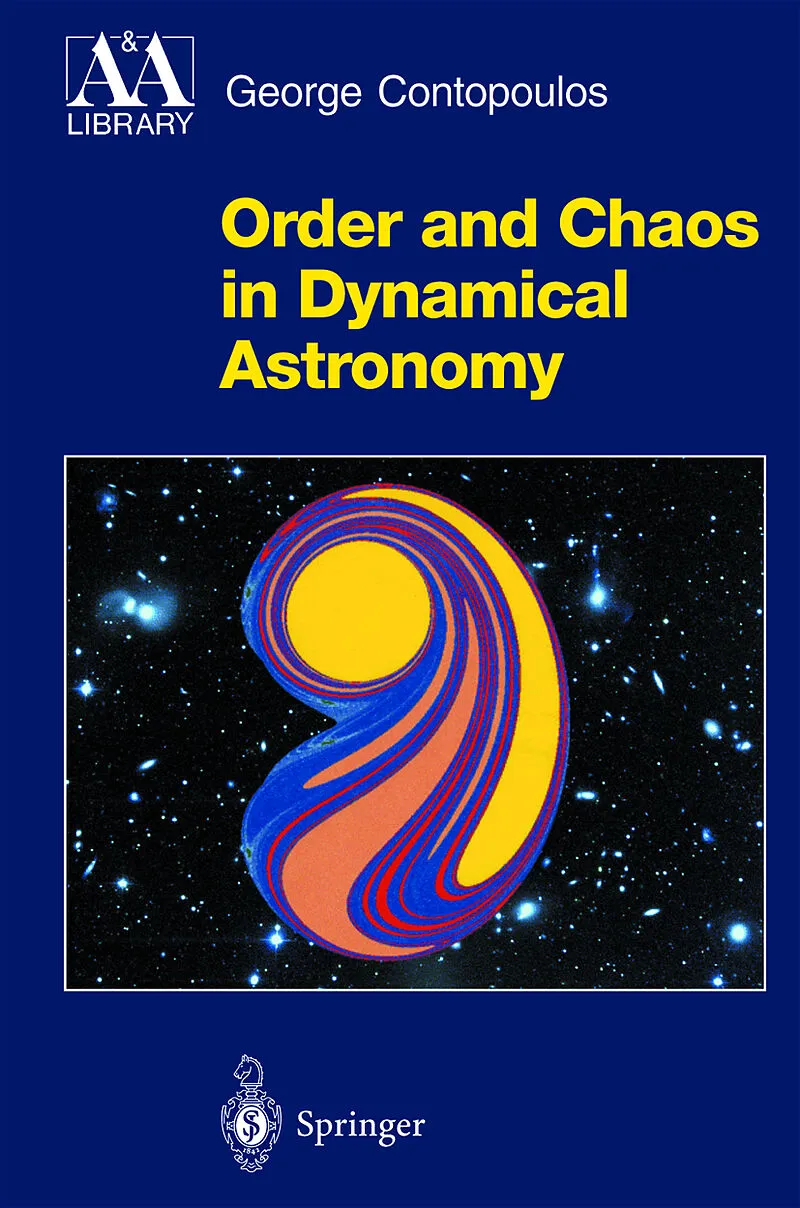
The study of orbits in dynamical systems and the theory of order and chaos has progressed enormously over the last few decades. It thus became an essential tool in dynamical astronomy. The book is the first to provide a general overview of order and chaos in dynamical astronomy. The progress of the theory of chaos has a profound impact on galactic dynamics. It has even invaded celestial mechanics, since chaos was found in the solar system which in the past was considered as a prototype of order. The book provides a unifying approach to these topics from an author who has spent more than 50 years of research in the field. The first part treats order and chaos in general. The other two parts deal with order and chaos in galaxies and with other applications in dynamical astronomy, ranging from celestial mechanics to general relativity and cosmology. This book, addressing especially the astrophysics, is also written as a textbook on dynamical systems for students in physics.
Inhalt
From the contents: Historical Introduction.- Order and Chaos in General.- Terminology and Classification of Dynamical Systems.- Integrable Systems.- Third Integral.- Periodic Orbits.- Systems of Two Degrees of Freedom.- Transition from Order to Chaos.- The Last KAM Torus.- Large Perturbations.- Systems with Escapes.- Dynamical Spectra.- Systems of Three Degrees of Freedom.- Systems of N-Degrees of Freedom.- Fractals.- Order and Chaos in Galaxies.- Orbits in the Plane of Symmetry of a Galaxy.- Orbits in 3-D Galaxies.- Theoretical Orbits in Galaxies.- Self-Consistent Models.- N-Body Systems.- Dynamical Spectra of Galaxies.- Other Applications in Dynamical Astronomy.- Order and Chaos in the Solar System.- Relativistic Chaos.- Chaotic Cosmology.- Appendix A: A Particular Application of the Painleve Test.- Appendix B: Construction of an Integrable System with Higher Order Islands.- References.- Index.