Beschreibung
Itgivesmegreatpleasuretoeditthisbook. Thegenesisofthisbookgoes backtotheconferenceheldattheUniversityofBolognainJune1999,on collaborativeworkbetweentheUniversityofCaliforniaatBerkeleyandthe UniversityofBologna. Theoriginalideawastoinvitesomespeakersatthe confe...Itgivesmegreatpleasuretoeditthisbook. Thegenesisofthisbookgoes backtotheconferenceheldattheUniversityofBolognainJune1999,on collaborativeworkbetweentheUniversityofCaliforniaatBerkeleyandthe UniversityofBologna. Theoriginalideawastoinvitesomespeakersatthe conferencetosubmitarticlestothebook. Thescopeofthebookwaslater- hancedand,inthepresentform,itisacompilationofsomeoftherecentwork usinggeometricpartialdi?erentialequationsandthelevelsetmethodology inmedicalandbiomedicalimageanalysis. Thesynopsisofthebookisasfollows:Inthe?rstchapter,R. Malladi andJ. A. Sethianpointtotheoriginsoftheuseoflevelsetmethodsand geometricPDEsforsegmentation,andpresentfastmethodsforshapes- mentationinbothmedicalandbiomedicalimageapplications. InChapter 2,C. OrtizdeSolorzano,R. Malladi,andS. J. Lockettdescribeabodyof workthatwasdoneoverthepastcoupleofyearsattheLawrenceBerkeley NationalLaboratoryonapplicationsoflevelsetmethodsinthestudyand understandingofconfocalmicroscopeimagery. TheworkinChapter3byA. Sarti,C. Lamberti,andR. Malladiaddressestheproblemofunderstanding di?culttimevaryingechocardiographicimagery. Thisworkpresentsvarious levelsetmodelsthataredesignedto?tavarietyofimagingsituations,i. e. timevarying2D,3D,andtimevarying3D. InChapter4,L. VeseandT. F. Chanpresentasegmentationmodelwithoutedgesandalsoshowextensions totheMumford-Shahmodel. Thismodelisparticularlypowerfulincertain applicationswhencomparisonsbetweennormalandabnormalsubjectsis- quired. Next,inChapter5,A. EladandR. Kimmelusethefastmarching methodontriangulateddomaintobuildatechniquetounfoldthecortexand mapitontoasphere. Thistechniqueismotivatedinpartbynewadvances infMRIbasedneuroimaging. InChapter6,T. DeschampsandL. D. Cohen presentaminimalpathbasedmethodofgroupingconnectedcomponentsand showcleverapplicationsinvesseldetectionin3Dmedicaldata. Finally,in Chapter7,A. Sarti,K. Mikula,F. Sgallari,andC. Lamberti,describean- linearmodelfor?lteringtimevarying3Dmedicaldataandshowimpressive resultsinbothultrasoundandechoimages. IoweadebtofgratitudetoClaudioLambertiandAlessandroSartifor invitingmetoBologna,andlogisticalsupportfortheconference. Ithank thecontributingauthorsfortheirenthusiasmand?exibility,theSpringer mathematicseditorMartinPetersforhisoptimismandpatience,andJ. A. Sethianforhisunfailingsupport,goodhumor,andguidancethroughthe years. Berkeley,California R. Malladi October,2001 Contents 1 FastMethodsforShapeExtractioninMedicaland BiomedicalImaging. . . . . . . . . . . . . . . . . . . . . . . . . . . . . . . . . . . . . . . . . . . 1 R. Malladi,J. A. Sethian 1. 1Introduction. . . . . . . . . . . . . . . . . . . . . . . . . . . . . . . . . . . . . . . . . . . . . . . . 1 1. 2TheFastMarchingMethod. . . . . . . . . . . . . . . . . . . . . . . . . . . . . . . . . . . 3 1. 3ShapeRecoveryfromMedicalImages. . . . . . . . . . . . . . . . . . . . . . . . . . 6 1. 4Results. . . . . . . . . . . . . . . . . . . . . . . . . . . . . . . . . . . . . . . . . . . . . . . . . . . . . 10 References. . . . . . . . . . . . . . . . . . . . . . . . . . . . . . . . . . . . . . . . . . . . . . . . . . . . . 13 2 AGeometricModelforImageAnalysisinCytology. . . . . . . 19 C. OrtizdeSolorzano,R. Malladi,,S. J. Lockett 2. 1Introduction. . . . . . . . . . . . . . . . . . . . . . . . . . . . . . . . . . . . . . . . . . . . . . . . 19 2. 2GeometricModelforImageAnalysis. . . . . . . . . . . . . . . . . . . . . . . . . . . 20 2. 3SegmentationofNuclei. . . . . . . . . . . . . . . . . . . . . . . . . . . . . . . . . . . . . . . 22 2. 4SegmentationofNucleiandCellsUsingMembrane-RelatedProtein Markers. . . . . . . . . . . . . . . . . . . . . . . . . . . . . . . . . . . . . . . . . . . . . . . . . . . . 31 2. 5Conclusions. . . . . . . . . . . . . . . . . . . . . . . . . . . . . . . . . . . . . . . . . . . . . . . . . 37 References. . . . . . . . . . . . . . . . . . . . . . . . . . . . . . . . . . . . . . . . . . . . . . . . . . . . . 38 3 LevelSetModelsforAnalysisof2Dand3D EchocardiographicData. . . . . . . . . . . . . . . .
Visualization has become increasingly important for many types of biomedial applications This book collects the latest results in the development of visualization methods in this field Includes supplementary material: sn.pub/extras
Klappentext
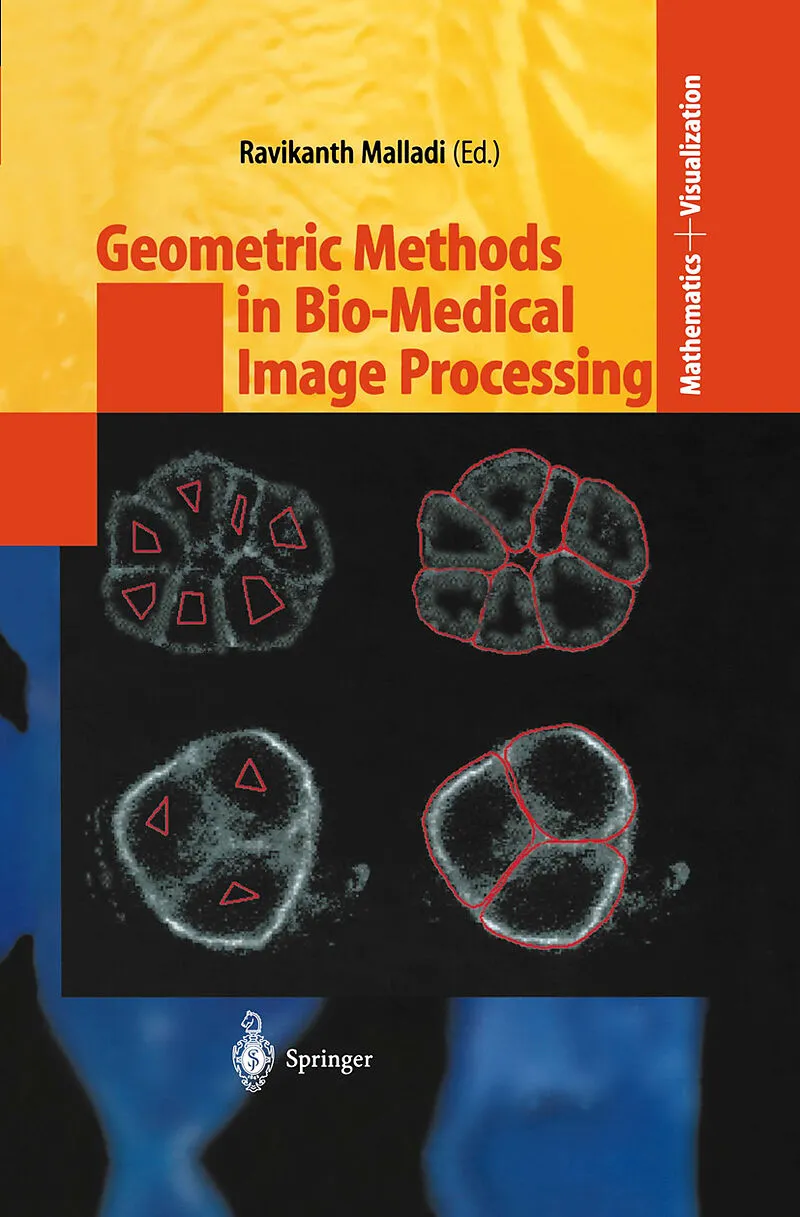
The genesis of this book goes back to the conference held at the University of Bologna, June 1999, on collaborative work between the University of California at Berkeley and the University of Bologna. The book, in its present form, is a compilation of some of the recent work using geometric partial differential equations and the level set methodology in medical and biomedical image analysis.The book not only gives a good overview on some of the traditional applications in medical imagery such as, CT, MR, Ultrasound, but also shows some new and exciting applications in the area of Life Sciences, such as confocal microscope image understanding.
Zusammenfassung
From the reviews:
R. Malladi (ed.)
Geometric Methods in Bio-Medical Image Processing
"This is an excellent monograph on geometric methods in biomedical image processing. I strongly recommend this book to visualization experts in mathematics, computer science and bio-medical applications and to research students on above topics."-JOURNAL OF COMPUTATIONAL METHODS IN APPLIED MATHEMATICS
"This book is based on the conference held at the University of Bologna at June 1999. ... The book gives a good review on some of the traditional applications in medical imagery (CT, MR, Ultrasound). ... This is an excellent monograph on geometric methods in biomedical image processing. I strongly recommend this book to visualization experts in mathematics, computer science and bio-medical applications and to research students on the above topics." (T. E. Simos, Journal of Computational Methods in Sciences and Engineering, Vol. 3 (2), 2003)
Inhalt
1 Fast Methods for Shape Extraction in Medical and Biomedical Imaging.- 1.1 Introduction.- 1.2 The Fast Marching Method.- 1.3 Shape Recovery from Medical Images.- 1.4 Results.- References.- 2 A Geometric Model for Image Analysis in Cytology.- 2.1 Introduction.- 2.2 Geometric Model for Image Analysis.- 2.3 Segmentation of Nuclei.- 2.4 Segmentation of Nuclei and Cells Using Membrane-Related Protein Markers.- 2.5 Conclusions.- References.- 3 Level Set Models for Analysis of 2D and 3D Echocardiographic Data.- 3.1 Introduction.- 3.2 The Geometric Evolution Equation.- 3.3 The Shock-Type Filtering.- 3.4 Shape Extraction.- 3.5 2D Echocardiography.- 3.6 2D + time Echocardiography.- 3.7 3D Echocardiography.- 3.8 3D + time Echocardiography.- 3.9 Conclusions.- References.- 4 Active Contour and Segmentation Models using Geometric PDE's for Medical Imaging.- 4.1 Introduction.- 4.2 Description of the Models.- 4.3 Applications to Bio-Medical Images.- 4.4 Concluding Remarks.- References.- 5 Spherical Flattening of the Cortex Surface.- 5.1 Introduction.- 5.2 Fast Marching Method on Triangulated Domains.- 5.3 Multi-Dimensional Scaling.- 5.4 Cortex Unfolding.- 5.5 Conclusions.- References.- 6 Grouping Connected Components using Minimal Path Techniques.- 6.1 Introduction.- 6.2 Minimal Paths in 2D and 3D.- 6.3 Finding Contours from a Set of Connected Components Rk.- 6.4 Finding a Set of Paths in a 3D Image.- 6.5 Conclusion.- References.- 7 Nonlinear Multiscale Analysis Models for Filtering of 3D + Time Biomedical Images.- 7.1 Introduction.- 7.2 Nonlinear Diffusion Equations for Processing of 2D and 3D Still*Images.- 7.3 Space-Time Filtering Nonlinear Diffusion Equations.- 7.4 Numerical Algorithm.- 7.5 Discussion on Numerical Experiments.- 7.6 Preconditioning and Solving of Linear Systems.-References.- Appendix. Color Plates.