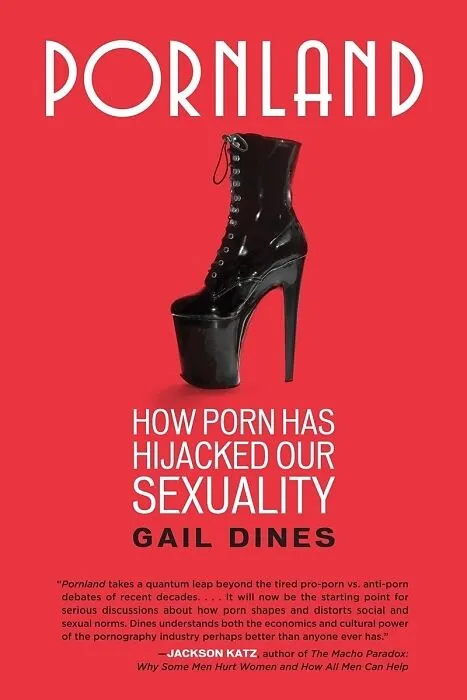
Pornland: How Porn Has Hijacked Our Sexuality
Beschreibung
Informationen zum Autor Gail Dines Klappentext Astonishingly, the average age of first viewing porn is now 11.5 years for boys, and with the advent of the Internet, it's no surprise that young people are consuming more porn than ever. And, as Gail Dines shows,...Format auswählen
- Poche format BCHF 19.50
- E-Book (epub)CHF 18.90

Wird oft zusammen gekauft
Andere Kunden kauften auch
Beschreibung
Informationen zum Autor Gail Dines Klappentext Astonishingly, the average age of first viewing porn is now 11.5 years for boys, and with the advent of the Internet, it's no surprise that young people are consuming more porn than ever. And, as Gail Dines shows, today's porn is strikingly different from yesterday's Playboy. As porn culture has become absorbed into pop culture, a new wave of entrepreneurs are creating porn that is even more hard-core, violent, sexist, and racist. Proving that porn desensitizes and actually limits our sexual freedom, Dines argues its omnipresence is a public health concern we can no longer ignore. Leseprobe From Chapter Six, "Growing Up Female in a Porn Culture" In her excellent book on body image and food, feminist philosopher Susan Bordo looks at the ways the culture helps shape women's ideas about what constitutes the perfect body. The bodies of the women we see in magazines and on television are actually very unusual in their measurements and proportions, with long necks, broad shoulders, and high waists. Yet because these are more or less the only images we see, we take them to be the norm rather than the exception and assume that the problem lies with us and not the fashion and media industries that insist on using a very specific body type. This is what the media do: they take the abnormal body and make it normal by virtue of its visibility, while making the normal bodies of real women look abnormal by virtue of their invisibility. The result is a massive image disorder on the part of society. Since we all develop notions of ourselves from cultural messages and images, it would seem that a truly disordered female is one who actually likes her body. Bordo's discussion of the way culture shapes notions of the body asks us to rethink the idea that women with eating disorders are somehow deviants. Women who starve themselves are actually overconforming to the societal message about what constitutes female perfection. They have taken in the messages and come to what looks like a very reasonable conclusion: thin women are prized in this culture, I want to be prized, and therefore I need to be thin, which means that I can't eat. How can it be any different in a world where anorexic-looking women such as Kate Moss, Victoria Beckham, Mary Kate Olsen, and Lindsay Lohan are praised by the celebrity magazines for their look? I do not mean to be glib here about the devastating effects of starving one's body. I have seen many students with a long list of health problems due to long-term starvation. But somewhere in this discussion, we need to see the society as pathological rather than the adolescent girl in the hospital ward who is being diagnosed with multiple disorders. Many of the young women I have spoken to who have been hospitalized for eating disorders talk about all the new tricks they learned from fellow patients for losing weight even faster. Not many talk about their hospitalizations in terms of recovery. While many of these young women end up hospitalized for complex reasons, the cultural obsession with female thinness has to figure in somewhere for most of them. Yet these recovery programs do not have classes on media literacy and cultural constructions of gender or rap sessions on resisting sexist imagery. Instead the focus is squarely on the individual female and her assumed psychological problems, which somehow dropped from the sky. One story that demonstrates the cultural components of this so-called individual disorder is writer Abra Chernik's experience of having a day out from the hospital, where she is being treated for anorexia.13 Close to death, Chernik goes to the mall and takes a fat test at a sporting goods store. She learns she is this week's winner, with the lowest percentage of body fat, and everyone in the store breaks into applause. Chernik then returns to the hospital, where she is meant to re...
Autorentext
Gail Dines
Klappentext
Astonishingly, the average age of first viewing porn is now 11.5 years for boys, and with the advent of the Internet, it's no surprise that young people are consuming more porn than ever. And, as Gail Dines shows, today's porn is strikingly different from yesterday's Playboy. As porn culture has become absorbed into pop culture, a new wave of entrepreneurs are creating porn that is even more hard-core, violent, sexist, and racist. Proving that porn desensitizes and actually limits our sexual freedom, Dines argues its omnipresence is a public health concern we can no longer ignore.
Leseprobe
From Chapter Six, "Growing Up Female in a Porn Culture"
In her excellent book on body image and food, feminist philosopher Susan Bordo looks at the ways the culture helps shape women’s ideas about what constitutes the perfect body. The bodies of the women we see in magazines and on television are actually very unusual in their measurements and proportions, with long necks, broad shoulders, and high waists. Yet because these are more or less the only images we see, we take them to be the norm rather than the exception and assume that the problem lies with us and not the fashion and media industries that insist on using a very specific body type. This is what the media do: they take the abnormal body and make it normal by virtue of its visibility, while making the normal bodies of real women look abnormal by virtue of their invisibility. The result is a massive image disorder on the part of society. Since we all develop notions of ourselves from cultural messages and images, it would seem that a truly disordered female is one who actually likes her body.
Bordo’s discussion of the way culture shapes notions of the body asks us to rethink the idea that women with eating disorders are somehow deviants. Women who starve themselves are actually overconforming to the societal message about what constitutes female perfection. They have taken in the messages and come to what looks like a very reasonable conclusion: thin women are prized in this culture, I want to be prized, and therefore I need to be thin, which means that I can’t eat. How can it be any different in a world where anorexic-looking women such as Kate Moss, Victoria Beckham, Mary Kate Olsen, and Lindsay Lohan are praised by the celebrity magazines for their “look”? I do not mean to be glib here about the devastating effects of starving one’s body. I have seen many students with a long list of health problems due to long-term starvation. But somewhere in this discussion, we need to see the society as pathological rather than the adolescent girl in the hospital ward who is being diagnosed with multiple disorders.
Many of the young women I have spoken to who have been hospitalized for eating disorders talk about all the new tricks they learned from fellow patients for losing weight even faster. Not many talk about their hospitalizations in terms of recovery. While many of these young women end up hospitalized for complex reasons, the cultural obsession with female thinness has to figure in somewhere for most of them. Yet these recovery programs do not have classes on media literacy and cultural constructions of gender or rap sessions on resisting sexist imagery. Instead the focus is squarely on the individual female and her assumed psychological problems, which somehow dropped from the sky. One story that demonstrates the cultural components of this so-called individual disorder is writer Abra Chernik’s experience of having a day out from the hospital, where she is being treated for anorexia.13 Close to death, Chernik goes to the mall and takes a “fat test” at a sporting goods store. She learns she is this week’s winner, with the lowest percentage of body fat, and everyone in the store breaks into applause. Chernik then returns to the hospital, where she is meant to recover wi…