
IHR WARENKORB IST AKTUELL LEER.
Haben Sie noch nichts passendes gefunden? Stöbern Sie durch unser komplettes Sortiment.
Oder melden Sie sich an bzw. registrieren Sie sich.
- Kostenlose Lieferung
- Kauf auf Rechnung
- Ex Libris Tiefpreis
- Filiallieferung und 650+ Abholorte
- Rabatt-Bons als Club-Mitglied
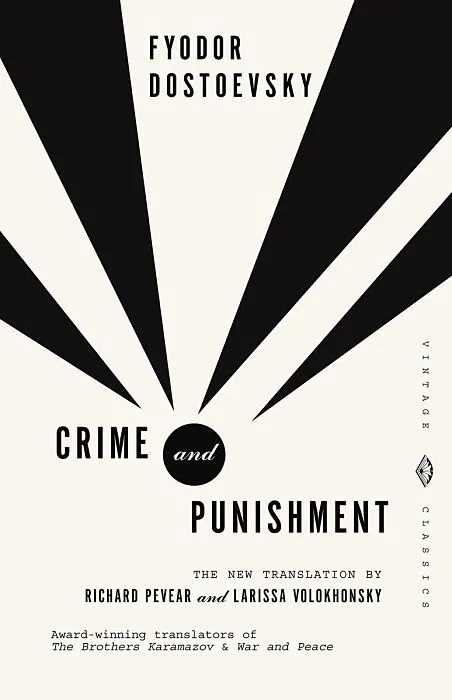
Crime and Punishment
Beschreibung
Zusatztext The best [translation of Crime and Punishment ] currently availableAn especially faithful re-creationwith a coiled-spring kinetic energyDon't miss it. Washington Post Book World This fresh! new translationprovides a more exact! idiomatic! and contem...Format auswählen
- Kartonierter EinbandCHF 24.80

Wird oft zusammen gekauft
Andere Kunden kauften auch
Beschreibung
Zusatztext The best [translation of Crime and Punishment ] currently availableAn especially faithful re-creationwith a coiled-spring kinetic energyDon't miss it. Washington Post Book World This fresh! new translationprovides a more exact! idiomatic! and contemporary rendition of the novel that brings Fyodor Dostoevsky's tale achingly aliveIt succeeds beautifully. San Francisco Chronicle Reaches as close to Dostoevsky's Russian as is possible in EnglishThe original's force and frightening immediacy is capturedThe Pevear and Volokhonsky translation will become the standard English version. Chicago Tribune Informationen zum Autor FYODOR MIKAILOVICH DOSTOEVSKY ' s life was as dark and dramatic as the great novels he wrote. He was born in Moscow in 1821. A short first novel, Poor Folk (1846) brought him instant success, but his writing career was cut short by his arrest for alleged subversion against Tsar Nicholas I in 1849. In prison he was given the silent treatment for eight months (guards even wore velvet soled boots) before he was led in front a firing squad. Dressed in a death shroud, he faced an open grave and awaited execution, when suddenly, an order arrived commuting his sentence. He then spent four years at hard labor in a Siberian prison, where he began to suffer from epilepsy, and he returned to St. Petersburg only a full ten years after he had left in chains. His prison experiences coupled with his conversion to a profoundly religious philosophy formed the basis for his great novels. But it was his fortuitous marriage to Anna Snitkina, following a period of utter destitution brought about by his compulsive gambling, that gave Dostoevsky the emotional stability to complete Crime and Punishment (1866), The Idiot (1868-69), The Possessed (1871-72), and The Brothers Karamazov (1879-80). When Dostoevsky died in 1881, he left a legacy of masterworks that influenced the great thinkers and writers of the Western world and immortalized him as a giant among writers of world literature. Klappentext Nominated as one of America's best-loved novels by PBS's The Great American Read With the same suppleness, energy, and range of voices that won their translation of The Brothers Karamazov the PEN/Book-of-the-Month Club Prize, Pevear and Volokhonsky offer a brilliant translation of Dostoevsky's classic novel that presents a clear insight into this astounding psychological thriller. "The best (translation) currently available"--Washington Post Book World. Leseprobe CHAPTER 1 On an exceptionally hot evening early in July a young man came out of the garret in which he lodged in S. Place and walked slowly, as though in hesitation, towards K. Bridge. He had successfully avoided meeting his landlady on the staircase. His garret was under the roof of a high, five-storied house, and was more like a cupboard than a room. The landlady, who provided him with garret, dinners, and attendance, lived on the floor below, and every time he went out he was obliged to pass her kitchen, the door of which invariably stood open. And each time he passed, the young man had a sick, frightened feeling, which made him scowl and feel ashamed. He was hopelessly in debt to his landlady, and was afraid of meeting her. This was not because he was cowardly and abject, quite the contrary; but for some time past, he had been in an over-strained, irritable condition, verging on hypochondria. He had become so completely absorbed in himself, and isolated from his fellows that he dreaded meeting, not only his landlady, but any one at all. He was crushed by poverty, but the anxieties of his position had of late ceased to weigh upon him. He had given up attending to matters of practical importance; he had lost all desire to do so. Nothing that any landlady could do had a real ...
#8220;The best [translation of Crime and Punishment] currently available…An especially faithful re-creation…with a coiled-spring kinetic energy…Don’t miss it.” –Washington Post Book World
“This fresh, new translation…provides a more exact, idiomatic, and contemporary rendition of the novel that brings Fyodor Dostoevsky’s tale achingly alive…It succeeds beautifully.” –San Francisco Chronicle
“Reaches as close to Dostoevsky’s Russian as is possible in English…The original’s force and frightening immediacy is captured…The Pevear and Volokhonsky translation will become the standard English version.”–Chicago Tribune
Autorentext
FYODOR MIKAILOVICH DOSTOEVSKY's life was as dark and dramatic as the great novels he wrote. He was born in Moscow in 1821. A short first novel, Poor Folk (1846) brought him instant success, but his writing career was cut short by his arrest for alleged subversion against Tsar Nicholas I in 1849. In prison he was given the “silent treatment” for eight months (guards even wore velvet soled boots) before he was led in front a firing squad. Dressed in a death shroud, he faced an open grave and awaited execution, when suddenly, an order arrived commuting his sentence. He then spent four years at hard labor in a Siberian prison, where he began to suffer from epilepsy, and he returned to St. Petersburg only a full ten years after he had left in chains.
His prison experiences coupled with his conversion to a profoundly religious philosophy formed the basis for his great novels. But it was his fortuitous marriage to Anna Snitkina, following a period of utter destitution brought about by his compulsive gambling, that gave Dostoevsky the emotional stability to complete Crime and Punishment (1866), The Idiot (1868-69), The Possessed (1871-72), and The Brothers Karamazov (1879-80). When Dostoevsky died in 1881, he left a legacy of masterworks that influenced the great thinkers and writers of the Western world and immortalized him as a giant among writers of world literature.
Klappentext
Nominated as one of America's best-loved novels by PBS's The Great American Read
With the same suppleness, energy, and range of voices that won their translation of The Brothers Karamazov the PEN/Book-of-the-Month Club Prize, Pevear and Volokhonsky offer a brilliant translation of Dostoevsky's classic novel that presents a clear insight into this astounding psychological thriller. "The best (translation) currently available"--Washington Post Book World.
Zusammenfassung
Hailed by Washington Post Book World as “the best [translation] currently available" when it was first published, this second edition of Crime and Punishment has been updated in honor of the 200th anniversary of Dostoevsky’s birth. • ONE OF TIME MAGAZINE'S 100 BEST MYSTERY AND THRILLER BOOKS OF ALL TIME
With the same suppleness, energy, and range of voices that won their translation of The Brothers Karamazov the PEN/Book-of-the-Month Club Prize, Richard Pevear and Larissa Volokhonsky offer a brilliant translation of Crime and Punishment, Dostoevsky's astounding pyschological thriller, newly revised for his bicentenniel.
In Crime and Punishment, when Raskolnikov, an impoverished student living in the St. Petersburg of the tsars, commits an act of murder and theft, he sets into motion a story that is almost unequalled in world literature for its excruciating suspense, its atmospheric vividness, and its depth of characterization and vision. Dostoevsky’s drama of sin, guilt, and redemption transforms the sordid story of an old woman’s murder into the nineteenth century’s profoundest and most compelling philosophical novel.
Leseprobe
CHAPTER 1
On an exceptionally hot evening early in July a young man came out of the garret in which he lodged in S. Place and walked slowly, as though in hesitation, towards K. Bridge.
He had successfully avoided meeting his land…