
IHR WARENKORB IST AKTUELL LEER.
Haben Sie noch nichts passendes gefunden? Stöbern Sie durch unser komplettes Sortiment.
Oder melden Sie sich an bzw. registrieren Sie sich.
- Kostenlose Lieferung
- Kauf auf Rechnung
- Ex Libris Tiefpreis
- Filiallieferung und 650+ Abholorte
- Rabatt-Bons als Club-Mitglied
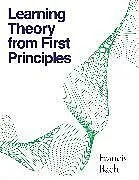
Learning Theory from First Principles
Beschreibung
A comprehensive and cutting-edge introduction to the foundations and modern applications of learning theory. Research has exploded in the field of machine learning resulting in;complex mathematical arguments that are hard to grasp for new comers.;. In this acc...Format auswählen
- Fester EinbandCHF 103.30

Wird oft zusammen gekauft
Andere Kunden kauften auch
Beschreibung
A comprehensive and cutting-edge introduction to the foundations and modern applications of learning theory. Research has exploded in the field of machine learning resulting in;complex mathematical arguments that are hard to grasp for new comers.;. In this accessible textbook, Francis Bach presents the foundations and latest advances of learning theory for graduate students as well as researchers who want to acquire a basic mathematical understanding of the most widely used machine learning architectures. Taking the position that learning theory does not exist outside of algorithms that can be run in practice, this book focuses on the theoretical analysis of learning algorithms as it relates to their practical performance. Bach provides the simplest formulations that can be derived from first principles, constructing mathematically rigorous results and proofs without overwhelming students.;
Autorentext
Francis Bach is a researcher at Inria where he leads the machine learning team which is part of the Computer Science department at Ecole Normale Supérieure. His research focuses on machine learning and optimization.
Inhalt
Preface ix
I Preliminaries 1
1 Mathematical preliminaries 3
1.1 Linear algebra and differentiable calculus.................. 3
1.1.1 Minimization of quadratic forms................... 3
1.1.2 Inverting a 2 × 2 matrix........................ 4
1.1.3 Inverting matrices defined by blocks, matrix inversion lemma... 4
1.1.4 Eigenvalue and singular value decomposition............ 6
1.1.5 Differential calculus.......................... 7
1.2 Concentration inequalities........................... 7
1.2.1 Hoeffding’s inequality......................... 9
1.2.2 McDiarmid’s inequality........................ 12
1.2.3 Bernstein’s inequality (x0007)....................... 14
1.2.4 Expectation of the maximum..................... 16
1.2.5 Estimation of expectations through quadrature (x0007)......... 17
1.2.6 Concentration inequalities for matrices (x0007__x0007)............. 18
2 Introduction to supervised learning 21
2.1 From training data to predictions....................... 22
2.2 Decision theory................................. 25
2.2.1 Loss functions............................. 25
2.2.2 Risks................................... 26
2.2.3 Bayes risk and Bayes predictor.................... 27
2.3 Learning from data............................... 30
2.3.1 Local averaging............................. 30
2.3.2 Empirical risk minimization...................... 31
2.4 Statistical learning theory........................... 33
2.4.1 Measures of performance....................... 35
2.4.2 Notions of consistency over classes of problems........... 35
2.5 No free lunch theorems (x0007).......................... 36
2.6 Quest for adaptivity.............................. 38
2.7 Beyond supervised learning.......................... 39
2.8 Summary - book outline............................ 40
3 Linear least-squares regression 43
3.1 Introduction................................... 43
3.2 Least-squares framework............................ 44
3.3 Ordinary least-squares (OLS) estimator................... 45
3.3.1 Closed-form solution.......................... 45
3.3.2 Geometric interpretation........................ 46
3.3.3 Numerical resolution.......................... 47
3.4 Statistical analysis of OLS........................... 47
3.5 Fixed design setting.............................. 48
3.5.1 Statistical properties of the OLS estimator............. 50
3.5.2 Experiments.............................. 52
3.6 Ridge least-squares regression......................... 53
3.7 Lower-bound (x0007)................................ 57
3.8 Random design analysis............................ 59
3.8.1 Gaussian designs............................ 61
3.8.2 General designs (x0007__x0007)......................... 61
3.9 Principal component analysis (x0007)....................... 63
3.10 Conclusion................................... 65
II Generalization bounds for learning algorithms 67
4 Empirical risk minimization 69
4.1 Convexification of the risk........................... 70
4.1.1 Convex surrogates........................... 71
4.1.2 Geometric interpretation of the support vector machine (x0007).... 72
4.1.3 Conditional Φ-risk and classification calibration (x0007)........ 74
4.1.4 Relationship between risk and Φ-risk (x0007__x0007).............. 76
4.2 Risk minimization decomposition....................... 80
4.3 Approximation error.............................. 80
4.4 Estimation error................................ 81
4.4.1 Application of McDiarmid’s inequality................ 82
4.4.2 Easy case I: quadratic functions.................... 83
4.4.3 Easy case II: Finite number of models................ 84
4.4.4 Beyond finitely many models through covering numbers (x0007)... 84
4.5 Rademacher complexity............................ 86
4.5.1 Symmetrization............................. 87
4.5.2 Lipschitz-continuous losses...................... 89
4.5.3 Ball-constrained linear predictions.................. 91
4.5.4 Putting things together (linear predictions)............. 92
4.5.5 From constrained to regularized estimation (x0007)........... 93
4.5.6 Extensions and improvements..................... 96
4.6 Model selection (x0007)............................... 98
4.6.1 Structural risk minimization...................... 98
4.6.2 Selection based on validation set................... 99
4.7 Relationship with asymptotic statistics (x0007)................. 99
4.8 Summary.................................... 101
5 Optimization for machine learning 103
5.1 Optimization in machine learning....................... 103
5.2 Gradient descent................................ 105
5.2.1 Simplest analysis: ordinary least-squares............... 106
5.2.2 Convex functions and their properties................ 110
5.2.3 Analysis of GD for strongly convex and smooth functions..... 112
5.2.4 Analysis of GD for convex and smooth functions (x0007)....... 117
5.2.5 Beyond gradient descent (x0007)..................... 120
5.2.6 Non-convex objective functions (x0007)................. 122
5.3 Gradient methods on non-smooth problems................. 123
5.4 Convergence rate of stochastic gradient descent (SGD)........... 127
5.4.1 Strongly convex problems (x0007).................... 132
5.4.2 Adaptive methods (x0007)......................... 134
5.4.3 Bias-variance trade-offs for least-squares (x0007)............. 135
5.4.4 Variance reduction (x0007)........................ 138
5.5 Conclusion................................... 143
6 Local averaging methods 145
6.1 Introduction................................... 145
6.2 Local averaging methods............................ 147
6.2.1 Linear estimators............................ 147
6.2.2 Partition estimators.......................... 148
6.2.3 Nearest-neighbors........................... 150
6.2.4 Nadaraya-Watson estimator a.k.a. kernel regression (x0007)...... 151
6.3 Generic “simplest” consistency analysis................... 153
6.3.1 Fixed partition............................. 155
6.3.2 k-nearest neighbor........................... 158
6.3.3 Kernel regression (Nadaraya-Watson) (x0007).............. 160
6.4 Universal consistency (x0007)........................... 163
6.5 Adaptivity (x0007__x0007)................................ 166
6.6 Conclusion................................... 167
7 Kernel methods 169
7.1 Introduction................................... 170
7.2 Representer theorem.............................. 170
7.3 Kernels..................................... 173
7.3.1 Linear and polynomial kernels........…