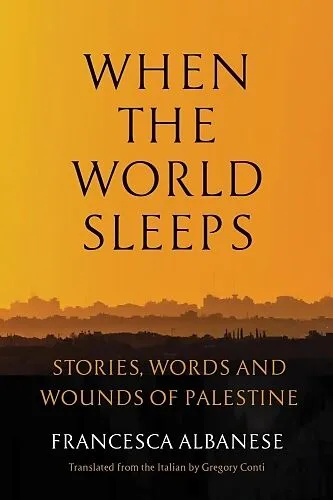
When the World Sleeps
Beschreibung
The first woman to serve as United Nations Special Rapporteur on the occupied Palestinian territories conveys the soul of a people through ten unforgettable stories of resilience and humanity. The spirit of a place lies in the people who inhabit it, in the sto...Format auswählen
- Fester EinbandCHF 30.30

Wird oft zusammen gekauft
Andere Kunden kauften auch
Beschreibung
The first woman to serve as United Nations Special Rapporteur on the occupied Palestinian territories conveys the soul of a people through ten unforgettable stories of resilience and humanity. The spirit of a place lies in the people who inhabit it, in the stories that intertwine through its streets. And this is especially true of a land like Palestine, the witness to defining historical transitions and stage to one of the most painful chapters in contemporary history.; With a voice both authoritative and deeply human, Francesca Albanese, who had been living in Palestine for many years while following the legal battles of numerous Palestinian families, takes on the role of narrator of the ongoing conflict, starting from the stories of the people she met. Albanese elegantly composes a gallery of stories, characters, and places that allow us to understand what Palestine was like until a year and a half ago, and what it has become today.; “Is it possible that after 42,000 people have been killed, you still cannot empathize with the Palestinians? Those among you who have not uttered a word about what is happening in Gaza demonstrate that empathy has evaporated from this room. Empathy is the glue that makes us stand united as humanity.” --Albanese at the United Nations General Assembly, October 2024
Autorentext
Francesca Albanese
Klappentext
The first woman to serve as United Nations Special Rapporteur for the Occupied Palestinian Territory conveys the spirit of a people through 10 unforgettable stories of resilience and humanity.
Francesca Albanese is the most lucid voice against Israel’s apartheid policies in Gaza and the West Bank, a voice that has been heard around the world when it comes to speaking the truth about the Palestinian genocide. In the wake of October 7, 2023, and Israel’s retaliatory war, the renowned Italian jurist has become a lightning rod for her staunch defense of human rights.
Reflecting on her years living in Jerusalem and her personal and professional journey toward understanding the Palestinian struggle, Albanese pays tribute to 10 people whose profoundly affecting stories opened her eyes, from Hind Rajab, a young Palestinian girl killed by Israeli forces, to the remarkable Jewish scholars who acted as Albanese’s mentors: forensic architect Eyal Weizman, trauma expert Gabor Maté, and Holocaust historian Alon Confino.
When the World Sleeps is a courageous testimony of the harsh reality that Palestinians face. It raises critical questions about the past, present, and future of Palestine: What are the consequences of the occupation? Where is a refugee’s home? In what conditions do Palestinians live? With the uncertain end of the war, will there be a Palestinian state? Will Palestinians have the right to self-determination, and will they be able to live in peace, free at last from the coercion of Israel?
Leseprobe
Hind
What is childhood in Palestine?
End of january 2024. Hind Rajab is six years old. She is curled up in the backseat of her uncle’s car, hunched together with four cousins. As soon as the umpteenth evacuation order arrived in the western area of Gaza, her mother and brothers fled on foot, but since it is raining and cold, her uncles have put her in the car with them.
It is early afternoon; the exploding bombs can be heard even inside the car, which seems to be stuck in a traffic jam. Something is not right. The uncles sense that, they’re agitated, talking frenetically. Not far from a gas station near Tel al-Hawa, the car happens onto a barrage of fire from Israeli artillery. Then a surreal cold. Hind looks around: No one is talking, and they are all slumped over. With her hands surely shaking, she takes the phone from between the fingers of her fifteen-year-old cousin Layan, who was hit while she was talking to the relief workers from the Red Crescent. Hind explains that “the others are dead or maybe they’re sleeping” and begs for help. “The tank is right next to me. It’s moving. Will you come to get me? I’m so afraid.”
On the other end of the line, the aide — struggling to control her fear, because she knows the risk that Hind is facing — answers with affection, “Habibti” (Honey), and stays on the phone with her so she won’t be alone.
After three hours on the phone — the time it took her colleagues from the Red Crescent to coordinate with the Israeli authorities to locate the car and get permission to rescue the little girl — the aide reassures Hind that two rescuers are on their way to help her. The recording of that heartrending conversation, with the little girl’s life hanging by a thread, has been conserved for history and hopefully, one day, for the judges who will punish those responsible for the massacre in which Hind was killed by the Israeli army.
Twelve days later, Hind’s lifeless body would be found in the car that was riddled with more than three hundred bullet holes, not far from the ambulance that contained the dead bodies of her rescuers, who had been killed by the Israeli army. The investigation by the British team from Forensic Architecture led by Eyal Weizman, after reconstructing the distances and the dynamics of the gunfire, demonstrated that it is “not plausible” that the Israeli soldiers who shot at the car from the tank could not have seen that the car was occupied by civilians, including the little girls.
Hind’s story has become a symbol of the brutality of the Israeli assault on the population of Gaza in the days following October 7, 2023. But Hind was killed more than three months after October 7th, when Israel had already killed ten thousand children. How is it possible to tolerate all this killing? And how is it possible that still today — as I am completing the revision of this book at the end of August 2025 — when the number of dead children has come to exceed twenty thousand, of whom more than one thousand were less than one year old, that impunity continues to reign and the death machine set in motion by Israel has not been stopped?
The answer lies in decades of narrative manipulation that has distorted the perception of the balance of power between Israelis and Palestinians.
In recent decades, this narrative has led many to believe that the Palestinians are to blame for their situation, that they are an existential threat to Israel. Even the children? Yes, even them, and maybe especially them, because in the logic of the Israeli assault begun on October 7th, every Palestine life is seen as a potential future danger to the survival of Israel.
Hind’s story, as atrocious as it is, is not an unusual one in Palestine. Mohammed Tamimi was two years old when, a few months before October 7, 2023, the Israeli occupation forces — formally known as the Israel Defense Forces — shot him in the head while he was in a car with his father in the occupied West Bank. No one has been held responsible, as usual.
This is childhood in Palestine.
In Jerusalem, next to the garden of the house where my Max and I lived, there was a small hill with a huge, incredible, generous mulberry tree, which bore fruit for months on end. A purple carpet of fallen mulberries always formed under that tree, and children often came to gather them.
Just below the house there was a low stone wall with a piece of metal fencing, which must have been added to the wall years before, temporarily, but had been left in place. The children, by repeatedly slipping under the fence to come and get mulberries, had made their own passageway. One fine day, I saw them and said: “Hi guys, when you want mulberries, if you knock on my door I’ll open it, so you don’t have to go under the fence.” Most of them …