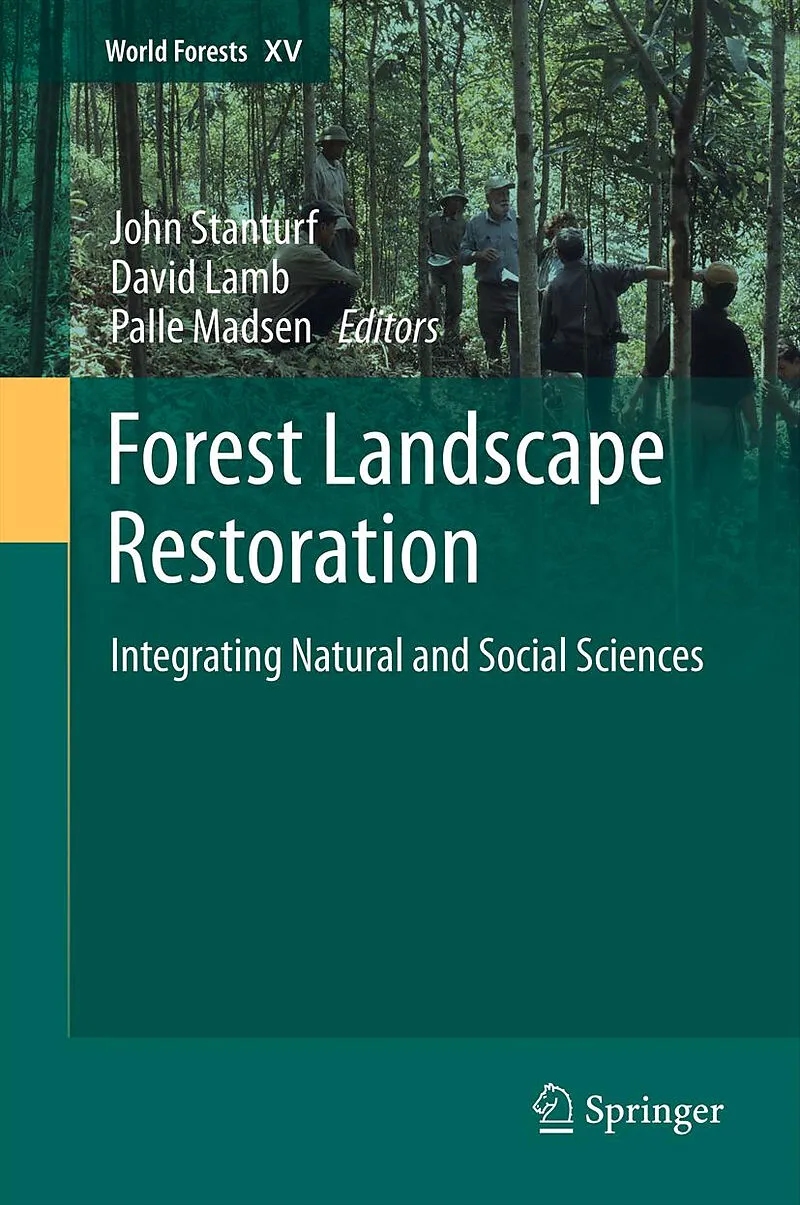
Forest Landscape Restoration
Beschreibung
Bringing together experts in landscape studies, natural resource management and forest restoration, conflict management, environmental economics and urban studies, this book defines the nature and potential of FLR to address a global environmental problem. Res...Format auswählen
- Kartonierter EinbandCHF 189.60
- Fester EinbandCHF 227.20
- E-Book (pdf)CHF 177.90

Wird oft zusammen gekauft
Andere Kunden kauften auch
Beschreibung
Bringing together experts in landscape studies, natural resource management and forest restoration, conflict management, environmental economics and urban studies, this book defines the nature and potential of FLR to address a global environmental problem.
Restoration ecology, as a scientific discipline, developed from practitioners' efforts to restore degraded land, with interest also coming from applied ecologists attracted by the potential for restoration projects to apply and/or test developing theories on ecosystem development. Since then, forest landscape restoration (FLR) has emerged as a practical approach to forest restoration particularly in developing countries, where an approach which is both large-scale and focuses on meeting human needs is required.Yet despite increased investigation into both the biological and social aspects of FLR, there has so far been little success in systematically integrating these two complementary strands. Bringing experts in landscape studies, natural resource management and forest restoration, together with those experienced in conflict management, environmental economics and urban studies, this book bridges that gap to define the nature and potential of FLR as a truly multidisciplinary approach to a global environmental problem. The book will provide a valuable reference to graduate students and researchers interested in ecological restoration, forest ecology and management, as well as to professionals in environmental restoration, natural resource management, conservation, and environmental policy.
A more integrated view of the topic than existing titles, combining social and ecological aspects Emphasis on landscape scale Balanced international perspectives and examples, including developing nations and tropics Chapter contributions by respected researchers New' agenda for restoration (landscape focus, restoration of function) will have strong appeal to those with a utilitarian philosophy
Autorentext
I. Introduction
- What is Forest Landscape Restoration? *David Lamb, University of Queensland, Brisbane, Australia, John Stanturf, US Forest Service, Athens, Georgia, USA, Palle Madsen, Forest and Landscape, University of Copenhagen, Denmark
- What Can Landscape Ecology Contribute to Forest Landscape Restoration? Tom Crow, US Forest Service, Ft. Collins, Colorado USA
- Landscape Management; Chadwick Dearing Oliver, Kristofer Covey, Aaron Hohl, Yale University, New Haven, Connecticut, David Larsen, University of Missouri, James B. McCarter, University of Washington, Andrew Niccolai, Yale University, and Jeremy Wilson, University of Maine, USA
II. Natural Science Perspectives - Hydrologic Connectivity of Landscapes and Implications for Forest Restoration; R. Chelsea Nagy, Brown University, Providence, Rhode Island and B. Graeme Lockaby, Auburn University, Auburn, Alabama, USA
- Connecting Landscape Fragments Through Riparian Zones; Gary Bentrup, Mike Dosskey, Gary Wells, and Michele Schoeneberger, National Agroforestry Center, Lincoln, Nebraska USA
- Understanding Landscapes through Spatial Modeling; Michael Wimberly and Stephen P. Boyte, South Dakota State University, Brookings, South Dakota, and Eric Gustafson, US Forest Service, Rhinelander, Wisconsin USA
III. Social Science Perspectives - Forest Landscape Restoration Decision-Making and Conflict Management: Applying Discourse-Based Approaches; Jens Emborg, University of Copenhagen, Frederiksberg , Denmark, Gregg Walker, Oregon State University, Corvallis, Oregon and Steven Daniels, Utah State University, Ogden, Utah, USA
- Alternative Approaches to Urban Natural Areas Restoration: Integrating Social and Ecological Goals; Paul Gobster, US Forest Service, Chicago, Illinois, USA
- Urban Forest Landscape Restoration - Applying Forest Development Types in Design and Planning; J. Bo Larsen, University of Copenhagen, Fredriksberg, Denmark and Anders Busse Nielsen, Swedish University of Agricultural Sciences, Alnarp, Sweden
- Watershed-Scale Adaptive Management: A Social Science Perspective; Catherine Allan and Allan Curtis, Charles Sturt University, Albury, Australia and Bruce Schindler, Oregon State University, Corvallis, Oregon, USA
- The Economics of Restoration; Kerrie A. Wilson, University of Queensland, Brisbane, Australia, Megan Lulow, Jutta Burger, Irvine Ranch Conservancy, Irvine, California, and Marissa F. McBride, University of Melbourne, Parkville, Victoria, Australia
- Wild Ennerdale: A Cultural Landscape; Ian Convery and Tom Dutson, University of Cumbria, United Kingdom
IV. Integrated Perspectives - The Role of Forest Landscape Restoration in Supporting a Transition Towards More Sustainable Coastal Development; Peter Burbridge, University of Newcastle-upon-Tyne, United Kingdom
- Broad-Scale Restoration of Landscape Function With Timber, Carbon and Water Investment; R.J. Harper, Forest Products Commission, Perth and Cooperative Research Centre for Future Farm Industries, The University of Western Australia, Nedlands, K.R.J. Smettem, Centre for Eco-Hydrology, School of Environmental Systems Engineering and Cooperative Research Centre for Future Farm Industries, The University of Western Australia, Nedlands, P.V. Townsend, Forest Products Commission, Perth, J.R. Bartle, Cooperative Research Centre for Future Farm Industries, The University of Western Australia, Nedlands and J.F. McGrath, Forest Products Commission, Perth, Australia
- Challenging a Paradigm: Toward Integrating Indigenous Species into Tropical Plantation Forestry; Anthony S. Davis, University of Idaho, Moscow, Douglass F. Jacobs, Purdue University, West Lafayette, Indiana and R. Kasten Dumroese, USForest Service, Moscow, Idaho, USA
- Forest Landscape Restoration: Restoring What and for Whom? Jeffrey Sayer and Agni Klintuni Boedhihartono, James Cook University, Cairns, Australia
Inhalt
I. Introduction.- 1. What is Forest Landscape Restoration?.- 2. What Can Landscape Ecology Contribute to Forest Landscape Restoration?.- 3. Landscape Management.- 4. Hydrologic Connectivity of Landscapes and Implications for Forest Restoration.- 5. Connecting Landscape Fragments Through Riparian Zones.- 6. Understanding Landscapes through Spatial Modeling.- III. Social Science Perspectives.- 7. Forest Landscape Restoration Decision-Making and Conflict Management: Applying Discourse-Based Approaches.- 8. Alternative Approaches to Urban Natural Areas Restoration: Integrating Social and Ecological Goals.- 9. Urban Forest Landscape Restoration - Applying Forest Development Types in Design and Planning.- 10 Watershed-Scale Adaptive Management: A Social Science Perspective.- 11. The Economics of Restoration.- 12, Wild Ennerdale: A Cultural Landscape.- IV. Integrated Perspectives.- 13. The Role of Forest Landscape Restoration in Supporting a Transition Towards More Sustainable Coastal Development.- 14. Broad-Scale Restoration of Landscape Function With Timber, Carbon and Water Investment.- 15. Challenging a Paradigm: Toward Integrating Indigenous Species into Tropical Plantation Forestry.- 16. Forest Landscape Restoration: Restoring What and for Whom?.
Produktinformationen
Weitere Produkte aus der Reihe "World Forests"


Tief- preis
- Forest Landscape Restoration

