
IHR WARENKORB IST AKTUELL LEER.
Haben Sie noch nichts passendes gefunden? Stöbern Sie durch unser komplettes Sortiment.
Oder melden Sie sich an bzw. registrieren Sie sich.
- Kostenlose Lieferung
- Kauf auf Rechnung
- Ex Libris Tiefpreis
- Filiallieferung und 650+ Abholorte
- Rabatt-Bons als Club-Mitglied
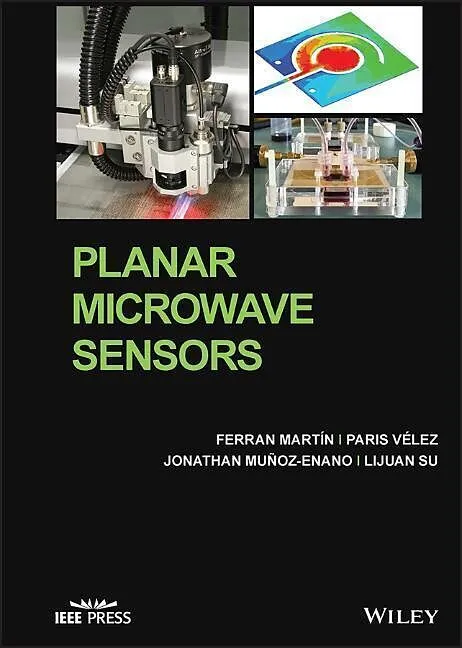
Planar Microwave Sensors
Beschreibung
Comprehensive resource detailing the latest advances in microwave and wireless sensors implemented in planar technology Planar Microwave Sensors is an authoritative resource on the subject, discussing the main relevant sensing strategies, working principles, a...Format auswählen
- Fester EinbandCHF 154.80

Wird oft zusammen gekauft
Andere Kunden kauften auch
Beschreibung
Comprehensive resource detailing the latest advances in microwave and wireless sensors implemented in planar technology
Planar Microwave Sensors is an authoritative resource on the subject, discussing the main relevant sensing strategies, working principles, and applications on the basis of the authors' own experience and background, while also highlighting the most relevant contributions to the topic reported by international research groups. The authors provide an overview of planar microwave sensors grouped by chapters according to their working principle.
In each chapter, the working principle is explained in detail and the specific sensor design strategies are discussed, including validation examples at both simulation and experimental level. The most suited applications in each case are also reported. The necessary theory and analysis for sensor design are further provided, with special emphasis on performance improvement (i.e., sensitivity and resolution optimization, dynamic range, etc.). Lastly, the work covers a number of applications, from material characterization to biosensing, including motion control sensors, microfluidic sensors, industrial sensors, and more.
Sample topics covered in the work include:
- Non-resonant and resonant sensors, reflective-mode and transmission-mode sensors, single-ended and differential sensors, and contact and contactless sensors
- Design guidelines for sensor performance optimization and analytical methods to retrieve the variables of interest from the measured sensor responses
- Radiofrequency identification (RFID) sensor types, prospective applications, and materials/technologies towards "green sensors" implementation
- Comparisons between different technologies for sensing and the advantages and limitations of microwave sensors, particularly planar sensors
Engineers and qualified professionals involved in sensor technologies, along with undergraduate and graduate students in related programs of study, can harness the valuable information inside Planar Microwave Sensors to gain complete foundational knowledge on the subject and stay up to date on the latest research and developments in the field.
Autorentext
Professor Ferran Martín (PhD, IEEE Fellow), Paris Vélez (PhD, Senior Member IEEE), Jonathan Muñoz-Enano (Graduate Student Member IEEE), and Lijuan Su (PhD, Member IEEE) are researchers at CIMITEC, a Research and Technology-Transfer Centre (headed by Ferran Martín) affiliated to the Departament d'Enginyeria Electrònica at the Universitat Autònoma de Barcelona (UAB), in Spain. Their activity in recent years has been mainly devoted to the design and applications of planar microwave sensors. They have generated dozens of journal papers and conference contributions related to the topic, published in the top international journals and conferences in the field of sensors and microwave technologies.
Inhalt
Preface
Acknowledgments
1 Introduction to Planar Microwave Sensors
1.1 Sensor performance indicators, classification criteria, and general overview of sensing technologies
1.1.1 Performance indicators
1.1.2 Sensors' classification criteria
1.1.3 Sensing technologies
1.1.3.1 Optical sensors
1.1.3.2 Magnetic sensors
1.1.3.3 Acoustic sensors
1.1.3.4 Mechanical sensors
1.1.3.5 Electric sensors
1.2 Microwave sensors
1.2.1 Remote sensing: RADARs and radiometers
1.2.2 Sensors for in situ measurement of physical parameters and material properties: non-remote sensors
1.2.2.1 Classification of non-remote microwave sensors
1.2.2.2 Resonant cavity sensors
1.2.2.3 The Nicolson-Ross-Weir (NRW) method
1.2.2.4 Coaxial probe sensors
1.2.2.5 Planar sensors
1.3 Classification of planar microwave sensors
1.3.1 Contact and contactless sensors
1.3.2 Wired and wireless sensors
1.3.3 Single-ended and differential-mode sensors
1.3.4 Resonant and non-resonant sensors
1.3.5 Reflective-mode and transmission-mode sensors
1.3.6 Sensor classification by frequency of operation
1.3.7 Sensor classification by application
1.3.8 Sensor classification by working principle
1.3.8.1 Frequency-variation sensors
1.3.8.2 Phase-variation sensors
1.3.8.3 Coupling-modulation sensors
1.3.8.4 Frequency-splitting sensors
1.3.8.5 Differential-mode sensors
1.3.8.6 RFID sensors
1.4 Comparison of planar microwave sensors with other sensing technologies
References
2 Frequency-Variation Sensors
2.1 General working principle of frequency-variation sensors
2.2 Transmission-line resonant sensors
2.2.1 Planar resonant elements for sensing
2.2.1.1 Semi-lumped metallic resonators
2.2.1.2 Semi-lumped slotted resonators
2.2.2 Sensitivity analysis
2.2.3 Sensors for dielectric characterization
2.2.3.1 CSRR-based microstrip sensor
2.2.3.2 DB-DGS-based microstrip sensor
2.2.4 Measuring material and liquid composition
2.2.5 Displacement sensors
2.2.6 Sensor arrays for biomedical analysis
2.2.7 Multi-frequency sensing for selective determination of material composition
2.3 Other frequency-variation resonant sensors
2.3.1 One-port reflective-mode submersible sensors
2.3.2 Antenna-based frequency-variation resonant sensors
2.4 Advantages and drawbacks of frequency-variation sensors
References
3 Phase-Variation Sensors
3.1 General working principle of phase-variation sensors
3.2 Transmission-line phase-variation sensors
3.2.1 Transmission-mode sensors
3.2.1.1 Transmission-mode four-port differential sensors
3.2.1.1.1 Sensor structure and analysis
3.2.1.1.2 Sensor implementation and application to dielectric characterization and comparators
3.2.1.2 Two-port sensors based on differential-mode to common-mode conversion detectors and sensitivity enhancement
3.2.1.2.1 Differential-mode to common-mode conversion detector
3.2.1.2.2 Analysis and sensitivity optimization
3.2.1.2.3 Sensor design
3.2.1.2.4 Comparator functionality
3.2.1.2.5 Dielectric constant measurements
3.2.1.2.6 Microfluidic sensor. Solute concentration measurements
3.2.2 Reflective-mode sensors
3.2.2.1 Sensitivity enhancement by means of step-impedance open-ended lines
3.2.2.2 Highly-sensitive dielectric constant sensors
3.2.2.3 Displacement sensors
3.2.2.4 Reflective-mode differential sensors
3.3 Resonant-type phase-variation sensors
3.3.1 Reflective-mode sensors based on resonant sensing elements
3.3.2 Angular displacement sensors
3.3.2.1 Cross-polarization in split ring resonator (SRRs) and complementary SRR (CSRR) loaded lines
3.3.2.2 Slot-line/SRR configuration
3.3.2.3 Microstrip-line/CSRR configuration
3.4 Phase-variation sensors based on artificial transmission lines
3.4.1 Sensors based on slow-wave transmission lines
3.4.1.1 Sensing through the host line
3.4.1.2 Sensing through the patch capacitors
3.4.2 Sensors based on composite right/left handed (CRLH) lines
3.4.3 Sensors based on electro-inductive wave (EIW) transmission lines
3.5 Advantages and drawbacks of phase-variation sensors
References
4 Coupling-Modulation Sensors
4.1 Symmetry properties in transmission lines loaded with single symmetric resonators
4.2 Working principle of coupling-modulation sensors
4.3 Displacement and velocity coupling-modulation sensors
4.3.1 One-dimensional and two-dimensional linear displacement sensors
4.3.2 Angular displacement and velocity sensors
4.3.2.1 Axial configuration and Analysis
4.3.2.1.1 Coplanar waveguide (CPW) stator
4.3.2.1.2 Microstrip stator
4.3.2.2 Edge configuration. Electromagnetic rotary encoders
4.3.2.2.1 CPW stator
4.3.2.2.2 Microstrip stator
4.3.2.2.3 Resolution and accuracy
4.3.3 Electromagnetic linear encoders
4.3.3.1 Strategy for synchronous reading. Quasi-absolute encoders
4.3.3.2 Application to motion control
4.4 Coupling-modulation sensors for dielectric characterization
4.5 Advantages a…