
IHR WARENKORB IST AKTUELL LEER.
Haben Sie noch nichts passendes gefunden? Stöbern Sie durch unser komplettes Sortiment.
Oder melden Sie sich an bzw. registrieren Sie sich.
- Kostenlose Lieferung
- Kauf auf Rechnung
- Ex Libris Tiefpreis
- Filiallieferung und 650+ Abholorte
- Rabatt-Bons als Club-Mitglied
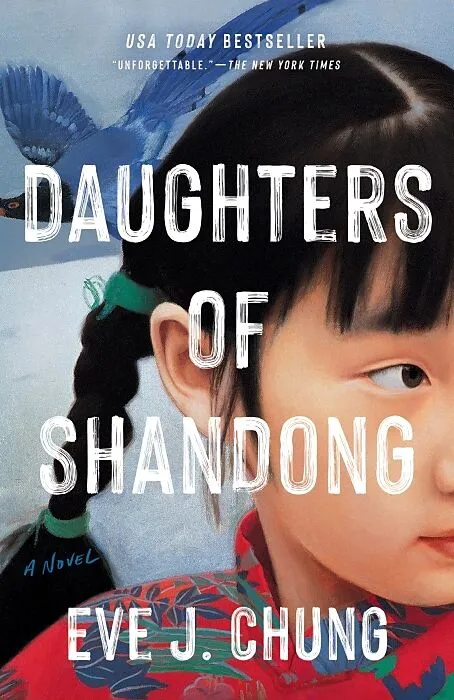
Daughters of Shandong
Beschreibung
An Instant “Throw open the doors of your heart for the lionhearted girls of Chung’s gripping debut…they are heroines for the ages." A propulsive, extraordinary novel about a mother and her daughters’ harrowing escape to Taiwan as the C...Format auswählen
- TaschenbuchCHF 22.70

Wird oft zusammen gekauft
Andere Kunden kauften auch
Beschreibung
An Instant “Throw open the doors of your heart for the lionhearted girls of Chung’s gripping debut…they are heroines for the ages." A propulsive, extraordinary novel about a mother and her daughters’ harrowing escape to Taiwan as the Communist revolution sweeps through China, by debut author Eve J. Chung, based on her family story Daughters are the Ang family’s curse. In 1948, civil war ravages the Chinese countryside, but in rural Shandong, the wealthy, landowning Angs are more concerned with their lack of an heir. Hai is the eldest of four girls and spends her days looking after her sisters. Headstrong Di, who is just a year younger, learns to hide in plain sight, and their mother--abused by the family for failing to birth a boy--finds her own small acts of rebellion in the kitchen. As the Communist army closes in on their town, the rest of the prosperous household flees, leaving behind the girls and their mother because they view them as useless mouths to feed. Without an Ang male to punish, the land-seizing cadres choose Hai, as the eldest child, to stand trial for her family’s crimes. She barely survives their brutality. Realizing the worst is yet to come, the women plan their escape. Starving and penniless but resourceful, they forge travel permits and embark on a thousand-mile journey to confront the family that abandoned them. From the countryside to the bustling city of Qingdao, and onward to British Hong Kong and eventually Taiwan, they witness the changing tide of a nation and the plight of multitudes caught in the wake of revolution. But with the loss of their home and the life they’ve known also comes new freedom--to take hold of their fate, to shake free of the bonds of their gender, and to claim their own story. Told in assured, evocative prose, with impeccably drawn characters, <Daughters of Shandong< is a hopeful, powerful story about the resilience of women in war; the enduring love between mothers, daughters, and sisters; and the sacrifices made to lift up future generations....
Autorentext
Eve J. Chung is a Taiwanese American human rights lawyer focusing on gender equality and women’s rights. She lives in New York with her husband, two children, and two dogs.
Klappentext
**A propulsive, extraordinary novel about a mother and her daughters’ harrowing escape to Taiwan as the Communist revolution sweeps through China, by debut author Eve J. Chung, based on her family story
An Instant USA Today Bestseller, a Good Morning America Buzz Pick, and a People Book of the Week!
“Throw open the doors of your heart for the lionhearted girls of Chung’s gripping debut . . . they are heroines for the ages."—People**
Daughters are the Ang family’s curse.
In 1948, civil war ravages the Chinese countryside, but in rural Shandong, the wealthy, landowning Angs are more concerned with their lack of an heir. Hai is the eldest of four girls and spends her days looking after her sisters. Headstrong Di, who is just a year younger, learns to hide in plain sight, and their mother—abused by the family for failing to birth a boy—finds her own small acts of rebellion in the kitchen. As the Communist army closes in on their town, the rest of the prosperous household flees, leaving behind the girls and their mother because they view them as useless mouths to feed.
Without an Ang male to punish, the land-seizing cadres choose Hai, as the eldest child, to stand trial for her family’s crimes. She barely survives their brutality. Realizing the worst is yet to come, the women plan their escape. Starving and penniless but resourceful, they forge travel permits and embark on a thousand-mile journey to confront the family that abandoned them.
From the countryside to the bustling city of Qingdao, and onward to British Hong Kong and eventually Taiwan, they witness the changing tide of a nation and the plight of multitudes caught in the wake of revolution. But with the loss of their home and the life they’ve known also comes new freedom—to take hold of their fate, to shake free of the bonds of their gender, and to claim their own story.
Told in assured, evocative prose, with impeccably drawn characters, Daughters of Shandong is a hopeful, powerful story about the resilience of women in war; the enduring love between mothers, daughters, and sisters; and the sacrifices made to lift up future generations.
Leseprobe
1
Heirless
Nai Nai said whores weren't allowed in the house, so she kicked Mom out, slamming the wooden door shut with a clatter that startled the birds. We didn't know where my sister Di was, but Three and I sat beside Mom as she leaned against the courtyard wall of our shiheyuan, hands red and chapped from washing dishes. "Don't worry," she said to us. "She'll calm down when your father comes home." Nai Nai was a small, thin lady with ebony hair, birdlike hands, and dainty bound feet. Yet, even as she tottered in her small silk slippers, she had the presence of a warlord and a tongue like a whip. I was eleven, and old enough to know that no one could calm her after such a rage, not even her first and favorite son.
It was fall, and dried leaves swirled in the chilly wind, skimming yellow grass that swayed gently. Luckily, the harvest was finished and most of the workers had gone home. Mom didn't want reports of this shameful spectacle to make the rounds-the peasants hated Nai Nai as much as they loved gossip, and this story would have spread like a wildfire. We lived in rural Zhucheng, a small town where my family reigned. For generations, our men had excelled in imperial exams, earning prestigious government positions and building an empire through renting land and running businesses. Our palatial shiheyuan, with its gleaming orange tiles and wooden latticed panels, was an ostentatious testament to our wealth. Magnificent stone lions framed the entrance of the courtyard, which was large enough for a lotus pond full of shimmering koi. They swam in circles lazily, eyes globular, and gulped at two-year-old Three as she peered into the water.
Nai Nai had a nose for lies and could almost always tell when a secret lurked inside her walls. Still, Mom had been hiding her pregnancy for weeks. "It will be a boy this time. I can feel it, Li-Hai," she said to me repeatedly, as though her anxious mutterings could manifest a son. As soon as I was born, I was a disappointment. When Second Sister arrived one year later, she was a failure. Father wistfully named her Li-Di, since di meant "younger brother." Then Third Sister came along, a catastrophe so horrific that she got only a number: Three.
Three girls rattled the Angs enough for Nai Nai to take drastic measures. Though she watched every coin like it was a fragment of her soul, she decided to trade an ounce of gold for a glimpse into the future. Together, she and Mom went to a famous fortune-teller in a neighboring town and asked if a male heir was forthcoming. Mom wrote down the date and time of her birth as he examined the lines on her palm, reading it like it was a map of her life. Handing Mom an amber amulet for protection, he declared solemnly that Mom would not have a son until she turned thirty-six.
Mom was only in her late twenties then, but Nai Nai came home giddy, delighted that an heir would arrive eventually. She ordered my parents to sleep in separate rooms and forbade them from having intercourse until Mom's thirty-sixth birthday. Lauding herself for her ingenuity, she boasted, "This will save us the expense of raising additional daughters!" After all, girls were nothing more than wives for other people's sons.
Father obeyed and set up his own bedroom, but he told Nai Nai that fortune-tellers were a scam. "We make our own fate," he insisted, a feeble protest that she ignored. At nigh…