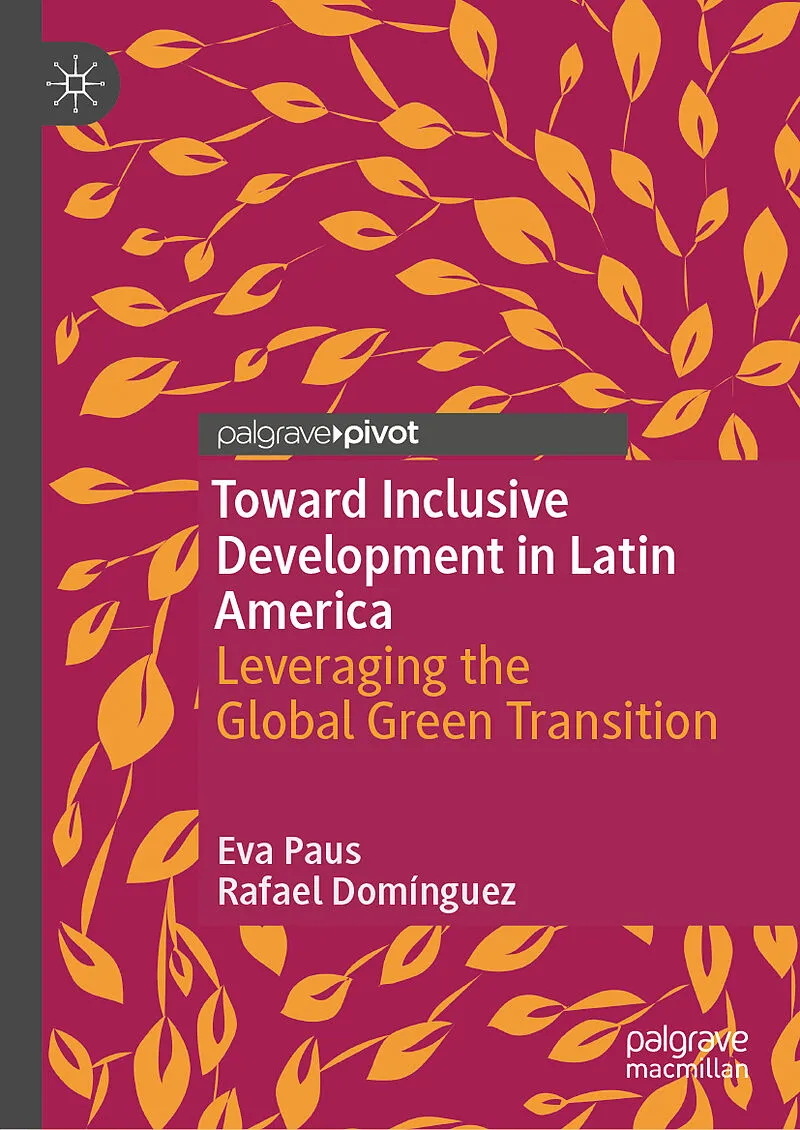
Beschreibung
The global green transition presents a unique opportunity for resource-rich Latin American nations to leverage natural assets to reduce problematic structural barriers while expanding social inclusion and strengthening responses to climate change. This book e...The global green transition presents a unique opportunity for resource-rich Latin American nations to leverage natural assets to reduce problematic structural barriers while expanding social inclusion and strengthening responses to climate change.
This book examines why coordinated and proactive development strategiesaligned with emerging global sustainability imperativesare essential for achieving these goals. It outlines the contours of an inclusive green development strategy, placing a green developmental state at the center and emphasizing the role of broadly defined industrial policies. Drawing on heterodox economics and international political economy, Eva Paus and Rafael Domínguez analyze how Latin American governments can respond to current economic and geopolitical pressures.
Systemic change is possible if states adopt environmental-developmental roles, pursue active non-alignment, and engage in more coordinated foreign policy efforts. Readers will gain insight into the political and economic conditions that shape the feasibility of inclusive green development. The resulting book breaks down the strategic choices available to governments seeking to integrate sustainability with long-term economic transformation and inclusion. It offers a grounded perspective on how policy direction, institutional capacity, and international positioning can be used to navigate the challenges of our times.
Demonstrates how Latin American governments can align resource use with green and inclusive development Identifies key national and international barriers to inclusive growth and offers state-led solutions to overcome them Analyzes the critical role of industrial policy for structural transformation and environmental resilience
Autorentext
Eva Paus is Professor of Economics Emerita at Mount Holyoke College, USA. Her recent research has focused on economic development in the context of globalization in the face of structural change, innovation, and the middle-income trap in Latin America and beyond. She is the author of several books, including Global Capitalism Unbound , Confronting Dystopia , * and Foreign Investment, Development, and Globalization* . Paus has collaborated with ECLAC, ILO, UNIDO, and UNDP.
Rafael Domínguez is Professor of Economic History and Institutions in the Department of Economics at the University of Cantabria, Spain. He is a Fellow of the Social Science Doctoral Program at the University of Salamanca, Spain. Domínguez leads the international research group on South-South Cooperation and Regional Integrations of the Spanish Network of Development Studies, and he has collaborated with CEPAL, GIZ, Europeaid, and the international development cooperation agencies of Mexico and Chile.
Klappentext
"A major contribution to the analysis of how to fulfill the triple dimensions of sustainable development: economic growth, social development, and environmental sustainability." José Antonio Ocampo , Professor at Columbia University, former Minister of Finance of Colombia, and UN Under-Secretary-General for Economic and Social Affairs
The global green transition presents a unique opportunity for resource-rich Latin American nations to leverage natural assets to reduce problematic structural barriers while expanding social inclusion and strengthening responses to climate change.
This book examines why coordinated and proactive development strategiesaligned with emerging global sustainability imperativesare essential for achieving these goals. It outlines the contours of an inclusive green development strategy, placing a green developmental state at the center and emphasizing the role of broadly defined industrial policies. Drawing on heterodox economics and international political economy, Eva Paus and Rafael Domínguez analyze how Latin American governments can respond to current economic and geopolitical pressures.
Systemic change is possible if states adopt environmental-developmental roles, pursue active non-alignment, and engage in more coordinated foreign policy efforts. Readers will gain insight into the political and economic conditions that shape the feasibility of inclusive green development. The resulting book breaks down the strategic choices available to governments seeking to integrate sustainability with long-term economic transformation and inclusion. It offers a grounded perspective on how policy direction, institutional capacity, and international positioning can be used to navigate the challenges of our times.
Eva Paus is Professor of Economics Emerita at Mount Holyoke College in the USA.
Rafael Domínguez Martín is Professor of Economic History and Institutions in the Department of Economics at the University of Cantabria in Spain.
Inhalt