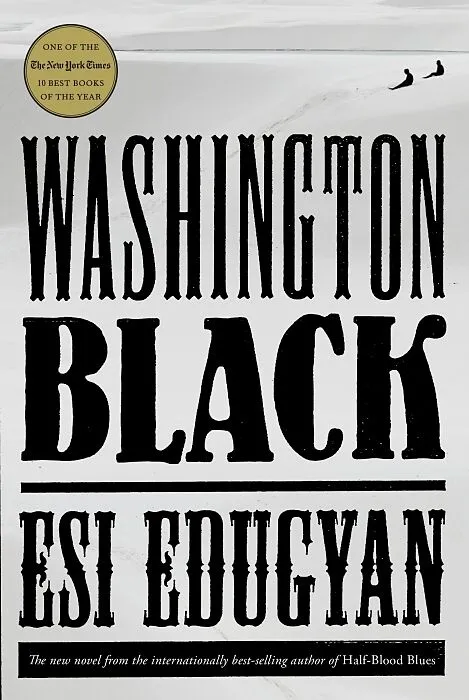
Washington Black
Beschreibung
Zusatztext 77497186 Informationen zum Autor ESI EDUGYAN is author of the novels The Second Life of Samuel Tyne and Half-Blood Blues, which won the Scotiabank Giller Prize and was a finalist for the Man Booker Prize, the Governor General's Literary Award, the R...Format auswählen
- Fester EinbandCHF 30.00

Wird oft zusammen gekauft
Andere Kunden kauften auch
Beschreibung
Zusatztext 77497186 Informationen zum Autor ESI EDUGYAN is author of the novels The Second Life of Samuel Tyne and Half-Blood Blues, which won the Scotiabank Giller Prize and was a finalist for the Man Booker Prize, the Governor General's Literary Award, the Rogers Writers' Trust Fiction Prize and the Orange Prize. She lives in Victoria, British Columbia. Klappentext • TOP TEN BOOK OF THE YEAR: New York Times, Washington Post, TIME, Entertainment Weekly • ONE OF THE BEST BOOKS OF THE YEAR: Minneapolis Star-Tribune, NPR, The Economist, Bustle • WINNER OF THE SCOTIABANK GILLER PRIZE • FINALIST FOR THE MAN BOOKER PRIZE, THE ANDREW CARNEGIE MEDAL FOR EXCELLENCE, THE ROGERS WRITERS' TRUST PRIZE "Enthralling" --Boston Globe "Extraordinary" --Seattle Times "A rip-roaring tale" --Washington Post A dazzling adventure story about a boy who rises from the ashes of slavery to become a free man of the world. George Washington Black, or "Wash," an eleven-year-old field slave on a Barbados sugar plantation, is terrified to be chosen by his master's brother as his manservant. To his surprise, the eccentric Christopher Wilde turns out to be a naturalist, explorer, inventor, and abolitionist. Soon Wash is initiated into a world where a flying machine can carry a man across the sky, where even a boy born in chains may embrace a life of dignity and meaning--and where two people, separated by an impossible divide, can begin to see each other as human. But when a man is killed and a bounty is placed on Wash's head, Christopher and Wash must abandon everything. What follows is their flight along the eastern coast of America, and, finally, to a remote outpost in the Arctic. What brings Christopher and Wash together will tear them apart, propelling Wash even further across the globe in search of his true self. From the blistering cane fields of the Caribbean to the frozen Far North, from the earliest aquariums of London to the eerie deserts of Morocco, Washington Black tells a story of self-invention and betrayal, of love and redemption, of a world destroyed and made whole again, and asks the question, What is true freedom? Part I Faith Plantation, Barbados 1830 1 I might have been ten, eleven years old I cannot say for certain when my first master died. No one grieved him; in the fields we hung our heads, keening, grieving for ourselves and the estate sale that must follow. He died very old. I saw him only at a distance: stooped, thin, asleep in a shaded chair on the lawn, a blanket at his lap. I think now he was like a specimen preserved in a bottle. He had outlived a mad king, outlived the slave trade itself, had seen the fall of the French Empire and the rise of the British and the dawn of the industrial age, and his usefulness, surely, had passed. On that last evening I remember crouching on my bare heels in the stony dirt of Faith Plantation and pressing a palm flat against Big Kit's calf, feeling the heat of her skin baking up out of it, the strength and power of her, while the red sunlight settled in the cane all around us. Together, silent, we watched as the overseers shouldered the coffin down from the Great House. They slid it rasping into the straw of the wagon and, dropping the rail into place with a bang, rode rattling away. That was how it began: me and Big Kit, watching the dead go free. His nephew arrived one morning eighteen weeks later at the head of a trail of dust-covered carriages driven directly from the harbour at Bridge Town. That the estate had not been sold off was, we thought at the time, a mercy. The carriages creaked their slow way up the soft embankment, shaded by palm trees. On a flatbed wagon at the rear of the caravan sat a strange object, draped in canvas, as large as the whipping boulder in the small field. I could not imagine its ...
ldquo;Perfectly executed . . . Soaring . . . More than a tale of human bondage, it’s also an enthralling meditation on the weight of freedom, wrapped in a rousing adventure story stretching to the ends of the earth.” *******—Renée Graham, *The *Boston Globe
“Terrifically exciting . . . An engrossing hybrid of 19th-century adventure and contemporary subtlety, a rip-roaring tale of peril imbued with our most persistent strife . . . Discover what the rest of the world already knows: Edugyan is a magical writer.” —Ron Charles, The Washington Post
“Riveting . . . [A] towering achievement . . . Edugyan is one of our sharpest and deepest writers of historical fiction.” —David Canfield, Entertainment Weekly
“A lush, exhilarating travelogue reminiscent of Jules Verne . . . Edugyan, like her hero, can paint an indelible scene.” —Laura Miller, The New Yorker
“Gripping . . . Astonishing . . . Washington Black’s presence in these pages is fierce and unsettling. His urge to live all he can is matched by his eloquence.” ****—Colm Toibin, *The New York Times Book Review
“A wonder of an adventure story, powered by the helium of fantasy, but also by the tender sensibility of its aspiring young hero, Wash Black . . . Much of the pleasure of reading Washington Black derives from Edugyan’s ingenious storytelling gifts, but her novel is more than just a buoyant bauble . . . Washington Black is an unconventional and often touching novel about the search for transcendence above categories.” *******—*Maureen Corrigan, NPR/Fresh Air
“As harrowing a portrayal of slavery as Colson Whitehead’s *The Underground Railroad, but also a globe-trotting, page-turning adventure story. A historical epic with much to say about the present-day world.” **—Justine Jordan, The Guardian****
“Extraordinary . . . Edugyan is a marvelous writer.” ************—**********Michael Upchurch, Seattle Times
“Profoundly humane.” —Johanna Thomas-Corr, The Times (UK)
****“A daring work of empathy and imagination, featuring a Barbados slave boy in the 1830s who flees barbaric cruelty in a hot-air balloon and embarks on a life of adventure that is wondrous, melancholy, and strange.” **—The New York Times Book Review (Editors’ Choice)****
"An astounding novel . . . It is impossible for the reader not to hang on to Wash’s every word.” —Holly Silva, St. Louis Post-Dispatch
“A sparkling subversion of a high-stakes Victorian yarn, full of truths and startling marvels . . . Wash is a singular, dazzling narrator.”—Anita Felicelli, San Francisco Chronicle
“Masterful . . . Wondrous . . . Gripping . . . Edugyan’s depiction of this dark period is vivid and captivating. [She] is too subtle a novelist to belabour her story’s contemporary relevance, but, like the moral stain of human bondage, it is palpable all the same. At a time when blackness still invites unwarranted violence, young Wash’s hard lessons resonate.”****—The Economist
“*Washington Black *is a rare creation. It is a work of unmistakable literary sensibility, written in prose that is fresh and beautiful, yet it retains a storyteller’s skill to shock and surprise.” —Amanda Craig, Daily Telegraph**
“Exquisite.” **—Boris Kachka, New York magazine
**“A full-pelt adventure story featuring hot-air balloon crashes, blizzards in the Arctic, scientific discovery, knife fights in dark alleys, bounty hunters, and forbidden romance, it has the seemingly old-fashioned qualities of being gripping …