
IHR WARENKORB IST AKTUELL LEER.
Haben Sie noch nichts passendes gefunden? Stöbern Sie durch unser komplettes Sortiment.
Oder melden Sie sich an bzw. registrieren Sie sich.
- Kostenlose Lieferung
- Kauf auf Rechnung
- Ex Libris Tiefpreis
- Filiallieferung und 650+ Abholorte
- Rabatt-Bons als Club-Mitglied
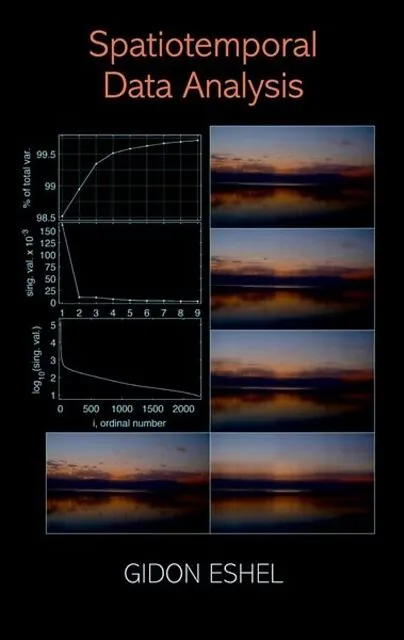
Spatiotemporal Data Analysis
Beschreibung
Zusatztext "I believe practitioners and theoreticians from many diverse fields will find the book comprehensive! detailed and beneficial. The material is applicable to a broad range of topics! and the author has a clear presentation with an in-class lecturing ...Format auswählen
- Fester EinbandCHF 158.00

Wird oft zusammen gekauft
Andere Kunden kauften auch
Beschreibung
Zusatztext "I believe practitioners and theoreticians from many diverse fields will find the book comprehensive! detailed and beneficial. The material is applicable to a broad range of topics! and the author has a clear presentation with an in-class lecturing tone." ---Elvan Ceyhan! Mathematical Reviews Clippings Informationen zum Autor Gidon Eshel Klappentext " Spatiotemporal Data Analysis is based on a lecture course that influenced the thesis work of every graduate student I knew in the department. This is due to the applicability of the material to a broad range of topics, and to Eshel's clear and insightful presentation." --David Archer, University of Chicago "A perfect and much-needed book for students and professionals tackling the complexities of data analysis in space and time. In my twenty-five years teaching in the environmental sciences, I've not encountered such a comprehensive and well-structured book that eloquently lays out the mathematical basis and data-analysis tools required to understand real-world environmental data structures with practical examples, applications, and problem assignments." --Alfredo Huete, University of Technology Sydney, Australia " Spatiotemporal Data Analysis is accessible and applicable without sacrificing rigor. The key is a steady stream of well-chosen examples and, most unusual in any textbook, a distinctive narrative voice that guides readers through the material, explaining the details while making sure the big picture is always in view. It will become an essential text for earth scientists and many others who analyze spatiotemporal data." --Mark Cane, Columbia University "This book offers an excellent survey of the mathematical aspects of spatiotemporal data analysis and will be useful to geoscientists in such applications as collecting, archiving, and interpreting satellite data. While treating some rather abstract matters, Eshel does not drown the reader in overly opaque notation but instead derives results and illustrates them with interesting examples, both numerical and conceptual." --Gerald R. North, Texas A&M University Zusammenfassung Introduces advanced undergraduate students, graduate students, and researchers to the statistical and algebraic methods used to analyze spatiotemporal data in a range of fields, including climate science, geophysics, ecology, astrophysics, and medicine....
Autorentext
Gidon Eshel
Klappentext
"Spatiotemporal Data Analysis is based on a lecture course that influenced the thesis work of every graduate student I knew in the department. This is due to the applicability of the material to a broad range of topics, and to Eshel's clear and insightful presentation."--David Archer, University of Chicago
"A perfect and much-needed book for students and professionals tackling the complexities of data analysis in space and time. In my twenty-five years teaching in the environmental sciences, I've not encountered such a comprehensive and well-structured book that eloquently lays out the mathematical basis and data-analysis tools required to understand real-world environmental data structures with practical examples, applications, and problem assignments."--Alfredo Huete, University of Technology Sydney, Australia
"Spatiotemporal Data Analysis is accessible and applicable without sacrificing rigor. The key is a steady stream of well-chosen examples and, most unusual in any textbook, a distinctive narrative voice that guides readers through the material, explaining the details while making sure the big picture is always in view. It will become an essential text for earth scientists and many others who analyze spatiotemporal data."--Mark Cane, Columbia University
"This book offers an excellent survey of the mathematical aspects of spatiotemporal data analysis and will be useful to geoscientists in such applications as collecting, archiving, and interpreting satellite data. While treating some rather abstract matters, Eshel does not drown the reader in overly opaque notation but instead derives results and illustrates them with interesting examples, both numerical and conceptual."--Gerald R. North, Texas A&M University
Zusammenfassung
Introduces advanced undergraduate students, graduate students, and researchers to the statistical and algebraic methods used to analyze spatiotemporal data in a range of fields, including climate science, geophysics, ecology, astrophysics, and medicine.
Inhalt
Preface xi Acknowledgments xv> Part 1. Foundations Chapter One: Introduction and Motivation 1 Chapter Two: Notation and Basic Operations 3 Chapter Three: Matrix Properties, Fundamental Spaces, Orthogonality 12 3.1 Vector Spaces 12 3.2 Matrix Rank 18 3.3 Fundamental Spaces Associated with A d R M # N 23 3.4 Gram-Schmidt Orthogonalization 41 3.5 Summary 45 Chapter Four: Introduction to Eigenanalysis 47 4.1 Preface 47 4.2 Eigenanalysis Introduced 48 4.3 Eigenanalysis as Spectral Representation 57 4.4 Summary 73 Chapter Five: The Algebraic Operation of SVD 75 5.1 SVD Introduced 75 5.2 Some Examples 80 5.3 SVD Applications 86 5.4 Summary 90 Part 2. Methods of Data Analysis Chapter Six: The Gray World of Practical Data Analysis: An Introduction to Part 2 95 Chapter Seven Statistics in Deterministic Sciences: An Introduction 96 7.1 Probability Distributions 99 7.2 Degrees of Freedom 104 Chapter Eight: Autocorrelation 109 8.1 Theoretical Autocovariance and Autocorrelation Functions of AR(1) and AR(2) 118 8.2 Acf-derived Timescale 123 8.3 Summary of Chapters 7 and 8 125 Chapter Nine: Regression and Least Squares 126 9.1 Prologue 126 9.2 Setting Up the Problem 126 9.3 The Linear System Ax = b 130 9.4 Least Squares: The SVD View 144 9.5 Some Special Problems Giving Rise to Linear Systems 149 9.6 Statistical Issues in Regression Analysis 165 9.7 Multidimensional Regression and Linear Model Identification 185 9.8 Summary 195 Chapter Ten:. The Fundamental Theorem of Linear Algebra 197 10.1 Introduction 197 10.2 The Forward Problem 197 10.3 The Inverse Problem 198 Chapter Eleven:. Empirical Orthogonal Functions 200 11.1 Introduction 200 11.2 Data Matrix Structure Convention 201 11.3 Reshaping Multidimensional Data Sets for EOF Analysis 201 11.4 Forming Anomalies and Removing Time Mean 204 11.5 Missing Values, Take 1 205 11.6 Choosing and Interpreting the Covariability Matrix 208 11.7 Calculating the EOFs 218 11.8 Missing Values, Take 2 225 11.9 Projection Time Series, the Principal Components 228 11.10 A Final Realistic and Slightly Elaborate Example: Southern New York State Land Surface Temperature 234 11.11 Extended EOF Analysis, EEOF 244 11.12 Summary 260 Chapter Twelve:. The SVD Analysis of Two Fields 261 12.1 A Synthetic Example 265 12.2 A Second Synthetic Example 268 12.3 A Real Data Example 271 12.4 EOFs as a Prefilter to SVD 273 12.5 Summary 274 Chapter Thirteen:. Suggested Homework 276 13.1 Homework 1, Corresponding to Chapter 3 276 13.2 Homework 2, Corresponding to Chapter 3 283 13.3 Homework 3, Corresponding to Chapter 3 290 13.4 Homework 4, Corresponding to Chapter 4 292 13.5 Homework 5, Corresponding to Chapter 5 296 13.6 Homework 6, Corresponding to Chapter 8 300 13.7 A Suggested Midterm Exam 303 13.8 A Suggested Final Exam 311 Index 313