
IHR WARENKORB IST AKTUELL LEER.
Haben Sie noch nichts passendes gefunden? Stöbern Sie durch unser komplettes Sortiment.
Oder melden Sie sich an bzw. registrieren Sie sich.
- Kostenlose Lieferung
- Kauf auf Rechnung
- Ex Libris Tiefpreis
- Filiallieferung und 650+ Abholorte
- Rabatt-Bons als Club-Mitglied
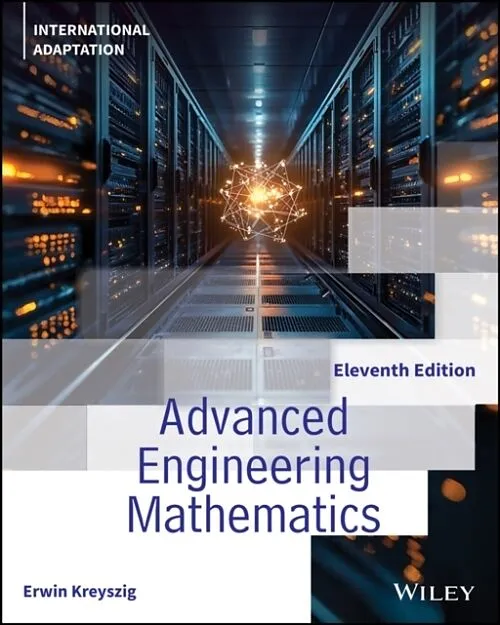
Advanced Engineering Mathematics, International Adaptation
Beschreibung
Autorentext ERWIN KREYSZIG, Professor of Mathematics, Ohio State University, Columbus, Ohio. Klappentext Advanced Engineering Mathematics, 11th Edition, is known for its comprehensive coverage, careful and correct mathematics, outstanding exercises, and self-c...Format auswählen
- Kartonierter EinbandCHF 110.00

Wird oft zusammen gekauft
Andere Kunden kauften auch
Beschreibung
Autorentext
ERWIN KREYSZIG, Professor of Mathematics, Ohio State University, Columbus, Ohio.
Klappentext
Advanced Engineering Mathematics, 11th Edition, is known for its comprehensive coverage, careful and correct mathematics, outstanding exercises, and self-contained subject matter parts for maximum flexibility. It opens with ordinary differential equations and ends with the topic of mathematical statistics. The analysis chapters address: Fourier analysis and partial differential equations, complex analysis, and numeric analysis. The book is written by a pioneer in the field of applied mathematics. This comprehensive volume is designed to equip students and professionals with the mathematical tools necessary to tackle complex engineering challenges and drive innovation.
This edition of the text maintains those aspects of the previous editions that have led to the book being so successful. In addition to introducing a new appendix on emerging topics in applied mathematics, each chapter now features a dedicated section on how mathematical modeling and engineering can address environmental and societal challenges, promoting sustainability and ethical practices. This edition includes a revision of the problem sets, making them even more effective, useful, and up-to-date by adding the problems on open-source mathematical software.
Inhalt
TABLE OF CONTENTS PART A Ordinary Differential Equations (ODEs)
CHAPTER 1 First-Order ODEs
1.1 Basic Concepts. Modeling
1.2 Geometric Meaning of y' = (x, y). Direction Fields, Euler's Method
1.3 Separable ODEs. Modeling
1.4 Exact ODEs. Integrating Factors
1.5 Linear ODEs. Bernoulli Equation. Population Dynamics
1.6 Orthogonal Trajectories. Optional
1.7 Existence and Uniqueness of Solutions for Initial Value Problems
Sustainability and Ethical Considerations
Chapter 1 Review Questions and Problems
Summary of Chapter 1
CHAPTER 2 Second-Order Linear ODEs
2.1 Homogeneous Linear ODEs of Second Order
2.2 Homogeneous Linear ODEs with Constant Coefficients
2.3 Differential Operators. Optional
2.4 Modeling of Free Oscillations of a Mass-Spring System
2.5 Euler-Cauchy Equations
2.6 Existence and Uniqueness of Solutions. Wronskian
2.7 Nonhomogeneous ODEs
2.8 Modeling: Forced Oscillations. Resonance
2.9 Modeling: Electric Circuits
2.10 Solution by Variation of Parameters
Sustainability and Ethical Considerations
Chapter 2 Review Questions and Problems
Summary of Chapter 2
CHAPTER 3 Higher Order Linear ODEs
3.1 Homogeneous Linear ODEs
3.2 Homogeneous Linear ODEs with Constant Coefficients
3.3 Nonhomogeneous Linear ODEs
Sustainability and Ethical Considerations
Chapter 3 Review Questions and Problems
Summary of Chapter 3
CHAPTER 4 Systems of ODEs. Phase Plane. Qualitative Methods
4.0 For Reference: Basics of Matrices and Vectors
4.1 Systems of ODEs as Models in Engineering Applications
4.2 Basic Theory of Systems of ODEs. Wronskian
4.3 Constant-Coefficient Systems. Phase Plane Method
4.4 Criteria for Critical Points. Stability
4.5 Qualitative Methods for Nonlinear Systems
4.6 Nonhomogeneous Linear Systems of ODEs
Sustainability and Ethical Considerations
Chapter 4 Review Questions and Problems
Summary of Chapter 4
CHAPTER 5 Series Solutions of ODEs. Special Functions
5.1 Power Series Method
5.2 Legendre's Equation. Legendre Polynomials (x)
5.3 Extended Power Series Method: Frobenius Method
5.4 Bessel's Equation. Bessel Functions (x)
5.5 Bessel Functions of the (x). General Solution
Sustainability and Ethical Considerations
Chapter 5 Review Questions and Problems
Summary of Chapter 5
CHAPTER 6 Laplace Transforms
6.1 Laplace Transform. Linearity. First Shifting Theorem (s-Shifting)
6.2 Transforms of Derivatives and Integrals. ODEs
6.3 Unit Step Function (Heaviside Function). Second Shifting Theorem (t-Shifting)
6.4 Short Impulses. Dirac's Delta Function. Partial Fractions
6.5 Convolution. Integral Equations
6.6 Differentiation and Integration of Transforms. ODEs with Variable Coefficients
6.7 Systems of ODEs
6.8 Laplace Transform: General Formulas
6.9 Table of Laplace Transforms
Sustainability and Ethical Considerations
Chapter 6 Review Questions and Problems
Summary of Chapter 6
PART B Linear Algebra. Vector Calculus
CHAPTER 7 Linear Algebra: Matrices, Vectors, Determinants. Linear Systems
7.1 Matrices, Vectors: Addition and Scalar Multiplication
7.2 Matrix Multiplication
7.3 Linear Systems of Equations. Gauss Elimination
7.4 Linear Independence. Rank of a Matrix. Vector Space
7.5 Solutions of Linear Systems: Existence, Uniqueness
7.6 For Reference: Second- and Third-Order Determinants
7.7 Determinants. Cramer's Rule
7.8 Inverse of a Matrix. Gauss-Jordan Elimination
7.9 Vector Spaces, Inner Product Spaces. Linear Transformations. Optional
Sustainability and Ethical Considerations
Chapter 7 Review Questions and Problems
Summary of Chapter 7
CHAPTER 8 Linear Algebra: Matrix Eigenvalue Problems
8.1 The Matrix Eigenvalue Problem. Determining Eigenvalues and Eigenvectors
8.2 Some Applications of Eigenvalue Problems
8.3 Symmetric, Skew-Symmetric, and Orthogonal Matrices
8.4 Eigenbases. Diagonalization. Quadratic Forms
8.5 Complex Matrices and Forms. Optional
Sustainability and Ethical Considerations
Chapter 8 Review Questions and Problems
Summary of Chapter 8
CHAPTER 9 Vector Differential Calculus. Grad, Div, Curl
9.1 Vectors in 2-Space and 3-Space
9.2 Inner Product (Dot Product)
9.3 Vector Product (Cross Product)
9.4 Vector and Scalar Functions and Their Fields. Vector Calculus: Derivatives
9.5 Curves. Arc Length. Curvature. Torsion
9.6 Calculus Review: Functions of Several Variables. Optional
9.7 Gradient of a Scalar Field. Directional Derivative
9.8 Divergence of a Vector Field
9.9 Curl of a Vector Field
Sustainability and Ethical Considerations
Chapter 9 Review Questions and Problems
Summary of Chapter 9
CHAPTER 10 Vector Integral Calculus. Integral Theorems
10.1 Line Integrals
10.2 Path Independence of Line Integrals
10.3 Calculus Review: Double Integrals. Optional
10.4 Green's Theorem in the Plane
10.5 Surfaces for Surface Integrals
10.6 Surface Integrals
10.7 Triple Integrals. Divergence Theorem of Gauss
10.8 Further Applications of the Divergence Theorem
10.9 Stokes's Theorem
Sustainability and Ethical Considerations
Chapter 10 Review Questions and Problems
Summary of Chapter 10
PART C Fourier Analysis. Partial Differential Equations (PDEs)
CHAPTER 11 Fourier Analysis
11.1 Fourier Series
11.2 Arbitrary Period. Even and Odd Functions. Half-Range Expansions
11.3 Forced Oscillations
11.4 Approximation by Trigonometric Polynomials
11.5 Sturm-Liouville Problems. Orthogonal Functions
11.6 Orthogonal Series. Generalized Fourier Series
11.7 Fourier Integral
11.8 Fourier Cosine and Sine Transforms
11.9 Fourier Transform. Discrete and Fast Fourier Transforms
11.10 Tables of Transforms
Sustainability and Ethical Considerations
Chapter 11 Review Questions and Problems
Summary of Chapter 11
CHAPTER 12 Partial Differential Equations (PDEs)
12.1 Basic Concepts of PDEs
12.2 Modeling: Vibrating String, Wave Equation
12.3 Solution by Separating Variables. Use of Fourier Series
12.4 D'Alembert's Solution of the Wave Equation. Characteristics
12.5 Modeling: Heat Flow from a Body in Space. Heat Equation
12.6 Heat Equation: Solution by Fourier Series. Steady Two-Dimensional Heat Problems. Dirichlet Problem
12.7 Heat Equation: Modeling Very Long Bars. Solution by Fourier Integrals and Transforms
12.8 Modeling: Membrane, Two-Dimensional Wave Equation
12.9 Rectangular Membrane. Do…