Beschreibung
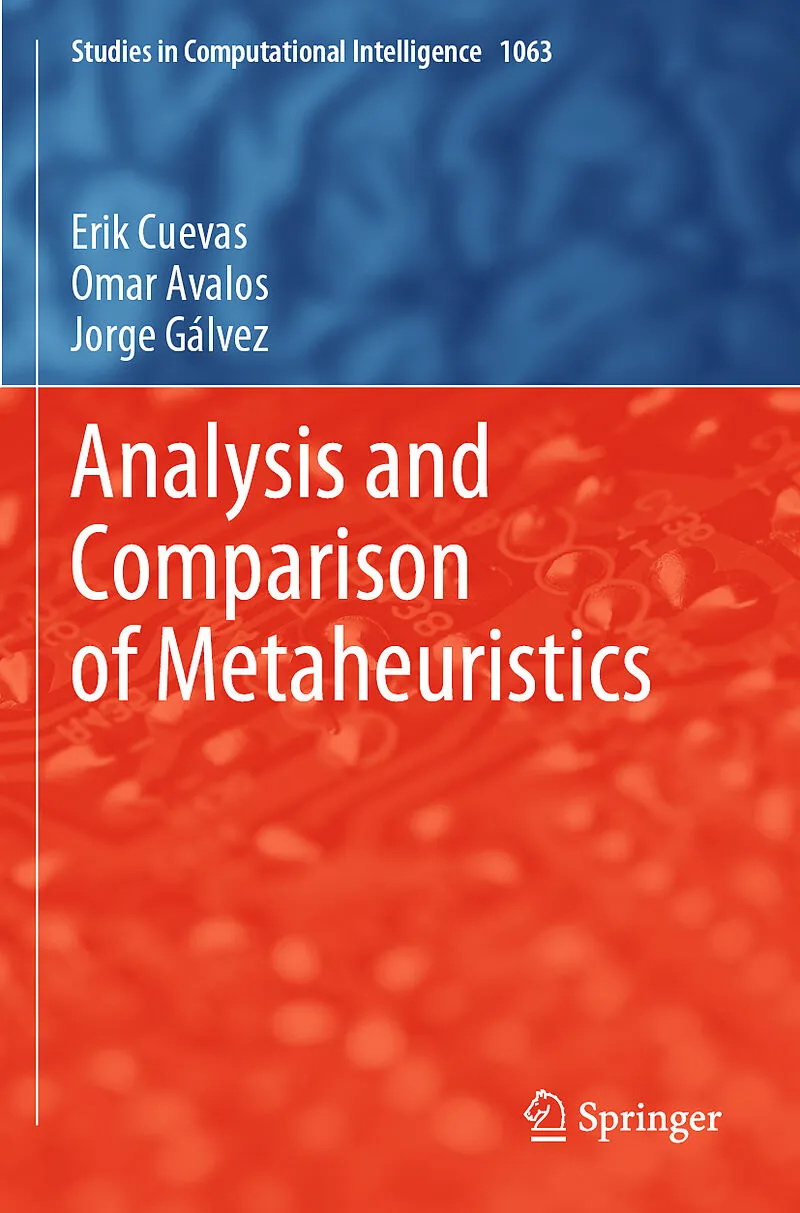
This book presents a comparative perspective of current metaheuristic developments, which have proved to be effective in their application to several complex problems. The study of biological and social entities such as animals, humans, or insects that manifes...This book presents a comparative perspective of current metaheuristic developments, which have proved to be effective in their application to several complex problems. The study of biological and social entities such as animals, humans, or insects that manifest a cooperative behavior has produced several computational models in metaheuristic methods. Although these schemes emulate very different processes or systems, the rules used to model individual behavior are very similar. Under such conditions, it is not clear to identify which are the advantages or disadvantages of each metaheuristic technique. The book is compiled from a teaching perspective. For this reason, the book is primarily intended for undergraduate and postgraduate students of Science, Electrical Engineering, or Computational Mathematics. It is appropriate for courses such as Artificial Intelligence, Electrical Engineering, Evolutionary Computation. The book is also useful for researchers from the evolutionary and engineering communities. Likewise, engineer practitioners, who are not familiar with metaheuristic computation concepts, will appreciate that the techniques discussed are beyond simple theoretical tools since they have been adapted to solve significant problems that commonly arise in engineering areas.
Presents a comparative perspective of current metaheuristic developments Includes effective applications to several complex problems Gives an introduction to Analysis and Comparison of Metaheuristics from a teaching perspective
Autorentext
Dr. Erik Cuevas received his B.S. degree with distinction in Electronics and Communications Engineering from the University of Guadalajara, Mexico, in 1995, the M.Sc. degree in Industrial Electronics from ITESO, Mexico, in 2000, and the Ph.D. degree from Freie Universität Berlin, Germany in 2006. Since 2006 he has been with the University of Guadalajara, where he is currently a full-time Professor in the Department of Computer Science. Since 2008, he is a member of the Mexican National Research System (SNI III). He is the author of several books and articles. A list of his books and publications can be seen in the CV attached to this application. His current research interest includes Meta-heuristics, computer vision, and mathematical methods. He serves as an editor in Expert System with Applications, ISA Transactions, and Applied Soft Computing, Applied Mathematical Modeling and Mathematics and Computers in Simulation. Alma Rodriguez earned her Bachelor of Science in Industrial Engineering and her Master's degree from CETI, Mexico, in 2005 and 2007, respectively. She went on to achieve her Doctorate in Engineering from the Universidad de Guadalajara, located in Guadalajara, Mexico, in 2021. Dr. Rodriguez has made her mark as an author of numerous engineering-related scientific publications. She contributed as a co-author to the publication "Recent Metaheuristic Computation Schemes in Engineering," released by Springer International Publishing. Her research primarily focuses on the areas of Metaheuristic Algorithms, Supplier Selection, Inventory Theory, and the broader field of optimization.Beatriz Rivera received a B.S. degree with distinction in Computer Engineering from UNIVA, México, a M.Sc. degree in Engineering Systems from UANL, México. Since 2014, she has been with The University of Guadalajara, where she is currently a Professor and enrolled in the Ph.D. program in Electronics and Computer Science. Her current research interests are metaheuristic algorithms and artificial intelligence. Jesús López obtained a bachelor's degree in Communications and Electronics Engineering in 2009 and a Master of Science degree in Electronic and Computer Engineering in 2014 from Centro Universitario de Ciencias Exactas e Ingenierías (CUCEI) of the University of Guadalajara, Mexico. He is currently pursuing a Ph. D. in Science degree in Electronic and Computer Engineering from 2021 at the University of Guadalajara. Collaborator in the development of two patents: "Magnetic levitator system for balancing a biped robot" and "Variable transmission system based on gear assemblies forming a truncated sphere". His research interests include metaheuristics algorithms, artificial intelligence, robotics topics, artificial vision, and their applications. Carlos Guzmán received the bachelor's degree in Mechatronics Engineering from Universidad Politécnica de Sinaloa, Mexico in 2020 and a M.Sc. degree in Electronic and Computer Engineering in 2023 from the University of Guadalajara, Mexico. He is currently pursuing a Ph.D degree in Electronics and Computer Science at the University of Guadalajara, Mexico. His research interests include artificial vision and their applications.
Inhalt
Fundamentals of Metaheuristic Computation.- A Comparative Approach for Two-Dimensional Digital IIR Filter Design Applying Different Evolutionary Computational Techniques.- Comparison of Metaheuristics for Chaotic Systems Estimation.- Comparison Study of Novel Evolutionary Algorithms for Elliptical Shapes in Images.- IIR System Identification using Several Optimization Techniques: A Review Analysis.- Fractional-order Estimation using Locust Search Algorithm.- Comparison of Optimization Techniques for Solar Cells Parameter Identification.- Comparison of Metaheuristics Techniques and Agent-Based Approaches. <p