
IHR WARENKORB IST AKTUELL LEER.
Haben Sie noch nichts passendes gefunden? Stöbern Sie durch unser komplettes Sortiment.
Oder melden Sie sich an bzw. registrieren Sie sich.
- Kostenlose Lieferung
- Kauf auf Rechnung
- Ex Libris Tiefpreis
- Filiallieferung und 650+ Abholorte
- Rabatt-Bons als Club-Mitglied
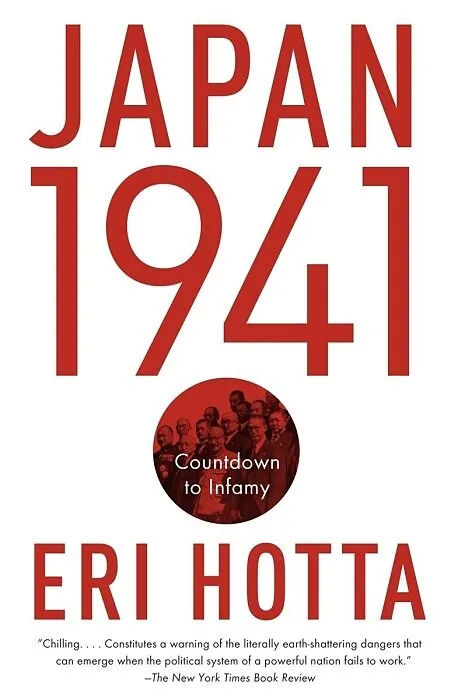
Japan 1941
Beschreibung
Zusatztext 90915564 Informationen zum Autor Eri Hotta, born in Tokyo and educated in Japan, the U.S., and the U.K., has taught at Oxford, in Tokyo, and in Jerusalem, specializing in international relations. Klappentext A Kirkus Reviews Best Nonfiction Book of ...Format auswählen
- Kartonierter EinbandCHF 24.70

Wird oft zusammen gekauft
Andere Kunden kauften auch
Beschreibung
Zusatztext 90915564 Informationen zum Autor Eri Hotta, born in Tokyo and educated in Japan, the U.S., and the U.K., has taught at Oxford, in Tokyo, and in Jerusalem, specializing in international relations. Klappentext A Kirkus Reviews Best Nonfiction Book of the YearA groundbreaking history that considers the attack on Pearl Harbor from the Japanese perspective and is certain to revolutionize how we think of the war in the Pacific.When Japan attacked the United States in 1941, its leaders, in large part, understood they were entering a war they were almost certain to lose. In a groundbreaking history that considers Pearl Harbor from the Japanese perspective, certain to revolutionize how we think of the war in the Pacific, Eri Hotta poses essential questions overlooked for the last seventy years: Why did these men-military men, civilian politicians, diplomats, the emperor-put their country and its citizens in harm's way? Why did they make a decision that was doomed from the start? Introducing us to the doubters, bluffers, and schemers who led their nation into this conflagration, Hotta brilliantly shows us a hidden Japan-eager to avoid war but fraught with tensions with the West, deluded by reckless militarism, tempted by the gambler's dream of scoring the biggest win against impossible odds and nearly escaping disaster before it finally proved inevitable. PROLOGUE What a Difference a Day Makes In the early-morning hours of a frosty day, December 8, 1941, the Japanese nation woke to astonishing news. It was announced, shortly after seven, that Japan had entered into a situation of war with the United States and Britain in the Western Pacific before dawn. Though no specifics were given, by then the U.S. naval base at Pearl Harbor, on Oahu, had been successfully attackedthe first wave of planes was dispatched at 1:30 a.m., Japanese time, and the surprise operation was completed by 5:30 a.m. When news of the attack arrived at 11:30 a.m., the nation was electrified. This was soon followed by Japan's formal declaration of war on the Allies and the report of its further military successes in British Malaya and Hong Kong. (The Malayan operation actually preceded the Pacific offensive by almost two hours.) Throughout the day, the public broadcasting network, NHK, aired twelve special news reports in addition to six regularly scheduled ones for the millions of Japanese glued to their radios. On what, because of the time difference, had been December 7 in Hawaii, the air force division of the Imperial Japanese Navy had sunk or damaged numerous ships, aircraft, and military facilities. About twentyfour hundred people were killed in the raid or died shortly afterward from their injuries. The devastating attack was carried out without a formal termination of diplomatic relations by Japan, let alone a declaration of war, a heavy, infamous legacy for the nation. But such tactical details did not interest ordinary Japanese citizens on December 8. The immediate public reaction was one of celebration. When Japan sent planes to attack Pearl Harbor, it was mired in economic and political uncertainties. A sense of helplessness pervaded its population as the state took more and more control of public life. From the beginning of Japan's war with China in mid-1937, its people were led to believe a swift, decisive victory was imminent. Despite all the announcements of Japanese victories in China, however, the Guomindang (a.k.a. Kuomintang, frequently referred to as the Nationalist Party) leader Chiang Kai-shek was not about to give up. Similar to Napoleon's army in Russia, the Japanese forces were drawn far too deep into harsh, unfamiliar terrain to carry out an effective operation. The jingoistic tone of Japan's media coverage continued regardless, but people were privately beginning to question why the war had not ended. Though largely ignorant of ...
“Hotta illuminates the extraordinary ideological and military predicament in which Japan found itself in the months before the attack on Pearl Harbor…[She] brings to life the key figures of a deeply divided Japanese leadership…[and] scrupulously details [their] negotiations and squabbles…against a backdrop of dauntingly complex domestic and international maneuverings.”
—*The New Yorker
*
“Outstanding...In lucid prose, Hotta...persuasively sketches the very distinct personalities shaping the decisions that drove Japan toward war….She makes it clear that there are two versions of the Asia-Pacific War in China and Japan that hardly meet at all…[and] concludes that after 1945, Japan’s actual ‘past, with its improbable story of how the war came to pass, became another country.’ It is a country that policymakers in Tokyo, Beijing, and Washington should seek to understand, not least through this humane and fair-minded book.”
—Rana Mitter, *The New York Review of Books
*
"Chilling…Constitutes a warning of the literally earth-shattering dangers that can emerge when the political system of a powerful nation fails to work."
—The New York Times Book Review
“Hotta’s groundbreaking work is both a fascinating history and a cautionary tale for those who wield power today.”
—The Dallas Morning News
“[Hotta’s] account is a warning to any country that would talk itself into a foolish war.”
—The Seattle Times
“In this focused, informed and persuasive book…Hotta effortlessly returns us to the moment just before the dice were so disastrously rolled. From a perspective little known to Americans, a masterful account of how and why World War II began.”
—Kirkus Reviews
*
*“A fascinating read for anyone interested in Japan’s involvement in World War II…While scholarly and thoroughly researched, it’s also a highly enjoyable read…A real page turner.”
—Library Journal
“In this fast-moving, persuasive account of Japan's road to Pearl Harbor, Eri Hotta describes the pathetic leadership of a country who argue among themselves endlessly when the crisis across the Pacific requires decisive action to preserve the peace. It is a story of self-delusion, irresponsibility, and ignorance from which Japan is not entirely free even today.”
—Akira Iriye, author of *Pearl Harbor and the Coming of the Pacific War
*
“This ambitious, groundbreaking history builds new layers atop a story that we thought we knew.”
—Everyday eBook
“Finely nuanced…[Hotta] forcefully reframes how we should consider the Japanese with respect to their positions as emerging world powers in [an]…era of international turmoil.
—Asian American Literature Fans
“Riveting…This important book should be in every major library. It will interest anyone attempting to make sense of Pearl Harbor, the Pacific War, or bureaucratic dysfunction and its possibly tragic consequences.”
—Choice
Autorentext
Eri Hotta, born in Tokyo and educated in Japan, the U.S., and the U.K., has taught at Oxford, in Tokyo, and in Jerusalem, specializing in international relations.
Klappentext …