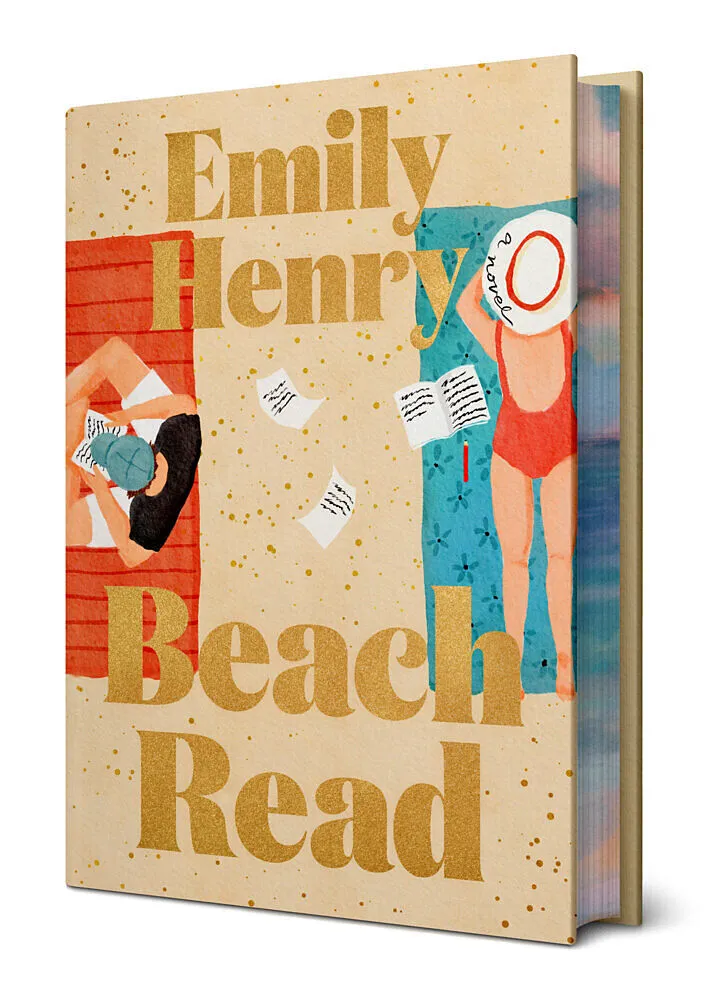
Beach Read. Deluxe Edition
Beschreibung
A special hardcover edition of Autorentext Emily Henry is the #1 New York Times bestselling author of Great Big Beautiful Life, Funny Story, Happy Place, Book Lovers, People We Meet on Vacation, and Beach Read. She studied creative writing at Hope College, and...Format auswählen
- Fester EinbandCHF 37.20
- Kartonierter EinbandCHF 19.90

Wird oft zusammen gekauft
Andere Kunden kauften auch
Beschreibung
A special hardcover edition of
Autorentext
Emily Henry is the #1 New York Times bestselling author of Great Big Beautiful Life, Funny Story, Happy Place, Book Lovers, People We Meet on Vacation, and Beach Read. She studied creative writing at Hope College, and now spends most of her time in Cincinnati, Ohio, and the part of Kentucky just beneath it. Find her on Instagram @emilyhenrywrites.
Klappentext
Emily Henry’s beloved New York Times bestselling novel now in this stunning hardcover collector’s edition featuring:
**• A shimmering revamped cover
• Sunset sky art endpapers and sprayed edges
• Gold foil stamped case, and...
• A new introduction from the author and a bonus January and Gus epilogue, “The Layover”**
A romance writer who no longer believes in love and a literary writer stuck in a rut engage in a summer-long challenge that may just upend everything they believe about happily ever afters.
Augustus Everett is an acclaimed author of literary fiction. January Andrews writes bestselling romance. When she pens a Happily Ever After, he kills off his entire cast.
They’re polar opposites.
In fact, the only thing they have in common is that for the next three months they’re living in neighboring beach houses, broke and bogged down with writer’s block.
Then one hazy evening, one thing leads to another and they strike a deal designed to force them out of their creative ruts: Augustus will spend the summer writing something happy, and January will pen the next Great American Novel. She’ll take him on field trips worthy of any rom-com montage, and he’ll take her to interview surviving members of a backwoods death cult (obviously). Everyone will finish a book and no one will fall in love. Really.
“A tender, thoughtful, and very funny book…it’s not only convincing but infectious.”—The New York Times Book Review
Leseprobe
9781984806734|excerpt
Henry / BEACH READ
1
The House
I have a fatal flaw.
I like to think we all do. Or at least that makes it easier for me when I m writing building my heroines and heroes up around this one self-sabotaging trait, hinging everything that happens to them on a specific characteristic: the thing they learned to do to protect themselves and can t let go of, even when it stops serving them.
Maybe, for example, you didn t have much control over your life as a kid. So, to avoid disappointment, you learned never to ask yourself what you truly wanted. And it worked for a long time. Only now, upon realizing you didn t get what you didn t know you wanted, you re barreling down the highway in a midlife-crisis-mobile with a suitcase full of cash and a man named Stan in your trunk.
Maybe your fatal flaw is that you don t use turn signals.
Or maybe, like me, you re a hopeless romantic. You just can t stop telling yourself the story. The one about your own life, complete with melodramatic soundtrack and golden light lancing through car windows.
It started when I was twelve. My parents sat me down to tell me the news. Mom had gotten her first diagnosis suspicious cells in her left breast and she told me not to worry so many times I suspected I d be grounded if she caught me at it. My mom was a do-er, a laugher, an optimist, not a worrier, but I could tell she was terrified, and so I was too, frozen on the couch, unsure how to say anything without making things worse.
But then my bookish homebody of a father did something unexpected. He stood and grabbed our hands one of Mom s, one of mine and said, You know what we need to get these bad feelings out? We need to dance!
Our suburb had no clubs, just a mediocre steak house with a Friday night cover band, but Mom lit up like he d just suggested taking a private jet to the Copacabana.
She wore her buttery yellow dress and some hammered metal earrings that twinkled when she moved. Dad ordered twenty-year-old Scotch for them and a Shirley Temple for me, and the three of us twirled and bobbed until we were dizzy, laughing, tripping all over. We laughed until we could barely stand, and my famously reserved father sang along to Brown Eyed Girl like the whole room wasn t watching us.
And then, exhausted, we piled into the car and drove home through the quiet, Mom and Dad holding tight to each other s hands between the seats, and I tipped my head against the car window and, watching the streetlights flicker across the glass, thought, It s going to be okay. We will always be okay.
And that was the moment I realized: when the world felt dark and scary, love could whisk you off to go dancing; laughter could take some of the pain away; beauty could punch holes in your fear. I decided then that my life would be full of all three. Not just for my own benefit, but for Mom s, and for everyone else around me.
There would be purpose. There would be beauty. There would be candlelight and Fleetwood Mac playing softly in the background.
The point is, I started telling myself a beautiful story about my life, about fate and the way things work out, and by twenty-eight years old, my story was perfect.
Perfect (cancer-free) parents who called several times a week, tipsy on wine or each other s company. Perfect (spontaneous, multilingual, six foot three) boyfriend who worked in the ER and knew how to make coq au vin. Perfect shabby chic apartment in Queens. Perfect job writing romantic novels inspired by perfect parents and perfect boyfriend for Sandy Lowe Books.
Perfect life.
But it was just a story, and when one gaping plot hole appeared,