Haben Sie noch nichts passendes gefunden? Stöbern Sie durch unser komplettes Sortiment.
Oder melden Sie sich an bzw. registrieren Sie sich.


Beschreibung
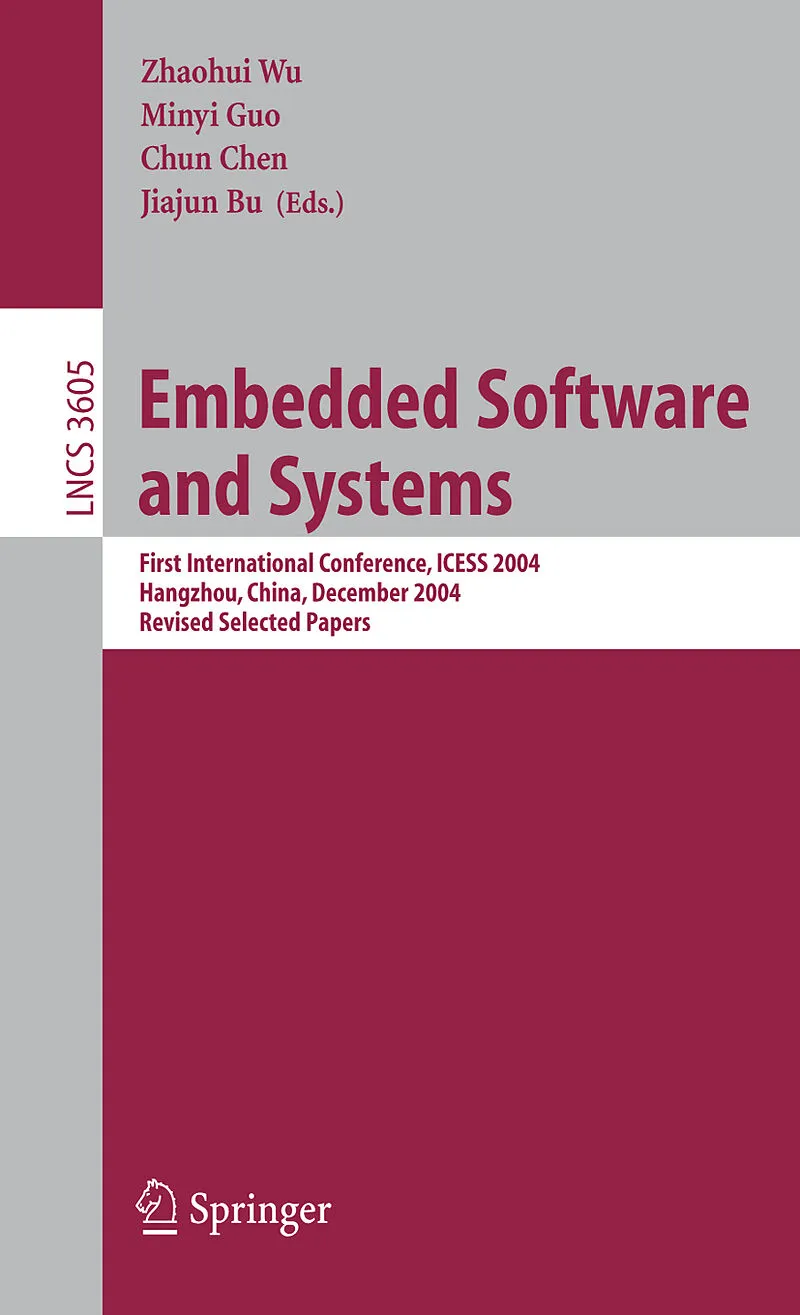
Welcome to the post proceedings of the First International Conference on Embedded Software and Systems (ICESS 2004), which was held in Hangzhou, P. R. China, 910 December 2004. Embedded Software and Systems technology is of increasing importance for a wide ran...Welcome to the post proceedings of the First International Conference on Embedded Software and Systems (ICESS 2004), which was held in Hangzhou, P. R. China, 910 December 2004. Embedded Software and Systems technology is of increasing importance for a wide range of industrial areas, such as aerospace, automotive, telecommunication, and manufacturing automation. Embedded technology is playing an increasingly dominant role in modern society. This is a natural outcome of amazingly fast developments in the embedded field. The ICESS 2004 conference brought together researchers and developers from academia, industry, and government to advance the science, engineering, and technology in embedded software and systems development, and provided them with a forum to present and exchange their ideas, results, work in progress, and experience in all areas of embedded systems research and development. The ICESS 2004 conference attracted much more interest than expected. The total number of paper submissions to the main conference and its three workshops, namely, Pervasive Computing, Automobile Electronics and Tele-communication, was almost 400, from nearly 20 countries and regions. All submissions were reviewed by at least three Program or Technical Committee members or external reviewers. It was extremely difficult to make the final decision on paper acceptance because there were so many excellent, foreseeing, and interesting submissions with brilliant ideas.
Includes supplementary material: sn.pub/extras
Autorentext
Zhaohui Wu is a Professor at the Department of Computer Science, Zhejiang University, Hangzhou, China. He has authored more than 200 refereed papers and 6 books. His research interests include pervasive computing, intelligent system, and semantic grid. And Gang Pan is a Professor at the same institute. He is mainly interested in pervasive computing, intelligent system, and computer vision. Quan Chen is currently an assistant professor at the Department of Computer Science and Engineering, Shanghai Jiao Tong University (SJTU), Shanghai, China. Before joining the SJTU, he pursued his post-doctoral research at the University of Michigan's Department of Computer Science, Ann Arbor, USA from 2014 to 2016. He received his MS degree in 2009 and his PhD degree in 2014, both from the SJTU. During his PhD, he was a research associate at the Department of Computer Science of Columbia University, USA from 2013 to 2014. From 2010 to 2011, he was a visiting scholar at the Department of Computer Science, University of Otago, New Zealand. His research interests include high-performance computing, task scheduling for various architectures, and resource management in datacenters, runtime systems and operating systems. His dissertation was honored with the Shanghai Excellent Doctoral Dissertation Award and the China Computer Federation (CCF) Excellent Doctoral Dissertation Award. Minyi Guo is a Zhiyuan Chair Professor and head of the Department of Computer Science and Engineering at Shanghai Jiao Tong University (SJTU), Shanghai, China. He is also the director of the SJTU's Embedded and Pervasive Computing Center. He received his BS and ME degrees in Computer Science from Nanjing University, China in 1982 and 1986, respectively. From 1986 to 1994, he served as an assistant professor at the Department of Computer Science, Nanjing University. He received his PhD degree in Information Science from the University of Tsukuba, Japan in 1998. His research interests include parallel and distributed processing, parallelizing compilers, cloud computing, pervasive computing, software engineering, embedded systems, green computing, and wireless sensor networks. He is an associate editor for IEEE Transactions on Parallel and Distributed Systems (TPDS), Journal of Parallel and Distributed Computing (JPDC), and Journal of Computer Science and Technology(JCST). He has published numerous articles in prominent journals, and has authored books with Springer. Further, he has led many research projects including Natural Science Foundation of China (NSFC) projects, 863 projects and 973 projects. Chun Chen is a professor from Department of Cultural Heritage and Museology of Fudan University. He has obtained his Ph.D. from McGill University in Montreal, Canada in 1992. His research interests include Paleolithic archaeology, archaeological method and theory, transition from hunter-gathering to food production, origin of civilization and early states. He has published widely in the field, including A Story of Early Man in China; Theory and Research in Archaeology; Archaeological Theory; Archaeology of the present; Exploration of the Origin of Civilization and Early States; Introduction to Archaeological Research; Frontiers of Archaeology: Theories and Issues; From Prehistory to Civilization; Essays of Armchair Archaeology.
Inhalt
Keynote Speeches and Invited Talks Abstracts (Partial).- Track 1 Distributed Embedded Computing.- Track 2 Embedded Systems.- Track 3 Embedded Hardware and Architecture.- Track 4 Middleware for Embedded Computing.- Track 5 Mobile Systems.- Track 6 Transducer Network.- Track 7 Embedded Operating System.- Track 8 Power-Aware Computing.- Track 9 Real-Time System.- Track 10 Embedded System Verification and Testing.- Track 11 Software Tools for Embedded Systems.