
IHR WARENKORB IST AKTUELL LEER.
Haben Sie noch nichts passendes gefunden? Stöbern Sie durch unser komplettes Sortiment.
Oder melden Sie sich an bzw. registrieren Sie sich.
- Kostenlose Lieferung
- Kauf auf Rechnung
- Ex Libris Tiefpreis
- Filiallieferung und 650+ Abholorte
- Rabatt-Bons als Club-Mitglied
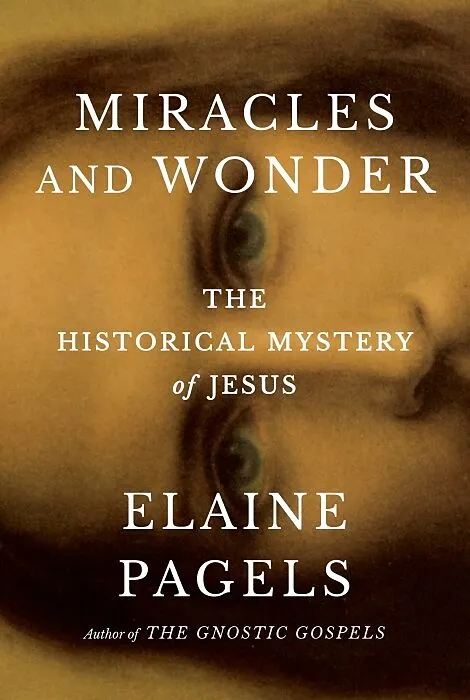
Miracles and Wonder
Beschreibung
From the award-winning author of Elaine Pagels changed our understanding of the origins of Christianity with her work on the Gnostic Gospels. Now, in the culmination of a decades-long career, she explores her most ambitious subject, the life of Jesus himself. ...Format auswählen
- Fester EinbandCHF 31.60

Wird oft zusammen gekauft
Andere Kunden kauften auch
Beschreibung
From the award-winning author of Elaine Pagels changed our understanding of the origins of Christianity with her work on the Gnostic Gospels. Now, in the culmination of a decades-long career, she explores her most ambitious subject, the life of Jesus himself. The story Pagels tells is thrilling and tense. Not just Jesus comes to life, but his desperate, hunted followers as well. They were writing in wartime and under occupation, she reminds us, endangered for spreading the gospel of a man who was executed as an insurrectionist.; Some of the most electrifying details in the Gospels, Pagels writes, may have been crafted by his disciples to avoid persecution and explain inconvenient facts. So Jesus wasn’t illegitimate; instead, his mother conceived by God.; Jesus’ body wasn’t humiliatingly tossed into a common grave; he was seen alive and whole by his followers. He wasn’t a failed messiah; his kingdom lives in us. Drawing on a lifetime of study and Pagels’ own personal journey, <Miracles and Wonders< ;beautifully depicts this lost world and captures Jesus’s enduring power to inspire and attract.
Autorentext
ELAINE PAGELS is the Harrington Spear Paine Professor of Religion at Princeton University. In 2015 she received the National Humanities Medal from President Barack Obama, and earlier in her career was awarded a Rockefeller, Guggenheim, and MacArthur fellowship in consecutive years. As a young researcher at Barnard College, she changed the historical landscape of the Christian religion by exploding the myth of the early Church as a unified movement. Her findings were published in the bestselling book The Gnostic Gospels (1979), which won both the National Book Critics Circle Award and the National Book Award. Her subsequent books include Why Religion? Revelations, Reading Judas, Beyond Belief, The Origin of Satan, and Adam, Eve, and the Serpent. She has been profiled in Time, The Atlantic, Vogue, The New Yorker, and Newsweek's issue "Women and Power."
Klappentext
**NEW YORK TIMES BESTSELLER • From a renowned National Book Award–winning scholar, an extraordinary new account of the life of Jesus that explores the mystery of how a poor young man inspired a religion that reshaped the world.
“This is a brilliant and necessary book. Sober, wise, respectful, and fearless." —Jon Meacham, author of The Soul of America
"Pagels’s story is for believers and non-believers alike.” —Tara Westover, author of Educated
"The depth of spirituality she uncovers is profound.” —The New York Times Book Review**
Early in her career, Elaine Pagels changed our understanding of the origins of Christianity with her work in The Gnostic Gospels. Now, in the culmination of a decades-long career, she explores the biggest subject of all, Jesus. In Miracles and Wonder she sets out to discover how a poor young Jewish man inspired a religion that shaped the world.
The book reads like a historical mystery, with each chapter addressing a fascinating question and answering it based on the gospels Jesus's followers left behind. Why is Jesus said to have had a virgin birth? Why do we say he rose from the dead? Did his miracles really happen and what did they mean?
The story Pagels tells is thrilling and tense. Not only does Jesus come to life but his desperate, hunted followers do as well. We realize that some of the most compelling details of Jesus's life may have been written by his disciples to paper over inconvenient facts, perhaps to avoid persecution. So Jesus wasn't illegitimate, as some said, but his mother conceived by God; Jesus’s body wasn’t left on the cross—instead, he was seen alive by his followers; Jesus isn’t a failed messiah—his kingdom lives in us. These details and promises electrified the Gospel writer’s listeners and helped his followers’ numbers grow.
In Miracles and Wonder, Pagels does more than indicate solutions to a historical mystery. She sheds light on Jesus's enduring power to inspire and attract.
Leseprobe
1
The Virgin Birth: What Happened?
Jesus’s Family and the Circumstances of His Birth
Perhaps the most unusual feature of the gospel stories is the virgin birth: What might it mean? How do the gospel writers say that it happened, and why? When I first started to ask these questions, I found many surprises. I’d always assumed that there was only one birth story, having seen different versions merged into one on Christmas Eve in our small Methodist church in California, when we acted out the children’s pageant, dressed as angels crowned with sparkling halos, or shepherds or kings with paper crowns, arriving to greet the baby Jesus, a doll cradled by the girl who’d scored the role of Mary. But when I went back to investigate the birth story, I was amazed to see that, although the New Testament gospels of Matthew and Luke agree that Jesus was a royal prince, born in Bethlehem, and that heavenly signs announced his birth, at nearly every other point each tells a very different story.
I was also surprised to see that the earliest written narrative of Jesus’s life in the Bible, the Gospel of Mark, tells us nothing about the circumstances of his birth, and nearly nothing about his family background. The same is true of the last of the four New Testament gospels, the Gospel of John, but the other two, the Gospel of Luke and the Gospel of Matthew, tell us a great deal, each offering many details.
Both Luke and Matthew start by telling of Jesus’s family and lineage, and relating the circumstances of his birth and youth. Each offers a genealogy that traces Jesus’s paternal descent from his father, Joseph, to Israel’s royal dynasty, back to King David, circa 1000 b.c.e. As we’ve noted, both locate Jesus’s birth in Bethlehem, the city native to Israel’s kings. Both also claim that Jesus’s parents received divine visions about their future child and his destiny—heavenly signs, astrological portents that signified the arrival of a divinely appointed “Son of God.” Most amazing of all, both Matthew and Luke insist that Jesus’s birth involved a miracle unprecedented in the history of the world—a “virgin birth.”
To understand what each writer has in mind, we need to read these stories separately. Matthew begins by announcing that Jesus is God’s chosen Messiah, setting forth a genealogy that shows his descent from Israel’s greatest kings, David and Solomon. Then he tells how magi, astrologers from foreign lands, alerted by the appearance of a new star signaling the birth of a future king, travel to Jerusalem bearing royal gifts to honor the newborn prince. But news of the birth of a potential rival terrifies the reigning king, Herod the Great. After convening his entire court, he summons the foreign ambassadors, ordering them to find the child and return to tell Herod how to locate him.
Although a familiar story in Luke’s gospel pictures Jesus’s parents traveling to Bethlehem, seeking an inn, and finding none, Matthew, surprisingly, says that his parents had a house in Bethlehem, ancestral city of the Davidic dynasty. Then, he says, the heavenly sign, the Christmas star, led the magi to their home (Matthew 2:10). Overwhelmed with joy, they enter the house and, seeing the child with Mary, his mother, kneel down to pay homage, opening their treasure chests to offer gold, frankincense, and myrrh. But after they secretly depart from Jerusalem, eluding Herod, the enraged king orders his soldiers to slaughter all male Jewish babies under the age of two—a fate Jesus escapes only because his father, Joseph, immediately takes his family into hiding in Egypt. Only lat…