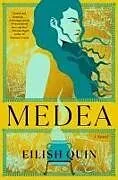
Medea
Beschreibung
Autorentext Eilish Quin Klappentext Discover the full story of the sorceress Medea, one of the most reviled and maligned women of Greek antiquity, in this propulsive and evocative debut in the tradition of Circe, Elektra, and Stone Blind. Among the women of Gr...Format auswählen
- Fester EinbandCHF 29.20

Wird oft zusammen gekauft
Andere Kunden kauften auch
Beschreibung
Autorentext
Eilish Quin
Klappentext
Discover the full story of the sorceress Medea, one of the most reviled and maligned women of Greek antiquity, in this propulsive and evocative debut in the tradition of Circe, Elektra, and Stone Blind.
Among the women of Greek mythology, the witch Medea may be the most despised. Known for the brutal act of killing her own children to exact vengeance on her deceitful husband, the Argonauts leader Jason, Medea has carved out a singularly infamous niche in our histories.
But what if that isn’t the full story?
The daughter of a sea nymph and the granddaughter of a Titan, Medea is a paradox. She is at once rendered compelling by virtue of the divinity that flows through her bloodline and made powerless by the fact of her being a woman. As a child, she intuitively submerges herself in witchcraft and sorcery, but soon finds it may not be a match for the prophecies that hang over her entire family like a shroud.
As Medea comes into her own as a woman and a witch, she also faces the arrival of the hero Jason, preordained by the gods to be not only her husband, but also her lifeline to escape her isolated existence. Medea travels the treacherous seas with the Argonauts, battles demons she had never conceived of, and falls in love with the man who may ultimately be her downfall.
In this propulsive, beautifully written debut, readers will finally hear Medea’s side of the story through a fresh and feminist lens.
Zusammenfassung
In the tradition of Circe, The Witch's Heart, and Ariadne, a propulsive, beautifully written debut about Circe's niece, Medea, whose destiny is shaped by her early years on the lonely island of Kolchis, her growing expertise in the art of sorcery, and her intense, but doomed love for the Argonauts' leader Jason.
Leseprobe
Chapter One: The Naiad CHAPTER ONE The Naiad
Of the Oceanids, there were innumerable. My mother was the youngest, and so too lately born to be a novelty among the Titans or the Gods. By the time she emerged, lithe and childlike from the edge of the Black Sea, her pale hair stuck wetly down her back and her eyes dark and swollen with salt, she already knew what she was.
Her own mother, Tethys, possessed a maritime attractiveness. Below the surface of the water, her eyes were a murky sea green, all shadow and gloom, looming out from skin so pale it glowed with a strange bioluminescence. On the occasions that she was dredged up from her repose beneath the waves, those same eyes glittered and gleamed like molten bronze when they caught the sun. She had polished thousands of children inside of her, had sheltered and shaped them in the womb of the ocean itself. And she had nursed them on the sweet fresh water from which she drew her own powers. If she had been mortal, she might have felt her body shoring against itself, straining under the pressure of producing infant after infant. But she was a Titan, the wet nurse of the earth. And so, she gave birth to the rivers, which roared with vitality, and the streams, which moved more softly; the clouds that grew heavy with rainwater; and the springs that bubbled up from the center of the world. Such was the fertility of Tethys.
From the Titan who birthed her, my mother acquired two things. The first was a body. Miniature and without blemish, skin as smooth and transparent as sea glass. The child was anointed in oils and swaddled in strands of kelp. Tethys, wan and exhausted from labor, handed over the newborn willingly into the arms of her other daughters.
The second gift my grandmother gave before returning to her own chambers beneath the sea was a name.
Idyia. Tethys would have conveyed it in her usual manner, a manner that did not involve language, for there was no need for words among the old Gods. And then, a promise, as her womb began to reknit itself. She will be the last of your brood.
And so it was Idyia’s sisters who whispered to the youngest the secrets of herself, explained the jagged gills that loomed like lacerations down her neck, and the webbing between her fingers and toes. Playfully they would trace, with graceful, darting fingers, the veins, which stood pronounced under the blue-green highlights of her skin. So perfectly was she suited for the sea that should she have beached herself, no mortal could possibly have confused her for a human child.
From her sisters, she understood that she was not quite a nymph, but a Naiad. They passed her among themselves, delighted by the fair hair that curled at the back of her neck.
For the children of Titans, time does not pass in the way it might for mortals. My mother spent only a matter of painful hours teething, and by the end of that first day, had gained a set of pale, pointed fangs. Her expressive eyes, initially a clouded sea green, would polish themselves in her infant sockets until they were clear gray orbs. How queer it must have been to hold her, to reconcile the supple sweetness of her newborn face with the deadly power of her muscles, the vivid sharpness of her fingernails.
From her father, Oceanus, she knew intimately of her own naturalness. He informed her in the same way he informed all his daughters, somewhere between conception and the accumulating sentience of each successive rippling impulse. She was the thing that flowed, a current that ebbed and settled itself like a compulsion. The urge that heaved against riverbanks. A shored thing. An infinite thing. She could be cut, by ship or swimmer, but never wounded. This is water’s divinity.
It was known that the daughters of Tethys and Oceanus made enviable wives. Although each was distinct, all possessed a perilous beauty—the kind of aching loveliness that drew sailors to their graves. In these daughters flowed the source of all things, and the Olympians, from on high, had ordained that they should preside over the young, nourishing and nurturing in the manner that they themselves were accustomed to. So alluring were the Oceanids that Zeus himself took some for wives.
And so when my father, Aeetes, landed upon the rocky shores of Kolchis, his eagle eyes penetrating and sharp, already surveying the land for what he could extract from it, Idyia came willingly out from the surf. It would be easier this way—if the local Naiad came to the new king’s bed willingly. They already shared blood; the new king of Kolchis was Idyia’s nephew, the peculiar and solitary son of her elder sister Perses. Even before his eyes fell on her and fixed upon the damp ringlets of her hair and the startling whiteness of her face, she knew what she would be to him. Even with the primordial essence of the earth and sky mixing in her veins, she was still only a woman.
My father built his palace at the edge of the cliffs overhanging the Black Sea. Perhaps he wanted to make his new bride feel more at home on dry land, or perhaps the construction was an homage to his own sea nymph mother. In truth, I suspect his reasons were not so straightforward or sentimental. My father, who was capable of all manner of things, from the breathtaking to the nightmarish, was naturally suspicious of every other creature he encountered. He assumed his own propensity for darkness flourished in them as well. His house, that palatial manifestation of his own power, should provoke terror in the hearts of his enemies, and kindle admiration in the breasts of his allies. A fortress straddling land and sea was militarily advantageous, aesthetically intimidating, and ideally situated for his experimentation.
But Idyia had little interest in the accommodations of mortal men. While her husband marveled at her neat ankles and luminous golden hair, she stared restlessly out of windows at the churning waters below, her yearning couched delicately on an elbow.
In the begin…