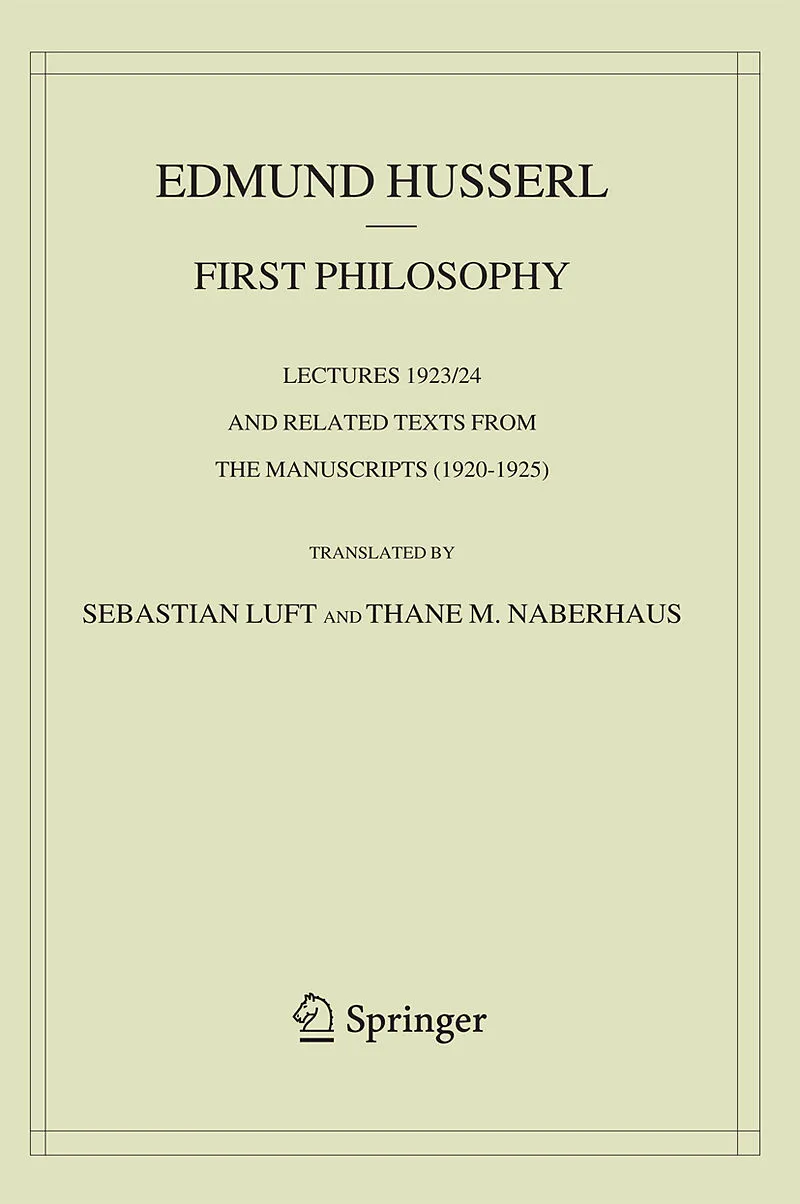
First Philosophy
Beschreibung
This volume presents, for the first time in English, Husserl's seminal 1923/24 lecture course First Philosophy ( Erste Philosophie ) together with a selection of material from the famous research manuscripts of the same time period. The lecture course is divi...Format auswählen
- Kartonierter EinbandCHF 140.40
- Fester EinbandCHF 196.80
- E-Book (pdf)CHF 142.90

Wird oft zusammen gekauft
Andere Kunden kauften auch
Beschreibung
This volume presents, for the first time in English, Husserl's seminal 1923/24 lecture course First Philosophy ( Erste Philosophie ) together with a selection of material from the famous research manuscripts of the same time period. The lecture course is divided into two systematic, yet interrelated parts (Critical History of Ideas and Theory of the Phenomenological Reduction). It has long been recognized by scholars as among the most important of the many lecture courses he taught in his career. Indeed it was deemed as crucially important by Husserl himself, who composed it with a view toward eventual publication. It is unsurprising, then, that First Philosophy is the only lecture course that is consistently counted among his major works. In addition to furnishing valuable insights into Husserl's understanding of the history of philosophy, First Philosophy is his most sustained treatment of the phenomenological reduction,the central concept of his philosophical methodology. The selection of supplemental texts expands on the topics treated in the lectures, but also add other themes from Husserl's vast oeuvre. The manuscript material is especially worthwhile, because in it, Husserl offers candid self-criticisms of his publicly enunciated words, and also makes forays into areas of his philosophy that he was loath to publicize, lest his words be misunderstood.
As Husserl's position as a key contributor to contemporary thought has, with the passage of time, become increasingly clear, the demand for access to his writings in English has steadily grown. This translation strives to meet this demand by providing English-speaking readers access to this central Husserlian text. It will be of interest to scholars of Husserl's work, non-specialists, and students of phenomenology.
The first translation of one of Husserl's major texts into English Husserl's extensive treatment of the history of philosophy Husserl's self-critique of the phenomenological method
Autorentext
Sara Heinämaa is a Professor of Philosophy at the University of Jyväskylä and an Academy Professor (2017-2021). She specializes in classical and contemporary phenomenology, existentialism, and the history of philosophy, and has published extensively in these fields, especially on normativity, emotion, embodiment, and intersubjectivity. She is co-author of Birth, Death, and Femininity (Indiana UP, 2010), and author of Toward a Phenomenology of Sexual Difference (Rowman & Littlefield, 2003), and has co-edited several volumes, including Contemporary Phenomenologies of Normativity (Routledge, 2022), Phenomenology as Critique (Routledge 2022), and Phenomenology and the Transcendental (Routledge, 2014) and Consciousness (Springer, 2007). Anthony J. Steinbock is Professor of Philosophy, at Stony Brook University and Director, of the Phenomenology Research Center. He works in the areas of phenomenology, social ontology, aesthetics, and religious philosophy. His publications include works on generative phenomenology, religious experience, and emotions. He is the author of six books, most recently, Knowing by Heart: Loving as Participation and Critique (Northwestern University Press, 2021) and is the translator of Edmund Husserl's Analyses Concerning Passive and Active Synthesis (Kluwer, 2001). He is Editor-in-Chief, of Continental Philosophy Review, and General Editor, of Northwestern University Press "SPEP" Series. Andrew D. Barrette is currently an Assistant Professor of the Practice in the Philosophy Department at Boston College. He wrote his dissertation on Edmund Husserl's analyses of inquiry and history at Southern Illinois University Carbondale. During that research, he studied at the Husserl-Archives in Leuven, first as a Fulbright Scholar, then again as an International Research Fellow. He then did post-doctorate work at the Lonergan Institute and the Institute for Advanced Jesuit Studies, both at Boston College.