Beschreibung
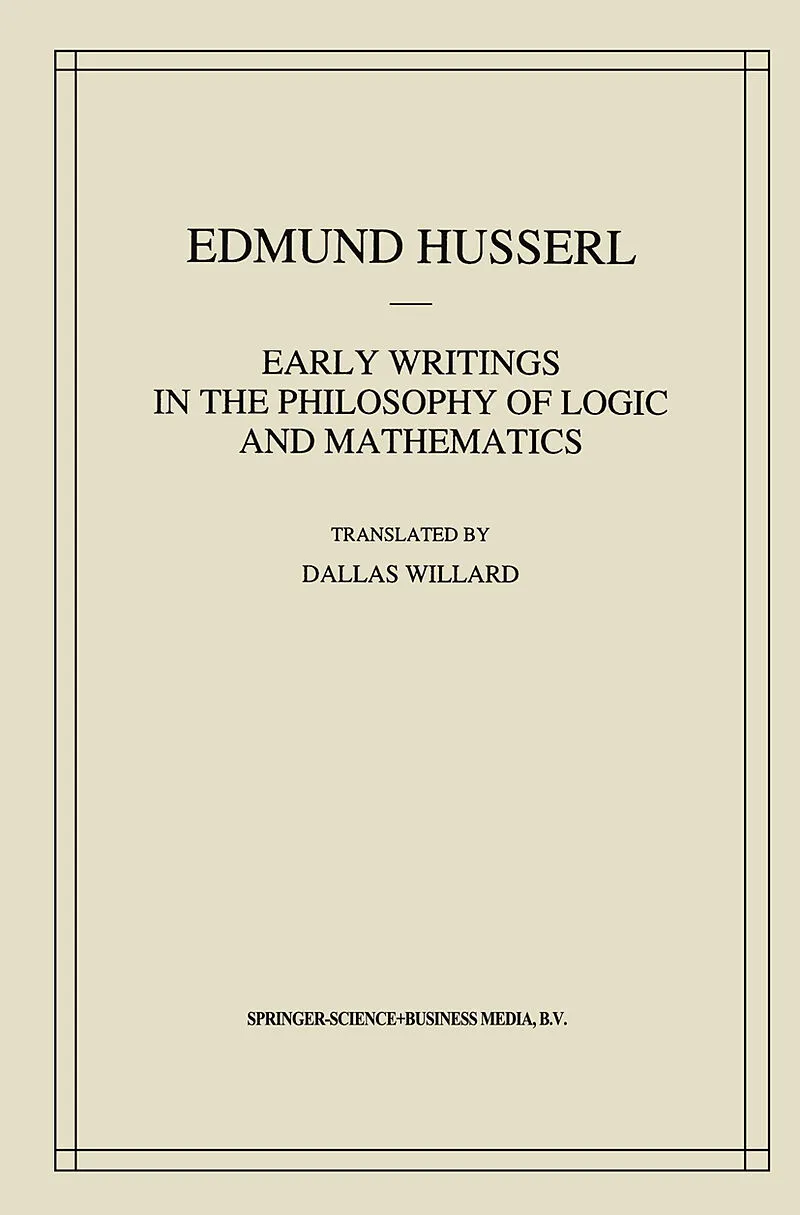
The primary intent of this volume is to give the English reader access to all the philosophical texts published by Husserl between the appearance of his first book, Philosophie der Arithmetik, and that of his second book, Logische Untersuchungen- roughly, from...The primary intent of this volume is to give the English reader access to all the philosophical texts published by Husserl between the appearance of his first book, Philosophie der Arithmetik, and that of his second book, Logische Untersuchungen- roughly, from 1890 through 1901. Along with these texts we have included a number of unpublished manuscripts from the same period and dealing with the same or closely related topics. A few of the texts here translated (the review of Pahigyi, the five "report" articles of 1903-1904, the "notes" in Lalande's Vocabulaire, and the brief discussion. article on Marty of 1910) obviously fall outside this time period, so far as their publication dates are concerned; but in content they seem clearly confined to it. The final piece translated, a set of personal notes that date from 1906 through 1908, provides insight into how Husserl experienced his early labors and their results, and into how he saw their relation to work before him: a phenomenological critique of reason in all of its forms. Thus the texts here translated - which obviously are to be read in conjunction with his first two books - cover the progression of Husserl's Problematik from the relatively narrow one of clarifying the epistemic structure of general arithmetic, to the all-encompassing one of establishing in principle, through phenomenological research, the line between legitimate and illegitimate claims to know or to be rational, regardless of the domain concerned.
Autorentext
Sara Heinämaa is a Professor of Philosophy at the University of Jyväskylä and an Academy Professor (2017-2021). She specializes in classical and contemporary phenomenology, existentialism, and the history of philosophy, and has published extensively in these fields, especially on normativity, emotion, embodiment, and intersubjectivity. She is co-author of Birth, Death, and Femininity (Indiana UP, 2010), and author of Toward a Phenomenology of Sexual Difference (Rowman & Littlefield, 2003), and has co-edited several volumes, including Contemporary Phenomenologies of Normativity (Routledge, 2022), Phenomenology as Critique (Routledge 2022), and Phenomenology and the Transcendental (Routledge, 2014) and Consciousness (Springer, 2007). Anthony J. Steinbock is Professor of Philosophy, at Stony Brook University and Director, of the Phenomenology Research Center. He works in the areas of phenomenology, social ontology, aesthetics, and religious philosophy. His publications include works on generative phenomenology, religious experience, and emotions. He is the author of six books, most recently, Knowing by Heart: Loving as Participation and Critique (Northwestern University Press, 2021) and is the translator of Edmund Husserl's Analyses Concerning Passive and Active Synthesis (Kluwer, 2001). He is Editor-in-Chief, of Continental Philosophy Review, and General Editor, of Northwestern University Press "SPEP" Series. Andrew D. Barrette is currently an Assistant Professor of the Practice in the Philosophy Department at Boston College. He wrote his dissertation on Edmund Husserl's analyses of inquiry and history at Southern Illinois University Carbondale. During that research, he studied at the Husserl-Archives in Leuven, first as a Fulbright Scholar, then again as an International Research Fellow. He then did post-doctorate work at the Lonergan Institute and the Institute for Advanced Jesuit Studies, both at Boston College.
Klappentext
This book makes available to the English reader nearly all of the shorter philosophical works, published or unpublished, that Husserl produced on the way to the phenomenological breakthrough recorded in his emLogical Investigations/em of 1900-1901. Here one sees Husserl's method emerging step by step, and such crucial substantive conclusions as that concerning the nature of Ideal entities and the status the intentional relation' and its objects'. Husserl's literary encounters with many of the leading thinkers of his day illuminates both the context and the content of his thought. Many of the groundbreaking analyses provided in these texts were never again to be given the thorough expositions found in these early writings.br/ emEarly Writings in the Philosophy of Logic and Mathematics/em is essential reading for students of Husserl and all those who enquire into the nature of mathematical and logical knowledge.
Inhalt
Translator's Introduction. 1. The Concept of General Arithmetic. 2. Arithmetic as an A Priori Science. 3. Letter from E. Husserl to Carl Stumpf. 4. On the Logic of Signs (Semiotic). 5. Review of Ernst Schröder's Vorlesungen über die Algebra der Logik. 6. The Deductive Calculus and the Logic of Contents. 7. Addenda: the Deductive Calculus and the Logic of Contents. 8. A. Voigt's Elemental Logic', in relation to my Statements on the Logic of the Logical Calculus. 9. Concerning the Calculus of the Logic of Contents: Rejoinder to Mr. Husserl's Article (by A. Voigt). 10. Husserl's Reply to the Foregoing Rejoinder'. 11. Psychological Studies in the Elements of Logic.12. Report on German Writings in Logic from the Year 1894. 13. Review of Melchior Palágyi's Der Streit der Psychologisten und Formalisten in der modernen Logik. 14. Report on German Writings in Logic: from the Years 1895-1899. 15. Comments in Lalande, Vocabulaire technique et critique de la philosophie. 16. Review of A. Marty, Untersuchungen zur Grundlegung der allgemeinen Grammatik und Sprachphilosophie. 17. Intuition and Repräsentation, Intention and Fulfilment. 18. Intentional Objects. 19. Discussion of K. Twardowski, Zur Lehre vom Inhalt und Gegenstand der Vorstellungen. 20. Discussion of H. Cornelius, Versuch einer Gheorie der Existentialurteile. 21. Appendices to Husserliana XXII. 22. `Personal Notes'. Index.