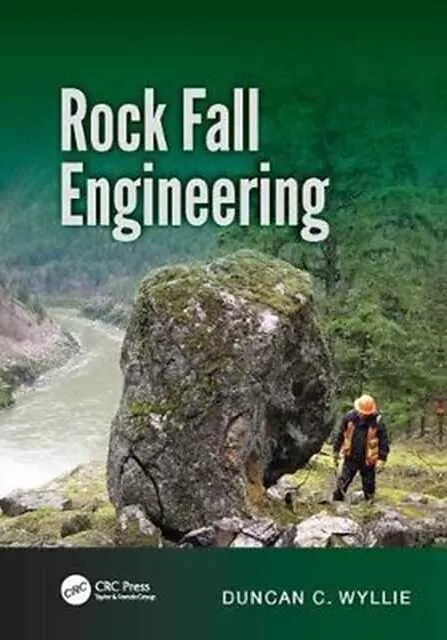
Rock Fall Engineering
Beschreibung
Rock falls can be a public safety issue; this book provides comprehensive information on the identification of these hazards related to geology, climate and topography, and the design and construction of protection structures. It sets out the theoretical back...
Format auswählen
- Kartonierter EinbandCHF 126.80

Wird oft zusammen gekauft
Andere Kunden kauften auch
Beschreibung
Rock falls can be a public safety issue; this book provides comprehensive information on the identification of these hazards related to geology, climate and topography, and the design and construction of protection structures. It sets out the theoretical background to rock fall behaviour in terms of impact and trajectory phases of rock falls, and applies this to the modeling of falls and the design of high impact energy capacity attenuator fences. The theory is supported by information from five carefully documented rock fall case studies.
Rock falls can be a public safety issue. This book provides comprehensive information on identification of these hazards, and design and construction of protection methods.
Rock Fall Engineering describes first, the theoretical background to rock fall behavior in terms of the impact and trajectory phases of rock falls, and second, how this information is applied to modeling of rock falls and the design of ditches, fences and sheds. The theory of rock fall behavior is verified by comparing the calculations with five carefully documented case studies.
The book covers four main topics as follows:
- Describes causes of rock falls, including geology, climate and topography, and provides detailed documentation on rock fall impacts and trajectories at five sites with a wide variety of topographic and geologic features
- Discusses theory of impact mechanics, and its application to velocity and energy changes during impacts and trajectories
- Reviews methods of modeling rock fall events, and presents analyses for the five case studies
- Examines rock fall protection in terms of selecting appropriate method(s) for site conditions, and design principles in which the objective is to absorb impact energy in an efficient manner
This book, which contains many worked examples, is of interest to practitioners and researchers working in the fields of geological engineering and natural hazards.
Duncan C. Wyllie is a principal with Wyllie & Norrish Rock Engineers in Vancouver, Canada, and a registered professional engineer in British Columbia. He has worked on rock fall hazard projects involving the design and construction protection measures since the 1970s. He is the author of Foundations on Rock, Second Edition, and Rock Slope Engineering, Fourth Edition, both published by CRC Press.
"This book provides an invaluable perspective to engineers and geologists dealing with rock slope failures: not so much what causes the failures in the first instance, but what happens to the rock masses as they move, and therefore how to analyse them. I don't think that there is a good, systematic, treatment elsewhere."Eddie Bromhead, retired from Kingston University, London, UK" a comprehensive book containing both the theory and practice of rock fall engineering. The author is experienced not only in these subjects but also in compiling books that present the material in a particularly easy-to-understand mannerwhich will be appreciated by all readers whether they be engineers, contractors, clients, researchers, teachers or students. In short, this book contains the necessary information to understand and design rock fall protection."Emeritus Professor John A. Hudson, Imperial College London
Autorentext
Duncan C. Wyllie has a physics degree from the University of London and engineering degrees from the University the New South Wales, Australia and the University of California, Berkeley. He is a principal with Wyllie & Norrish Rock Engineers in Vancouver, Canada, and a registered professional engineer in British Columbia. Duncan Wyllie has lectured widely and has also authored or co-authored a number of textbooks on applied rock mechanics including Foundations on Rock (1st and 2nd editions in 1989 and 2001), and Rock Slope Engineering, Fourth Edition (2002), both published by Taylor & Francis.
Inhalt
Rock FallsCauses and Consequences. Documentation of Rock Fall Events. Rock Fall Velocities and Trajectories. Impact Mechanics. Coefficient of Restitution. Energy Changes during Impacts and Trajectories. Rock Fall Modeling. Selection of Protection Structures. Design Principles of Rock Fall Protection Structures. Rock Fall Protection IBarriers, Nets, and Fences. Rock Fall Protection IIRock Sheds. Appendices: Impact MechanicsNormal Coefficient of Restitution, Impact MechanicsImpact of Rough, Rotating Bodies, Energy Loss Equations, Conversion Factors. References.