
IHR WARENKORB IST AKTUELL LEER.
Haben Sie noch nichts passendes gefunden? Stöbern Sie durch unser komplettes Sortiment.
Oder melden Sie sich an bzw. registrieren Sie sich.
- Kostenlose Lieferung
- Kauf auf Rechnung
- Ex Libris Tiefpreis
- Filiallieferung und 650+ Abholorte
- Rabatt-Bons als Club-Mitglied
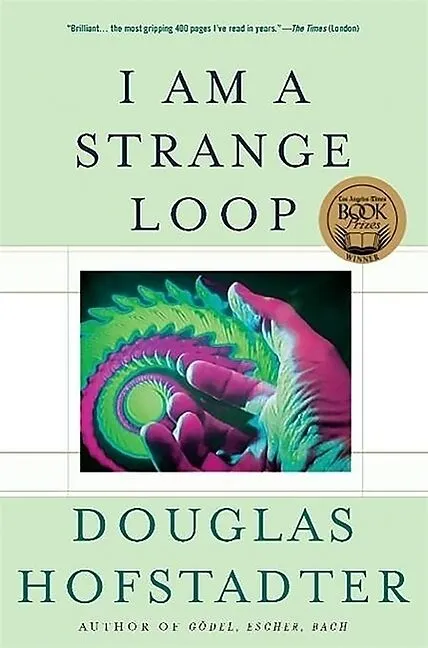
I Am a Strange Loop
Beschreibung
One of our greatest philosophers and scientists of the mind asks, where does the self come from--and how our selves can exist in the minds of others Can thought arise out of matter? Can self, soul, consciousness, I" arise out of mere matter? If it cannot,...Format auswählen
- Kartonierter EinbandCHF 29.20

Wird oft zusammen gekauft
Andere Kunden kauften auch
Beschreibung
One of our greatest philosophers and scientists of the mind asks, where does the self come from--and how our selves can exist in the minds of others Can thought arise out of matter? Can self, soul, consciousness, I" arise out of mere matter? If it cannot, then how can you or I be here? I Am a Strange Loop argues that the key to understanding selves and consciousness is the strange loop",a special kind of abstract feedback loop inhabiting our brains. The most central and complex symbol in your brain is the one called I." The I" is the nexus in our brain, one of many symbols seeming to have free will and to have gained the paradoxical ability to push particles around, rather than the reverse. How can a mysterious abstraction be real,or is our I" merely a convenient fiction? Does an I" exert genuine power over the particles in our brain, or is it helplessly pushed around by the laws of physics? These are the mysteries tackled in I Am a Strange Loop , Douglas Hofstadter's first book-length journey into philosophy since Gödel, Escher, Bach . Compulsively readable and endlessly thought-provoking, this is a moving and profound inquiry into the nature of mind.
Informationen zum Autor Douglas R. Hofstadter?is College of Arts and Sciences?Distinguished?Professor of Cognitive Science and?Comparative Literature?at Indiana University, Bloomington. He is the author?of the Pulitzer Prize-winning Gödel, Escher, Bach;?Metamagical?Themas;?Fluid Concepts and Creative Analogies;?Translator, Trader;?and?most recently,?Ambigrammia: Between Creation and?Discovery.??He translated?Alexander?Pushkin's novel-in-verse?Eugene Onegin?from?Russian?verse?into English?verse, and?has also?translated books from?several other?languages?into English. Klappentext One of our greatest philosophers and scientists of the mind examines where the self comes from and how our selves can exist in the minds of others. I Am a Strange Loop?is a work of rigorous thinking, but it's also an extraordinary tribute to the memory of romantic love:?The Year of Magical Thinking?for mathematicians. ?Time Deep down, your brain is a chaotic seething soup of particles. On a higher level it is a jungle of neurons, and on a yet higher level it is a network of abstractions that we call symbols. The most central and complex symbol is the one you call I. An I is a strange loop where the brain's symbolic and physical levels feed back into each other and flip causality upside down so that symbols seem to have gained the paradoxical ability to push particles around, rather than the reverse. To each human being, this I is the realest thing in the world. But how can such a mysterious abstraction be real? Is our I merely a convenient fiction? Does I exert genuine power over the particles in our brain, or is it helplessly pushed around by the all-powerful laws of physics? These are among the mysteries tackled in I Am a Strange Loop, Douglas Hofstadter's first book-length journey into philosophy since his Pulitzer Prize-winning Gödel, Escher, Bach. It is a tale crisply told, rife with anecdotes, analogies, and metaphors cutting-edge philosophy that any strange loop can understand. Zusammenfassung One of our greatest philosophers and scientists of the mind asks, where does the self come from--and how our selves can exist in the minds of others...
Autorentext
Douglas R. Hofstadter is College of Arts and Sciences Distinguished Professor of Cognitive Science and Comparative Literature at Indiana University, Bloomington. He is the author of the Pulitzer Prize-winning Gödel, Escher, Bach; Metamagical Themas; Fluid Concepts and Creative Analogies; “Translator, Trader”; and most recently, Ambigrammia: Between Creation and Discovery. He translated Alexander Pushkin’s novel-in-verse *Eugene Onegin *from Russian verse into English verse, and has also translated books from several other languages into English.
Klappentext
**One of our greatest philosophers and scientists of the mind examines where the self comes from – and how our selves can exist in the minds of others.
“I Am a Strange Loop is a work of rigorous thinking, but it’s also an extraordinary tribute to the memory of romantic love: The Year of Magical Thinking for mathematicians.” ―Time**
Deep down, your brain is a chaotic seething soup of particles. On a higher level it is a jungle of neurons, and on a yet higher level it is a network of abstractions that we call “symbols.” The most central and complex symbol is the one you call “I.” An “I” is a strange loop where the brain’s symbolic and physical levels feed back into each other and flip causality upside down so that symbols seem to have gained the paradoxical ability to push particles around, rather than the reverse.
To each human being, this “I” is the realest thing in the world. But how can such a mysterious abstraction be real? Is our “I” merely a convenient fiction? Does “I” exert genuine power over the particles in our brain, or is it helplessly pushed around by the all-powerful laws of physics?
These are among the mysteries tackled in I Am a Strange Loop, Douglas Hofstadter’s first book-length journey into philosophy since his Pulitzer Prize-winning Gödel, Escher, Bach. It is a tale crisply told, rife with anecdotes, analogies, and metaphors – cutting-edge philosophy that any strange loop can understand.