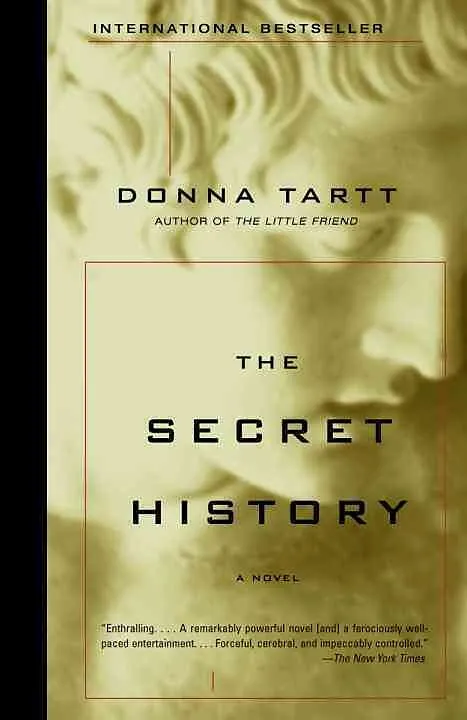
The Secret History
Beschreibung
A transfer student from a small town in California, Richard Papen is determined to affect the ways of his Hampden College peers, and he begins his intense studies under the tutelage of eccentric Julian Morrow Autorentext DONNA TARTT is the author of the novels...Format auswählen
- Fester EinbandCHF 37.20

Wird oft zusammen gekauft
Andere Kunden kauften auch
Beschreibung
A transfer student from a small town in California, Richard Papen is determined to affect the ways of his Hampden College peers, and he begins his intense studies under the tutelage of eccentric Julian Morrow
Autorentext
DONNA TARTT is the author of the novels The Secret History, The Little Friend, and The Goldfinch. Her work has been published in forty languages and her third novel, The Goldfinch, was awarded the Carnegie Medal and the Pulitzer Prize for Fiction.
Klappentext
Storytelling in the grand manner, The Secret History is a debut remarkable for its hypnotic erudition and acute psychological suspense, and for the richness of its emotions, ideas, and language. These are the confessions, years afterward, of a young man who found at a small Vermont college the life of privilege and intellect he'd long coveted - and rarely has the glorious experience of youth infatuated with knowledge and with itself been so achingly realized. Then, amazed, Richard Papen is drawn into the ultimate inner circle: five students, worldly and self-assured, selected by a charismatic classics professor to participate in the search for truth and beauty. Together they study the mysteries of ancient Greek culture and spend long weekends at an old country house, reading, boating, basking in an Indian summer that stretches late into autumn. Mesmerized by his new comrades, Richard is unaware of the crime which they have committed in his dreamy, unwitting presence. But once taken into their confidence, he and the others slowly and inevitably begin to believe in the necessity of murdering the one classmate and friend who might betray both their secret and their future. Hugely ambitious and compulsively readable, this is a chronicle of deception and complicity, of Dionysian abandon, of innocence corrupted by self-love and moral arrogance; and, finally, it is a story of guilt and responsibility. An astonishing achievement by any standard, The Secret History immediately establishes Donna Tartt as a supremely gifted novelist.
Zusammenfassung
****A READ WITH JENNA BOOK CLUB PICK • ONE OF TIME MAGAZINE'S 100 BEST MYSTERY AND THRILLER BOOKS OF ALL TIME • INTERNATIONAL BESTSELLER • A contemporary literary classic and "an accomplished psychological thriller ... absolutely chilling" (Village Voice), from the Pulitzer Prize–winning author of *The Goldfinch.
*****One of The Atlantic’s Great American Novels of the Past 100 Years
Under the influence of a charismatic classics professor, a group of clever, eccentric misfits at a New England college discover a way of thought and life a world away from their banal contemporaries. But their search for the transcendent leads them down a dangerous path, beyond human constructs of morality.
“A remarkably powerful novel [and] a ferociously well-paced entertainment . . . Forceful, cerebral, and impeccably controlled.” —The New York Times
Leseprobe
PROLOGUE
THE SNOW in the mountains was melting and Bunny had been dead for several weeks before we came to understand the gravity of our situation. He’d been dead for ten days before they found him, you know. It was one of the biggest manhunts in Vermont history—state troopers, the FBI, even an army helicopter; the college closed, the dye factory in Hampden shut down, people coming from New Hampshire, upstate New York, as far away as Boston.
It is difficult to believe that Henry’s modest plan could have worked so well despite these unforeseen events. We hadn’t intended to hide the body where it couldn’t be found. In fact, we hadn’t hidden it at all but had simply left it where it fell in hopes that some luckless passer-by would stumble over it before anyone even noticed he was missing. This was a tale that told itself simply and well: the loose rocks, the body at the bottom of the ravine with a clean break in the neck, and the muddy skidmarks of dug-in heels pointing the way down; a hiking accident, no more, no less, and it might have been left at that, at quiet tears and a small funeral, had it not been for the snow that fell that night; it covered him without a trace, and ten days later, when the thaw finally came, the state troopers and the FBI and the searchers from the town all saw that they had been walking back and forth over his body until the snow above it was packed down like ice.
It is difficult to believe that such an uproar took place over an act for which I was partially responsible, even more difficult to believe I could have walked through it—the cameras, the uniforms, the black crowds sprinkled over Mount Cataract like ants in a sugar bowl—without incurring a blink of suspicion. But walking through it all was one thing; walking away, unfortunately, has proved to be quite another, and though once I thought I had left that ravine forever on an April afternoon long ago, now I am not so sure. Now the searchers have departed, and life has grown quiet around me, I have come to realize that while for years I might have imagined myself to be somewhere else, in reality I have been there all the time: up at the top by the muddy wheel-ruts in the new grass, where the sky is dark over the shivering apple blossoms and the first chill of the snow that will fall that night is already in the air.
What are you doing up here? said Bunny, surprised, when he found the four of us waiting for him.
Why, looking for new ferns, said Henry.
And after we stood whispering in the underbrush—one last look at the body and a last look round, no dropped keys, lost glasses, everybody got everything?—and then started single file through the woods, I took one glance back through the saplings that leapt to close the path behind me. Though I remember the walk back and the first lonely flakes of snow that came drifting through the pines, remember piling gratefully into the car and starting down the road like a family on vacation, with Henry driving clench-jawed through the potholes and the rest of us leaning over the seats and talking like children, though I remember only too well the long terrible night that lay ahead and the long terrible days and nights that followed, I have only to glance over my shoulder for all those years to drop away and I see it behind me again, the ravine, rising all green and black through the saplings, a picture that will never leave me.
I suppose at one time in my life I might have had any number of stories, but now there is no other. This is the only story I will ever be able to tell.
BOOK I
CHAPTER 1
DOES SUCH a thing as “the fatal flaw,” that showy dark crack running down the middle of a life, exist outside literature? I used to think it didn’t. Now I think it does. And I think that mine is this: a morbid longing for the picturesque at all costs.
A moi. L’histoire d’une de mes folies.
*
My name is Richard Papen. I am twenty-eight years old and I had never seen New England or Hampden College until I was nineteen. I am a Californian by birth and also, I have recently discovered, by nature. The last is something I admit only now, after the fact. Not that it matters.
I grew up in Plano, a small silicon village in the north. No sisters, no brothers. My father ran a gas station and my mother stayed at home until I got older and times got tighter and she went to work, answering phones in the office of one of the big chip factories outside San Jose.
Plano. The word conjures up drive-ins, tract homes, waves of heat rising from the blacktop. My years there created for me an expendable past, disposable as a plastic cup. Which I suppose was a very great gif…