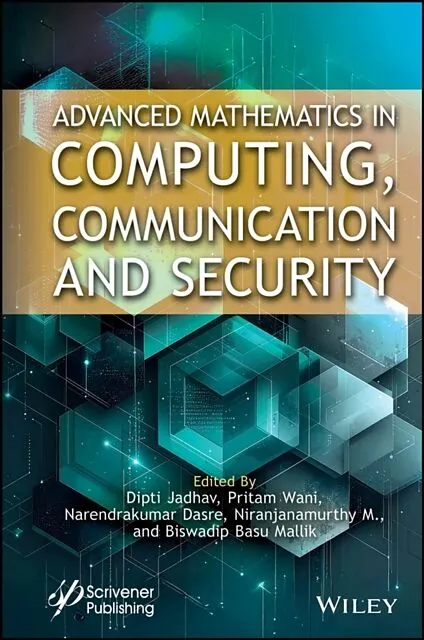
Advanced Mathematics in Computing, Communication and Security
Beschreibung
Autorentext Dipti Jadhav, PhD is an Associate Professor in the Department of Information Technology in the Ramrao Adik Institute of Technology at D.Y. Patil University with more than 18 years of research and teaching experience. She has edited one book, author...Format auswählen
- Fester EinbandCHF 272.80

Wird oft zusammen gekauft
Andere Kunden kauften auch
Beschreibung
Autorentext
Dipti Jadhav, PhD is an Associate Professor in the Department of Information Technology in the Ramrao Adik Institute of Technology at D.Y. Patil University with more than 18 years of research and teaching experience. She has edited one book, authored more than 30 research papers in international journals and conferences, and holds one Australian and one German patent. Her research focuses on image processing, computer vision, pattern recognition, software engineering, machine learning, and artificial intelligence. Pritam Wani, PhD is a Professor at the Ramrao Adik Institute of Technology. Nerul, India. She has published papers in national and international journals. Narendrakumar Dasre, PhD is an Associate Professor of Applied Mathematics at the Ramrao Adik Institute of Technology with more than 21 years of teaching experience. He has authored and reviewed 14 national and international books and published 11 research papers in national and international journals. His areas of interest include image processing, topology, number theory, and applied mathematics. Niranjanamurthy M., PhD is an Assistant Professor in the Department of Artificial Intelligence and Machine Learning at the BMS Institute of Technology and Management with more than 14 years of experience. He has published more than 25 books and more than 95 articles in various national and international conferences and journals. He has also filed 30 patents, six of which have been granted. His areas of interest include data science, machine learning, e-commerce and m-commerce, software testing and engineering, and cloud computing. Biswadip Basu Mallik, PhD is an Associate Professor of Mathematics in the Department of Basic Sciences and Humanities at the Institute of Engineering and Management with more than 22 years of research and teaching experience. He has published several research papers and book chapters in various scientific journals, authored five books, edited an additional 13, and published five Indian patents. His research focuses on computational fluid dynamics, mathematical modeling, machine learning, and optimization.
Klappentext
Explore the cutting edge of scientific computing with this volume, which provides a comprehensive look at the interdependency between mathematics and computer science. Within the evolving landscape of computer science, mathematics is increasingly playing a pivotal role. Disciplines like linear algebra, statistics, calculus, and discrete mathematics serve as the cornerstone for comprehension and innovation within various computer science domains. This book underscores the deep-seated interdependency between the realms of mathematics and scientific computing, exploring how each discipline mutually reinforces and advances the other. With its rich theoretical framework and analytical rigor, mathematics provides the bedrock upon which many computational concepts and methodologies are built. In turn, computer science offers a practical avenue for applying mathematical abstractions to tackle real-world problems efficiently and effectively. Cutting-edge technologies, such as scientific computing, deep learning, and computer vision, require not only a mastery of foundational mathematics, but a diverse interdisciplinary approach. This book sheds light on the burgeoning frontiers of computer science, bringing together researchers with expertise across multiple industries, making it an essential resource for beginners and experienced practitioners alike.
Inhalt
Preface xxi
1 Comparative Analysis of Secure Multi-Party Techniques in the Cloud 1
Janak Dhokrat, Namita Pulgam, Tabassum Maktum and Vanita Mane
1.1 Introduction 2
1.2 Related Work 5
1.3 Comparative Analysis 9
1.4 Summary 11
1.5 Conclusion 16
1.6 Compliance with Ethical Standards 17
2 Exploring the Role of Mathematics in Artificial Intelligence (AI), Machine Learning (ML) and Deep Learning (DL) Applications 21
R. Venkatesh
2.1 Introduction to Mathematics in Artificial Intelligence 23
2.2 Mathematical Foundations of AI 29
2.3 Advanced Mathematical Techniques in Machine Learning 33
2.4 Applications of Mathematics in Deep Learning 41
2.5 Future Directions and Challenges 47
2.6 Conclusion 53
3 ChatGPT as Rough Set Model Bridging Conversation Gap and Uncertainty 57
Anshit Mukerjee, Biswadip Basu Mallik and Sudeshna Das
3.1 Introduction 58
3.2 Literature Review 58
3.3 Methodology 62
3.4 Results 68
3.5 Discussions 76
3.6 Conclusion and Future Works 77
4 Simulating M/G/1 Queuing Network with Time-Varying Arrival Rates and Server Failure Using Python Programming 81
Sreelekha Menon, Surya K.A. and Reshma R.
4.1 Introduction 82
4.2 Methodology 84
4.3 Numerical Example 86
4.4 Python Code 89
4.5 Negative Arrivals 89
4.6 Conclusion 89
5 A Technique of Watermarking Using DGT and DCT 91
Narendrakumar R. Dasre and Pritam Gujarathi
5.1 Introduction 91
5.2 Proposed Algorithm Using DGT and DCT 93
5.3 Experimental Results 95
5.4 Statistical Analysis 99
5.5 Conclusion 113
6 Performance and Economic Study of an Impatient Consumer Queue with Working Vacations, Secondary Service and Server Failures 117
K. Jyothsna, P. Vijaya Kumar and P. Vijaya Laxmi
6.1 Introduction 118
6.2 Model Overview 121
6.3 Steady-State Analysis 122
6.4 Performance Characteristics 125
6.5 Sensitivity Analysis 128
6.6 Conclusion 135
7 Optimal Strategies for Multi-Item Stochastic Inventory Model for Convertible Items 139
Mamta Keswani and Uttam Kumar Khedlekar
7.1 Introduction 139
7.2 Literature Survey 142
7.3 Problem Statement 144
7.4 Assumptions 145
7.5 Notations 146
7.6 Model Formulation 147
7.7 Optimization by Using Dynamic Programming 148
7.8 Numerical Validations 158
7.9 Conclusion 163
8 Sampling Statistics-Based Predictive Machine Learning Model for Large Scale Data Set 165
Kamlesh Kumar Pandey, Anurag Singh and Sudeep Kumar Verma
8.1 Introduction 166
8.2 Challenging Issues of Big Data for Machine Learning 168
8.3 Big Data Strategies for Machine Learning 170
8.4 Sampling 172
8.5 Sampling Model for Machine Learning 180
8.6 Experimental Analysis 184
8.7 Conclusion 188
9 Correlation of Family History with Tumor Grade and Lymph Node Involvement in Breast Cancer Patients 195
Suganthi P. and Ebenesar Anna Bagyam J.
9.1 Introduction 196
9.2 Literature Review 197
9.3 Methodology 201
9.4 Data Collection and Analysis of Parameters 201
9.5 Analysis of Parameters Using Statistical Tool 206
9.6 Conclusion 209
10 Unlocking AI, ML, and DL Innovations: "The Essential Role of Mathematics" 211
R. Roselinkiruba, Vasumathy M., C.P. Koushik, C. Saranya Jothi, S. Divya and A. Keerthika
10.1 Introduction for the Mathematical Concepts in AI, ML and DL 212
10.2 Linear Algebra 215
10.3 Calculus: Foundations for Optimization and Training Algorithms 221
10.4 Probability and Statistics: Analyzing and Validating Models 225
10.5 Optimization: Refining Models and Resource Allocation 230
10.6 Discrete Mathematics: Graph Theory and Combinatorics in AI 235
10.7 Information Theory: Guiding Feature Selection and Model Evaluation 240
10.8 Applications in Various Domains 243
10.9 Conclusion 245
11 Optimization and Metaheuristics: Mathematical Approaches in AI, Machine Learning, and Deep Learning 247
C. Saranya Jothi, J.P. Shritharanyaa, E. Surya, R. Roselinkiruba, P. Jeevanasree and B. Lalitha
11.1 Introduction to Metaheuristics and Optimization 248
11.2 Metaheuristics Algorithms and Their Mathematical Foundations 252
11.3 Applications in Artificial Intelligence 263
11.4 Metaheuristics in Machine Learning Applications 266
11.5 Metaheuristics in Deep Learning Applications 268
11.6 Challenges and Future Directions 271
11.7 Conclusions 272
**12 A Survey on Mathematics for …