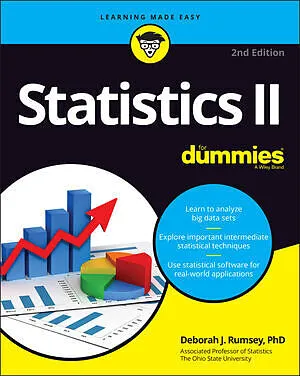
Statistics II For Dummies
Beschreibung
Continue your statistics journey with this all-encompassing reference Completed Statistics through standard deviations, confidence intervals, and hypothesis testing? Then you're ready for the next step: Statistics II. And there's no better way to tac...Format auswählen
- Kartonierter EinbandCHF 30.00

Wird oft zusammen gekauft
Andere Kunden kauften auch
Beschreibung
Continue your statistics journey with this all-encompassing reference
Completed Statistics through standard deviations, confidence intervals, and hypothesis testing? Then you're ready for the next step: Statistics II. And there's no better way to tackle this challenging subject than with Statistics II For Dummies! Get a brief overview of Statistics I in case you need to brush up on earlier topics, and then dive into a full explanation of all Statistic II concepts, including multiple regression, analysis of variance (ANOVA), Chi-square tests, nonparametric procedures, and analyzing large data sets. By the end of the book, you'll know how to use all the statistics tools together to create a great story about your data.
For each Statistics II technique in the book, you get an overview of when and why it's used, how to know when you need it, step-by-step directions on how to do it, and tips and tricks for working through the solution. You also find:
- What makes each technique distinct and what the results say
- How to apply techniques in real life
- An interpretation of the computer output for data analysis purposes
- Instructions for using Minitab to work through many of the calculations
- Practice with a lot of examples
With Statistics II For Dummies, you will find even more techniques to analyze a set of data. Get a head start on your Statistics II class, or use this in conjunction with your textbook to help you thrive in statistics!
Autorentext
Deborah J. Rumsey, PhD, is a Statistics Education Specialist and Associated Professor in the Department of Statistics at The Ohio State University. She is also a Fellow of the American Statistical Association and has received the Presidential Teaching Award from Kansas State University. Dr. Rumsey has published numerous papers and given many professional presentations on the subject of statistics education.
Klappentext
Continue your statistics journey with this all-encompassing reference Completed Statistics through standard deviations, confidence intervals, and hypothesis testing? Then you're ready for the next step: Statistics II. And there's no better way to tackle this challenging subject than with Statistics II For Dummies! Get a brief overview of Statistics I in case you need to brush up on earlier topics, and then dive into a full explanation of all Statistic II concepts, including multiple regression, analysis of variance (ANOVA), Chi-square tests, nonparametric procedures, and analyzing large data sets. By the end of the book, you'll know how to use all the statistics tools together to create a great story about your data. For each Statistics II technique in the book, you get an overview of when and why it's used, how to know when you need it, step-by-step directions on how to do it, and tips and tricks for working through the solution. You also find: * What makes each technique distinct and what the results say * How to apply techniques in real life * An interpretation of the computer output for data analysis purposes * Instructions for using Minitab to work through many of the calculations * Practice with a lot of examples With Statistics II For Dummies, you will find even more techniques to analyze a set of data. Get a head start on your Statistics II class, or use this in conjunction with your textbook to help you thrive in statistics!
Inhalt
Introduction 1
About This Book 1
Foolish Assumptions 3
Icons Used in This Book 3
Beyond the Book 4
Where to Go from Here 4
Part 1: Tackling Data Analysis and Model-Building Basics 7
Chapter 1: Beyond Number Crunching: The Art and Science of Data Analysis 9
Data Analysis: Looking before You Crunch 9
Nothing (not even a straight line) lasts forever 10
Data snooping isn't cool 11
No (data) fishing allowed 12
Getting the Big Picture: An Overview of Stats II 13
Population parameter 13
Sample statistic 13
Confidence interval 14
Hypothesis test 14
Analysis of variance (ANOVA) 15
Multiple comparisons 15
Interaction effects 16
Correlation 16
Linear regression 17
Chi-square tests 18
Chapter 2: Finding the Right Analysis for the Job 21
Categorical versus Quantitative Variables 22
Statistics for Categorical Variables 23
Estimating a proportion 23
Comparing proportions 24
Looking for relationships between categorical variables 25
Building models to make predictions 26
Statistics for Quantitative Variables 27
Making estimates 27
Making comparisons 28
Exploring relationships 28
Predicting y using x 30
Avoiding Bias 31
Measuring Precision with Margin of Error 33
Knowing Your Limitations 35
Chapter 3: Having the Normal and Sampling Distributions in Your Back Pocket 37
Recognizing the VIP Distribution - the Normal 38
Characterizing the normal 38
Standardizing to the standard normal (Z-) distribution 38
Using the normal table 40
Finding probabilities for the normal distribution 41
Finally Getting Comfortable with Sampling Distributions 42
The mean and standard error of a sampling distribution 42
Sampling distribution of X 43
Sampling distribution of p 44
Heads Up! Building Confidence Intervals and Hypothesis Tests 45
Confidence interval for the population mean 45
Confidence interval for the population proportion 46
Hypothesis test for population mean 46
Hypothesis test for the population proportion 47
Chapter 4: Reviewing Confidence Intervals and Hypothesis Tests 49
Estimating Parameters by Using Confidence Intervals 50
Getting the basics: The general form of a confidence interval 50
Finding the confidence interval for a population mean 51
What changes the margin of error? 52
Interpreting a confidence interval 55
What's the Hype about Hypothesis Tests? 56
What Ho and Ha really represent 56
Gathering your evidence into a test statistic 57
Determining strength of evidence with a p-value 57
False alarms and missed opportunities: Type I and II errors 58
The power of a hypothesis test 60
Part 2: Using Different Types of Regression to Make Predictions 65
Chapter 5: Getting in Line with Simple Linear Regression 67
Exploring Relationships with Scatterplots and Correlations 68
Using scatterplots to explore relationships 69
Collating the information by using the correlation coefficient 70
Building a Simple Linear Regression Model 71
Finding the best-fitting line to model your data 72
The y-intercept of the regression line 73
The slope of the regression line 74
Making point estimates by using the regression line 75
No Conclusion Left Behind: Tests and Confidence Intervals for Regression 75
Scrutinizing the slope 76
Inspecting the y-intercept 78
Building confidence intervals for the average response 80
Making the band with prediction intervals 81
Checking the Model's Fit (The Data, Not the Clothes!) 83
Defining the conditions 84
Finding and exploring the residuals 85
Using r2 to measure model fit 89
Scoping for outliers 90
Knowing the Limitations of Your Regression Analysis 92
Avoiding slipping into cause-and-effect mode 92
Extrapolation: The ultimate no-no 93
Sometimes you need more than one variable 94
Chapter 6: Multiple Regression with Two X Variables 95
Getting to Know the Multiple Regression Model 96
Discovering the uses of multiple regression 96
Looking at the general form of the multiple regression model 96
Stepping through the analysis 97
Looking at x's and y's 97
Collecting the Data 98
Pinpointing Possible Relationships 100
Making scatterplots 100
Correlations: Examining the bond 101
Checking for Multicolinearity 104
Finding the Best-Fitting Model for Two x Variables 105
Getting the multiple regression coefficients 106
Interpreting the coefficients 107
Testing the coefficients 108
Predicting y by Using the x Variab…