Haben Sie noch nichts passendes gefunden? Stöbern Sie durch unser komplettes Sortiment.
Oder melden Sie sich an bzw. registrieren Sie sich.


Beschreibung
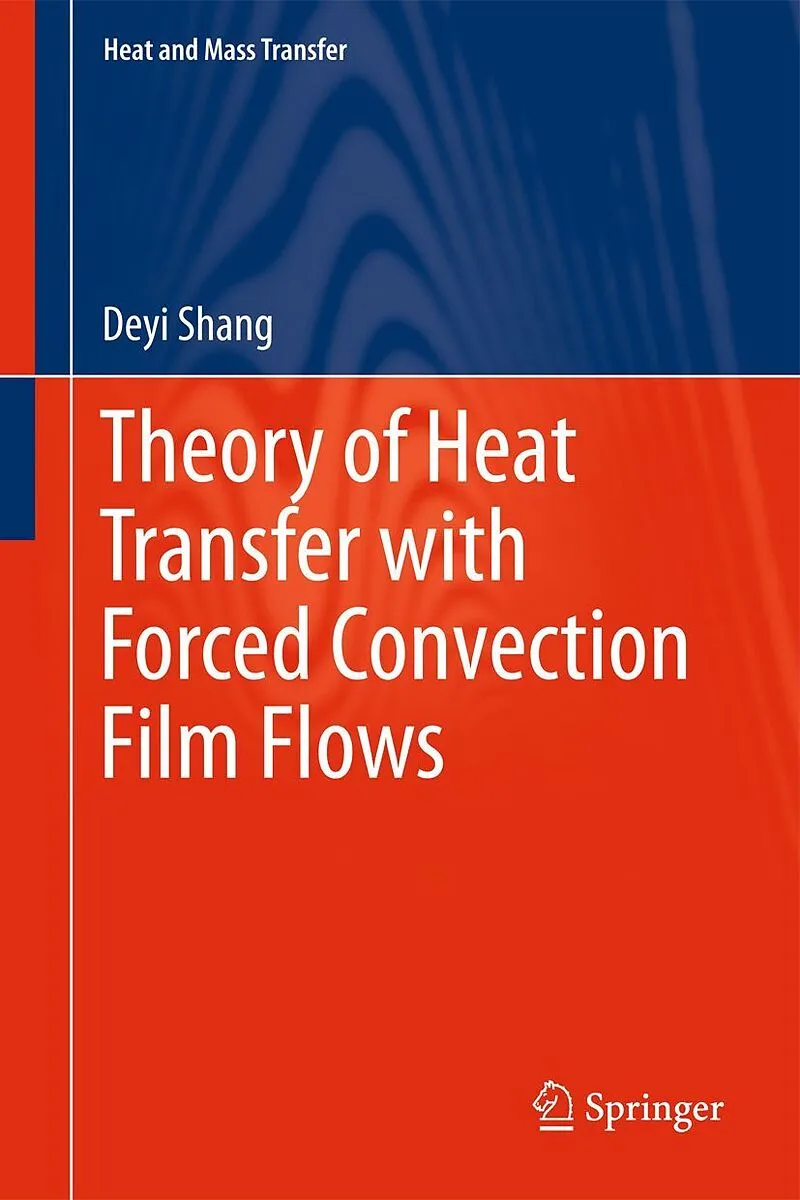
This book systematically presents recent developments for laminar forced convection and forced film condensation, both from pure vapor and vapor-gas mixture for variable properties. The book will prove a useful reference to researchers and graduate students. D...This book systematically presents recent developments for laminar forced convection and forced film condensation, both from pure vapor and vapor-gas mixture for variable properties. The book will prove a useful reference to researchers and graduate students.
Developing a new treatment of 'Free Convection Film Flows and Heat Transfer' began in Shang's first monograph and is continued in this monograph. The current book displays the recent developments of laminar forced convection and forced film condensation. It is aimed at revealing the true features of heat and mass transfer with forced convection film flows to model the deposition of thin layers. The novel mathematical similarity theory model is developed to simulate temperature- and concentration- dependent physical processes. The following topics are covered in this book: 1. Mathematical methods - advanced similarity analysis method to replace the traditional Falkner-Skan type transformation - a novel system of similarity analysis and transformation models to overcome the difficult issues of forced convection and forced film flows - heat and mass transfer equations based on the advanced similarity analysis models and equations formulated with rigorous key numerical solutions 2. Modeling the influence of physical factors - effect of thermal dissipation on forced convection heat transfer - a system of models of temperature and concentration-dependent variable physical properties based on the advanced temperature-parameter model and rigorous analysis model on vapor-gas mixture physical properties for the rigorous and convenient description of the governing differential equations - an available approach to satisfy interfacial matching conditions for rigorous and reliable solutions - a system of numerical results on velocity, temperature and concentration fields, as well as, key solutions on heat and mass transfer - the effect of non-condensable gas on heat and mass transfer for forced film condensation. This way it is realized to conveniently and reliably predict heat and mass transfer for convection and film flows and to resolve a series of current difficult issues of heat and mass transfer with forced convection film flows. Professionals in this fields aswell as graduate students will find this a valuable book for their work.
Presents a new approach for calculations of heat and mass transfer Models presented for laminar forced convection and forced film condensation System of novel theories on hydrodynamics and heat mass transfer for laminar forced convection and film flows and advanced similarity analysis presented Numerical calculation approaches extensively presented Useful reference to researchers and graduate students alike Includes supplementary material: sn.pub/extras
Autorentext
De-Yi Shang, has a doctorate from Tsinghua University, and was a Professor at Northeastern University, China. An active scientist in the area of heat and mass transfer, he now resides in Canada. He proposed an innovative method of similarity transformation of velocity fields on laminar boundary layers. As a better alternative approach to Falkner-Skan transformation, this method has successfully been applied for in-depth studies on convection heat and mass transfer of actual fluids. He also developed a novel model of the temperature-dependent physical properties of gases and liquids, which ensures the practical value of theoretical research on convective heat and mass transfer. He developed the weighted model of concentration- and temperature-dependent physical properties of vapor-gas mixture. He is author of four Springer scientific monographs and of numerous journal papers on the theory and practical application of heat and mass transfer. In 1994, he won the Chinese EducationCommissio's scientific progress prize. In 1996, he was awarded scientific grants by the Norwegian Research Council as outstanding foreign scientist with proven international reputation. In 2015, he was appointed a lead guest editor of the Science Publishing Group (New York, USA) responsible for Special Issues on Convection Heat and Mass Transfer.Dr. Liang-Cai Zhong is a Professor at Northeastern University, China. In 1993 he worked as a visiting scientist for research on convection heat transfer at the University of Stuttgart, Germany. In 2002, he was a visiting scientist at Kyushu Institute of Technology, Japan. In 2003 he was appointed as Associate Professor of Northeastern University, China, in 2004 was awarded a Ph.D degree of Northeastern University, China, and in 2008 became Professor. During this time he carried out scientific investigations on convection heat and mass transfer, process modeling and optimization in ferrous metallurgy, especially in hot metal treatment, converter steelmaking, secondary refining and continuous casting. He has hosted and participated in 5 state-level projects and 50 scientific research projects from major and medium-sized iron and steel companies. He has published more than 60 papers in national and international academic journals, including 40 papers cited by SCI and EI. He has also published five academic books. He has received four scientific and technological progress awards at provincial and ministerial levels.
Inhalt
Introduction.- Basic conservation equations for laminar forced convection.- Falkner-Skan type transformation for laminar forced convection.- New similarity analysis and transformation method for laminar forced convection.- Heat transfer on laminar forced convection without consideration of viscous thermal dissipation.- Heat transfer on laminar forced convection with consideration of viscous thermal dissipation.- Heat transfer on laminar forced convection with consideration of variable thermophysical properties.- Complete similarity mathematical models on laminar forced film condensation of pure vapor.- Velocity and temperature fields on laminar forced film condensation of pure vapor.- Heat and mass transfer on laminar forced film condensation of pure vapor.- Complete similarity mathematical models on laminar forced film condensation of vapor-gas mixture.- Velocity and temperature fields on laminar forced film condensation of vapor-gas mixture.- Heat and mass transfer on laminar forced film condensation of vapor-gas mixture