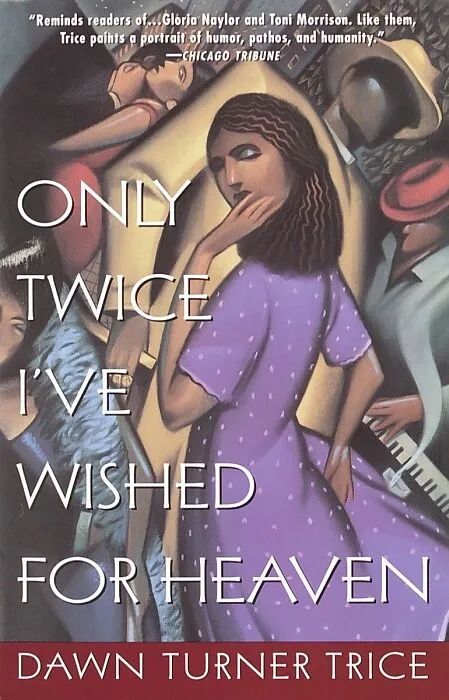
Only Twice I've Wished for Heaven
Beschreibung
Zusatztext "Dawn Turner Trice has written a magical! word-wise! utterly original novel of love and hate." --Dallas Morning News "A polished gem that shines from every angle! rich in rhythm! story! and characterization...A genuine delight." --Washington Post Bo...Format auswählen
- Kartonierter EinbandCHF 19.20

Wird oft zusammen gekauft
Andere Kunden kauften auch
Beschreibung
Zusatztext "Dawn Turner Trice has written a magical! word-wise! utterly original novel of love and hate." --Dallas Morning News "A polished gem that shines from every angle! rich in rhythm! story! and characterization...A genuine delight." --Washington Post Book World "Touching and memorable." --The New York Times Book Review "Engrossing...Trice has woven an intricate! delicate web of a novel that disturbs! reveals! and satisfies." --San Francisco Chronicle " Only Twice I've Wished for Heaven is universal fiction! gratifying and frightening." --Vibe Magazine Informationen zum Autor Dawn Turner Trice Klappentext In 1975, Tempestt Saville and her family are chosen by lottery to "move on up" to Lakeland: one square mile of sparkling apartment towers and emerald lawns where the Black elite live sheltered from the ghetto by a ten-foot-tall, ivy-covered wrought-iron fence. Eleven-year-old Temmy doesn't enjoy the privilege, however, and thinks Lakeland is the "kingdom of the drab." Instead, she is drawn to the vivid world outside the fence: to 35th Street, where the saved and the sinners are both so "done up" you can't tell one from the other. Tempestt's curiosity soon leads her down a dangerous path, however, and after witnessing the death of a friend, she sets into motion a chain of events that will send 35th Street up in flames.I was sixteen years old when I first set foot on Thirty-fifth Street and first saw Alfred Mayes. And when Child came that night, I knowed exactly what she saw while staring into his old devil eyes. I had saw it myself, lo them many years ago. Honey, them eyes could cast a spell. They invited you in. Told you to make yourself at home, and then before you got comfortable good, they done grabbed hold of the corners of your soul and shook till your whole being was shuffled in the darkness, till you hardly could speak your name. Child didn't have sense enough to be scared for herself, but I was scared for her. The Right Reverend Alfred Mayes and me went back a long way. As I finished closing the store that night, all I could do was think about that little girl--her pretty red hair, her cute little crooked smile, the way she walked holding Hump's hand, looking over her shoulder, waving back at me. There was something about Child that was special. I saw that the moment I laid eyes on her, just like I could tell she was coming back no matter how I warned her to stay away. When she nodded, even after I asked her if she understood it wasn't safe over here, I knowed that nod was a lie. Like I said, I was sixteen when I came to Thirty-fifth Street and first saw Alfred Mayes. It was the summer of 1932. And I don't mind saying I was fine, long black hair, with an even finer waist. Everybody say I looked just like my mother, a cross between Mahalia Jackson and Bessie Smith. But high yellow as honey dew, with big dimples and green eyes trimmed in amber. My mama died birthing me, so I never got a chance to see her. I had to take everybody's word. I still keeps a photograph in my pocketbook that shows me in my fine days, though. It's of me and my big sister, Essie, sporting Sunday flop hats with wax sunflowers and gingham dresses, looking cleaner than the board of health (even though there was a few holes here and there we tucked out of view). The night we made it to Thirty-fifth Street we'd been in Chicago a couple of months. Essie and me waited for everyone crowded in that old tenement house we was staying in to fall asleep. We was two young girls sneaking out our bedroom window like two men tipping out on their wives. We had on the same Sunday dresses and hats we had on in that picture, and some fresh from-the-kitchen bacon grease that we spread across our legs and elbows to get rid of the ash. We thought this was a occasion to be fancy. I was the one that want...
"Dawn Turner Trice has written a magical, word-wise, utterly original novel of love and hate."
*--Dallas Morning News*
"A polished gem that shines from every angle, rich in rhythm, story, and characterization...A genuine delight."
*--Washington Post Book World*
"Touching and memorable."
*--The New York Times Book Review*
"Engrossing...Trice has woven an intricate, delicate web of a novel that disturbs, reveals, and satisfies."
*--San Francisco Chronicle*
"Only Twice I've Wished for Heaven is universal fiction, gratifying and frightening."
*--Vibe* Magazine
Autorentext
Dawn Turner Trice
Klappentext
In 1975, Tempestt Saville and her family are chosen by lottery to "move on up" to Lakeland: one square mile of sparkling apartment towers and emerald lawns where the Black elite live sheltered from the ghetto by a ten-foot-tall, ivy-covered wrought-iron fence. Eleven-year-old Temmy doesn't enjoy the privilege, however, and thinks Lakeland is the "kingdom of the drab." Instead, she is drawn to the vivid world outside the fence: to 35th Street, where the saved and the sinners are both so "done up" you can't tell one from the other. Tempestt's curiosity soon leads her down a dangerous path, however, and after witnessing the death of a friend, she sets into motion a chain of events that will send 35th Street up in flames.
Leseprobe
I was sixteen years old when I first set foot on Thirty-fifth Street and first saw Alfred Mayes. And when Child came that night, I knowed exactly what she saw while staring into his old devil eyes. I had saw it myself, lo them many years ago. Honey, them eyes could cast a spell. They invited you in. Told you to make yourself at home, and then before you got comfortable good, they done grabbed hold of the corners of your soul and shook till your whole being was shuffled in the darkness, till you hardly could speak your name. Child didn't have sense enough to be scared for herself, but I was scared for her. The Right Reverend Alfred Mayes and me went back a long way.
As I finished closing the store that night, all I could do was think about that little girl--her pretty red hair, her cute little crooked smile, the way she walked holding Hump's hand, looking over her shoulder, waving back at me. There was something about Child that was special. I saw that the moment I laid eyes on her, just like I could tell she was coming back no matter how I warned her to stay away. When she nodded, even after I asked her if she understood it wasn't safe over here, I knowed that nod was a lie.
Like I said, I was sixteen when I came to Thirty-fifth Street and first saw Alfred Mayes. It was the summer of 1932. And I don't mind saying I was fine, long black hair, with an even finer waist. Everybody say I looked just like my mother, a cross between Mahalia Jackson and Bessie Smith. But high yellow as honey dew, with big dimples and green eyes trimmed in amber. My mama died birthing me, so I never got a chance to see her. I had to take everybody's word. I still keeps a photograph in my pocketbook that shows me in my fine days, though. It's of me and my big sister, Essie, sporting Sunday flop hats with wax sunflowers and gingham dresses, looking cleaner than the board of health (even though there was a few holes here and there we tucked out of view).
The night we made it to Thirty-fifth Street we'd been in Chicago a couple of months. Essie and me waited for everyone crowded in that old tenement house we was staying in to fall asleep. We was two young girls sneaking out our bedroom window like two men tipping out on their wives. We had on the same Sunday dresses and hats we had on in that picture, and some fresh from-the-kitchen bacon grease that we spread across our legs and elbows to get rid of the ash. We thought this was a occasion to be fancy.
I was the one that wanted to go to Thirty-fifth Street. Poor Essie, I just drug her with me. She was three years older, but I always led the way to the fun stuff. I probably wouldn't a gave a hoot about the place if Aunt Ethel hadn'…