Beschreibung
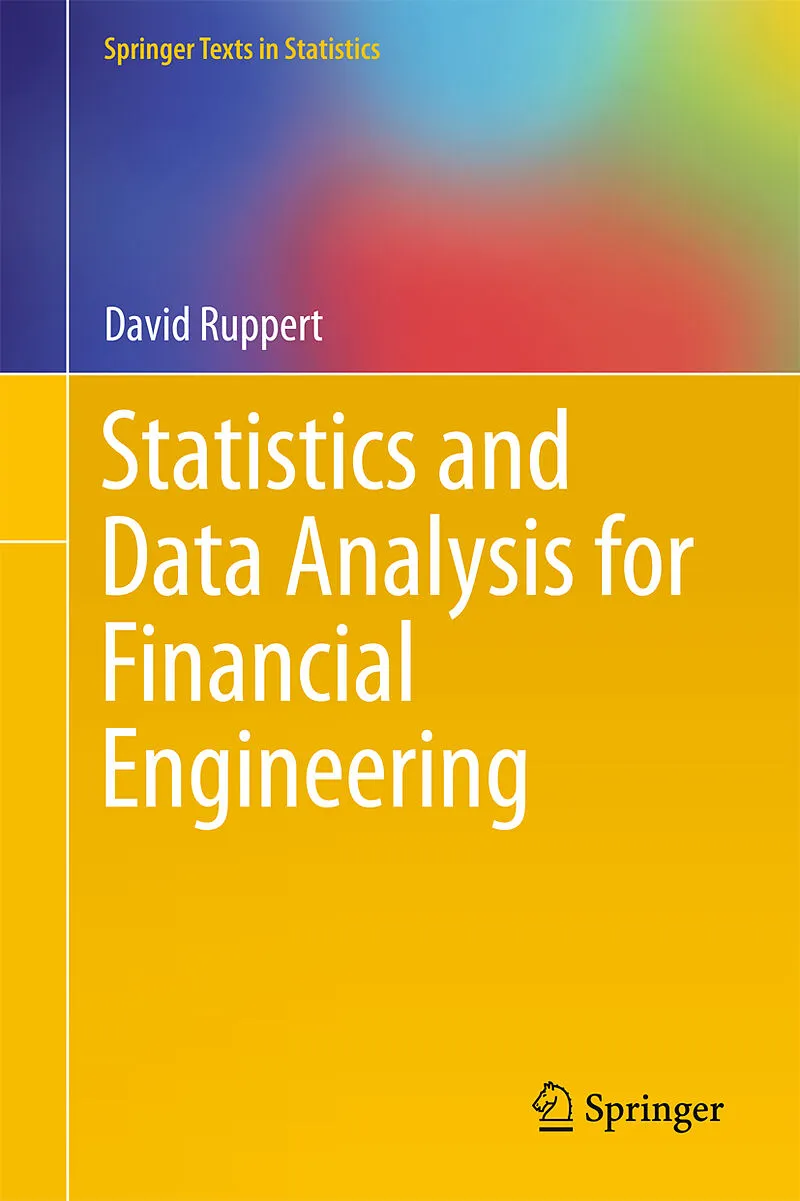
Statistics and Data Analysis for Financial Engineering provides an overview of the methods and techniques used to extract quantitative information from enormous amounts of data. The text includes R Labs with real-data exercises, and integrates graphical and an...Statistics and Data Analysis for Financial Engineering provides an overview of the methods and techniques used to extract quantitative information from enormous amounts of data. The text includes R Labs with real-data exercises, and integrates graphical and analytical methods for modeling and diagnosing modeling errors.
Financial engineers have access to enormous quantities of data but need powerful methods for extracting quantitative information, particularly about volatility and risks. Key features of this textbook are: illustration of concepts with financial markets and economic data, R Labs with real-data exercises, and integration of graphical and analytic methods for modeling and diagnosing modeling errors. Despite some overlap with the author's undergraduate textbook Statistics and Finance: An Introduction, this book differs from that earlier volume in several important aspects: it is graduate-level; computations and graphics are done in R; and many advanced topics are covered, for example, multivariate distributions, copulas, Bayesian computations, VaR and expected shortfall, and cointegration.
The prerequisites are basic statistics and probability, matrices and linear algebra, and calculus.
Some exposure to finance is helpful.
Examples using financial markets and economic data illustrate important concepts R Labs with real-data exercises give students practice in data analysis Integration of graphical and analytic methods for model selection and model checking quantify and help mitigate risks due to modeling errors and uncertainty Includes supplementary material: sn.pub/extras Request lecturer material: sn.pub/lecturer-material
Autorentext
David Ruppert is Andrew Schultz, Jr., Professor of Engineering and Professor of Statistical Science, School of Operations Research and Information Engineering and Department of Statistical Science, Cornell University, where he teaches statistics and financial engineering and is a member of the Program in Financial Engineering. His research areas include asymptotic theory, semiparametric regression, functional data analysis, biostatistics, model calibration, measurement error and astrostatistics. Professor Ruppert received his PhD in Statistics at Michigan State University. He is a Fellow of the American Statistical Association and the Institute of Mathematical Statistics and won the Wilcoxon prize. He is Editor of the Journal of the American Statistical Association-Theory and Methods, former editor of the Electronic Journal of Statistics, former Editor of the Institute of Mathematical Statistics's Lecture Notes--Monographs Series and former Associate Editor of several major statistics journals. Professor Ruppert has published over 125 scientific papers and four books: Transformation and Weighting in Regression, Measurement Error in Nonlinear Models, Semiparametric Regression, and Statistics and Finance: An Introduction. David S. Matteson is Assistant Professor of Statistical Science, ILR School and Department of Statistical Science, Cornell University, where he is a member of the Center for Applied Mathematics, Field of Operations Research, and the Program in Financial Engineering, and teaches statistics and financial engineering courses. His research areas include multivariate time series, signal processing, financial econometrics, spatio-temporal modeling, dimension reduction, machine learning, and biostatistics. Professor Matteson received his PhD in Statistics at the University of Chicago and his BS in Finance, Mathematics, and Statistics at the University of Minnesota. He received a CAREER Award from the National Science Foundation and won Best Academic Paper Awards from the annual R/Finance conference. He is an Associate Editor of the Journal of the American Statistical Association-Theory and Methods, Biometrics, and Statistica Sinica. He is also an Officer for the Business and Economic Statistics Section of American Statistical Association, and a member of the Institute of Mathematical Statistics and the International Biometric Society.
Klappentext
Financial engineers have access to enormous quantities of data but need powerful methods for extracting quantitative information, particularly about volatility and risks. Key features of this textbook are: illustration of concepts with financial markets and economic data, R Labs with real-data exercises, and integration of graphical and analytic methods for modeling and diagnosing modeling errors. Despite some overlap with the author's undergraduate textbook Statistics and Finance: An Introduction, this book differs from that earlier volume in several important aspects: it is graduate-level; computations and graphics are done in R; and many advanced topics are covered, for example, multivariate distributions, copulas, Bayesian computations, VaR and expected shortfall, and cointegration. The prerequisites are basic statistics and probability, matrices and linear algebra, and calculus. Some exposure to finance is helpful.
Zusammenfassung
Financial engineers have access to enormous quantities of data but need powerful methods for extracting quantitative information, particularly about volatility and risks. Key features of this textbook are: illustration of concepts with financial markets and economic data, R Labs with real-data exercises, and integration of graphical and analytic methods for modeling and diagnosing modeling errors. Despite some overlap with the author's undergraduate textbook Statistics and Finance: An Introduction, this book differs from that earlier volume in several important aspects: it is graduate-level; computations and graphics are done in R; and many advanced topics are covered, for example, multivariate distributions, copulas, Bayesian computations, VaR and expected shortfall, and cointegration.
The prerequisites are basic statistics and probability, matrices and linear algebra, and calculus.
Some exposure to finance is helpful.
Inhalt
Introduction.- Returns.- Fixed income securities.- Exploratory data analysis.- Modeling univariate distributions.- Resampling.- Multivariate statistical models.- Copulas.- Time series models: basics.- Time series models: further topics.- Portfolio theory.- Regression: basics.- Regression: troubleshooting.- Regression: advanced topics.- Cointegration.- The capital asset pricing model.- Factor models and principal components.- GARCH models.- Risk management.- Bayesian data analysis and MCMC.- Nonparametric regression and splines.