Beschreibung
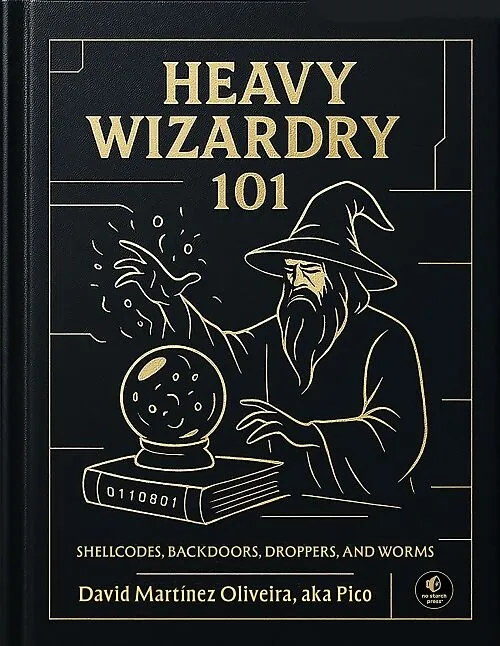
Aspiring hackers will learn foundational programming in C and assembly languages from a veteran hacker and develop the skills to create their own hacking tools. In hacker lore, heavy wizardry means code so close to the metal it feels like magic—craft...Aspiring hackers will learn foundational programming in C and assembly languages from a veteran hacker and develop the skills to create their own hacking tools.
In hacker lore, heavy wizardry means code so close to the metal it feels like magic—crafted by those who truly understand how the machine works. <Heavy Wizardry 101< is your apprenticeship in that art.
You’ll start with the foundations—computer architecture, memory, and the stack—before progressing to real-world programs: shellcode, backdoors, droppers, and worms (all built and tested in safe, contained environments). Each chapter provides complete, working code for four major architectures: x86_64, ARM, MIPS, and RISC-V, revealing the similarities and differences between them.
You’ll learn how to:
<lFollow code from human-readable C down to raw assembly and opcodes</l<lAdapt tools across architectures for maximum portability</l<lStrip away compiler overhead to write smaller, faster binaries</l<lWork confidently without relying on fragile, cutting-edge tools that can quickly become obsolete or change with new versions</l
Whether you’re an aspiring hacker, a security researcher, or a systems programmer, this book will give you the knowledge to not just run tools, but create them and understand exactly how and why they work.
Autorentext
David Martínez Oliveira, aka Pico, has been writing code close to the metal since the 1990s, building software for computer vision, communications systems, laboratory equipment, and AR/VR/MR applications. A longtime GNU/Linux user, he explores security and low-level system internals both professionally and for fun.
Klappentext
Your spellbook for code close to the metal.
In hacker circles, heavy wizardry means code that trades on intimate knowledge of a system—the kind that speaks its private dialects and bends its rules. Heavy Wizardry 101 teaches you to write it. You’ll build shellcode, backdoors, droppers, and worms from scratch, working at the instruction level where magic happens.
Every project is implemented for four architectures: x86_64, ARM, MIPS, and RISC-V. You’ll write the same program four times, seeing exactly what stays constant and what changes. Each chapter starts with architecture fundamentals, such as memory layout, calling conventions, and stack mechanics, then walks through complete working implementations on Linux in safe, contained environments.
Learn to:
Inhalt
Acknowledgments
Introduction
**
Part I: Into the Machine: Awakening Code Spells**
Chapter 1: Spell of the Binary Oracle: When Hardware Whispers in Opcodes
Chapter 2: Spell of Essence: Distilling C to Its Primordial ASM
Chapter 3: Spell of Rebirth: Transmuting Greetings into Shellcode
Chapter 4: Spell of Overflowing Frame: Mastering Stack Secrets
Chapter 5: Spell of the Undead: Writing a REPL to Animate a Botnet
**
Part II: Onto the Network: Unveiling Mystic Gateways**
Chapter 6: Veil of Shadows: Unlocking Hidden Backdoors
Chapter 7: Veil of Ash: The Dropper That Leaves No Flame Behind
**
Part III: Through the Network: Casting Crawlers**
Chapter 8: Casting the Twin Serpent: Summoning a Two-Headed Worm
Chapter 9: Casting the Lone Strand: Single-Stage Wormcraft
Chapter 10: Casting the Lost Hosts: Conjuring Network Scanners
**
Appendixes: The Forge**
Appendix A: The Sorcerer's Forge: Preparing Your Workshop
Appendix B: Secrets of the Forge: Arcane Tricks for Low-Level Tools
Index