
IHR WARENKORB IST AKTUELL LEER.
Haben Sie noch nichts passendes gefunden? Stöbern Sie durch unser komplettes Sortiment.
Oder melden Sie sich an bzw. registrieren Sie sich.
- Kostenlose Lieferung
- Kauf auf Rechnung
- Ex Libris Tiefpreis
- Filiallieferung und 650+ Abholorte
- Rabatt-Bons als Club-Mitglied
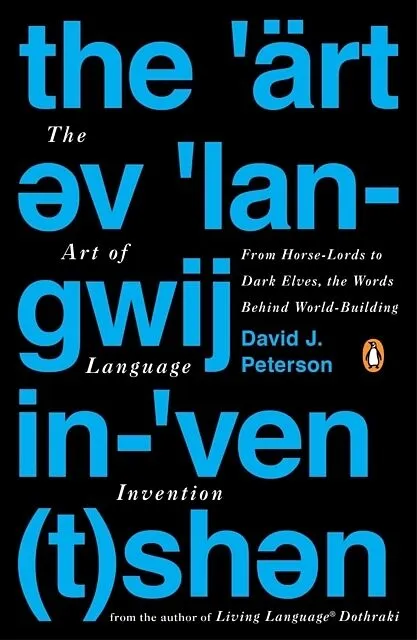
The Art of Language Invention
Beschreibung
An insider’s tour through the construction of invented languages from the bestselling author and creator of languages for the HBO series Game of Thrones and the Syfy series Defiance From master language creator David J. Peterson comes a creative guide to...Format auswählen
- BroschiertCHF 29.50
Wird oft zusammen gekauft
Andere Kunden kauften auch
Beschreibung
An insider’s tour through the construction of invented languages from the bestselling author and creator of languages for the HBO series Game of Thrones and the Syfy series Defiance From master language creator David J. Peterson comes a creative guide to language construction for sci-fi and fantasy fans, writers, game creators, and language lovers. Peterson offers a captivating overview of language creation, covering its history from Tolkien’s creations and Klingon to today’s thriving global community of conlangers. He provides the essential tools necessary for inventing and evolving new languages, using examples from a variety of languages including his own creations, punctuated with references to everything from Star Wars to Michael Jackson. Along the way, behind-the-scenes stories lift the curtain on how he built languages like Dothraki for HBO’s Game of Thrones and Shiväisith for Marvel’s Thor: The Dark World , and an included phrasebook will start fans speaking Peterson’s constructed languages. The Art of Language Invention is an inside look at a fascinating culture and an engaging entry into a flourishing art form--and it might be the most fun you’ll ever have with linguistics.
ldquo;David Peterson's language work transformed our show, investing it with a sense of reality and history that would have been impossible without him. There's nothing like the real thing, and David Peterson is it. This fascinating book will not only illuminate the task of language creation--it will make you look at your own language in a whole new way.”
**—David Benioff and D.B. Weiss, co-creators of HBO's ***Game of Thrones
*
“George R. R. Martin created Khal Drogo, and David Benioff and Dan Weiss believed in me, but David Peterson gave me life.”
—Jason Momoa
“David J. Peterson’s The Art of Language Invention accomplishes a minor miracle in taking a potentially arcane discipline and infusing it with life, humor and passion. It makes a compelling and entertaining case for language creation as visual and aural poetry. I cherish words, I love books about words and for me this is the best book about language since Stephen Fry’s The Ode Less Traveled. And, best of all, there’s a phrasebook!”
—Kevin Murphy, co-creator and showrunner of Syfy’s Defiance
“If you want to know how someone makes up a language from the ground up, you'll find out how in this book—and the glory of it is that along the way you'll get the handiest introduction now in existence to what linguistics is. In fact, read this even if you DON'T feel like making up a language!”
—John McWhorter, author of The Language Hoax
“Accessible, entertaining, and thorough, Peterson has created an invaluable resource for authors, dedicated fans, and casual enthusiasts. This is the book I wish I'd had when I started writing.”
**—Leigh Bardugo, New York Times bestselling author of Shadow and Bone
“This book not only lucidly ushers language invention into its own as an art form, it's also an excellent introduction to linguistics.”
—Arika Okrent, author of In the Land of Invented Languages
"Mr. Peterson illuminates the ins and outs of being a professional developer of “constructed languages”...Language invention requires not only technical know-how but also playfulness and a degree of historical savvy.”
—The Wall Street Journal
Autorentext
David J. Peterson began creating languages in 2000, received his MA in Linguistics from the University of California, San Diego, in 2005, and cofounded the Language Creation Society in 2007. He has created languages for HBO’s Game of Thrones, Syfy’s Defiance and Dominion, the CW’s Star-Crossed, and Thor: The Dark World. He has also created languages for many other television shows, such as the CW's The 100, Netflix's The Witcher, and Showtime's Penny Dreadful, as well as films such as Marvel's Doctor Strange, Netflix's Bright, and Legendary's Dune.
Leseprobe
When I was a kid, the original Star Wars trilogy had just completed its initial run in theaters, and Star Wars was everywhere. I had a toy sand skimmer (which I broke), a toy TIE fighter (which I also broke), and a read-along Return of the Jedi picture book with accompanying record which would play the sound of a ship’s blaster when you were supposed to turn the page. (If you’re too young to be familiar with record players as anything other than “vinyl,” type “Pac-Man record read along” into YouTube to familiarize yourself with the concept. That was my childhood.)
In short, aside from He-Man, Star Wars was pretty much the thing if you were a child of four in 1985. At that age, when I watched movies, I didn’t really pay careful attention to the dialogue, and wasn’t able to follow stories that well. Consequently when the Star Wars trilogy was rereleased in 1995, I rewatched it eagerly. Once I got to Return of the Jedi, I was struck by what I thought was a particularly bizarre scene. In the beginning of the movie, Princess Leia, disguised as a bounty hunter, infiltrates Jabba the Hutt’s palace in order to rescue Han Solo. She pretends to have captured Chewbacca, and engages Jabba to negotiate a price for handing him over. In doing so, Leia pretends to speak (or evidently does speak, via some sort of voice modification device) a language Jabba doesn’t. He employs the recently acquired C-3PO as an intermediary. As near as I can tell, this is how the exchange goes (transcription is my own; accent marks indicate where the main stress is):
LEIA: Yaté. Yaté. Yotó. (SUBTITLE: “I have come for the bounty on this Wookiee.”)
C-3PO relays this message and Jabba says he’ll offer 25,000 for Chewie.
LEIA: Yotó. Yotó. (SUBTITLE: “50,000, no less.”)
C-3PO relays this message and Jabba asks why he should pay so much.
LEIA: Eí yóto.
The above isn’t subtitled, but Leia pulls out a bomb and activates it.
C-3PO: Because he’s holding a thermal detonator!
Jabba is impressed by this and offers 35,000.
LEIA: Yató cha.
The above isn’t subtitled, but Leia deactivates the bomb and puts it away.
C-3PO: He agrees.
Order is restored.
I want you to remember that I was in seventh or eighth grade at the time that I was rewatching this. I was not a “language” guy at that point by any stretch of the imagination. I never dreamed that a human could invent a language, and even if I had, I probably wouldn’t have been able to come up with a good reason for one to do so. Furthermore, up to that point, I’d never studied a second language, and the prospect filled me with dread (I had enough trouble understanding my Spanish-speaking relatives who always spoke too fast for me).
But even so, I knew something was wrong here. How on earth does Leia say the same thing twice and have it mean something different the second time? Even if we take C-3PO for an unreliable translator (he is quite loquacious, after all), that applies only to the last two phrases. How could one expect to have an unreliable subtitle? Subtitles are supposed to lie outside the world of the film. If you can’t rely on a subtitle provided by the film’s creators, how can you rely on anything?
In trying to resolve this conflict, it occurred to me that the only plausible explanation for this aberrant phenomenon is that the language itself was correct, but worked differently from all other human languages. In our languages (take English, for exampl…