
IHR WARENKORB IST AKTUELL LEER.
Haben Sie noch nichts passendes gefunden? Stöbern Sie durch unser komplettes Sortiment.
Oder melden Sie sich an bzw. registrieren Sie sich.
- Kostenlose Lieferung
- Kauf auf Rechnung
- Ex Libris Tiefpreis
- Filiallieferung und 650+ Abholorte
- Rabatt-Bons als Club-Mitglied
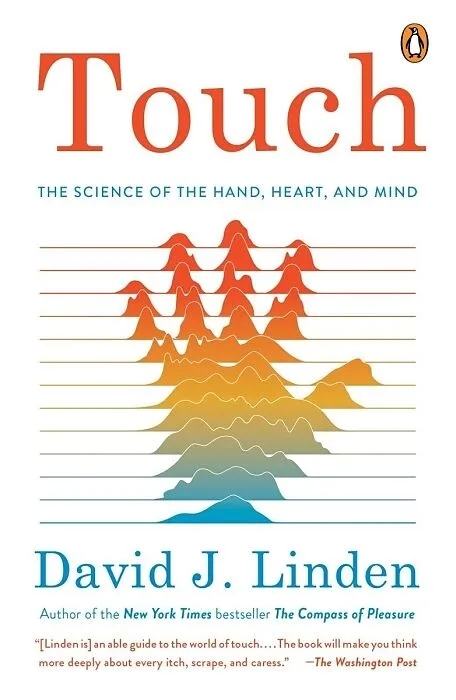
Touch
Beschreibung
Zusatztext 90859395 Informationen zum Autor David J. Linden Klappentext The New York Times-bestselling author of The Compass of Pleasure examines how our sense of touch is interconnected with our emotions Dual-function receptors in our skin make mint feel cool...Format auswählen
- Kartonierter EinbandCHF 30.00

Wird oft zusammen gekauft
Andere Kunden kauften auch
Beschreibung
Zusatztext 90859395 Informationen zum Autor David J. Linden Klappentext The New York Times-bestselling author of The Compass of Pleasure examines how our sense of touch is interconnected with our emotions Dual-function receptors in our skin make mint feel cool and chili peppers hot. Without the brain's dedicated centers for emotional touch, an orgasm would feel more like a sneeze-convulsive, but not especially nice. From skin to nerves to brain, the organization of our body's touch circuits is a complex and often counterintuitive system that affects everything from our social interactions to our general health and development. In Touch, neuroscientist and bestselling author David J. Linden explores this critical interface between our bodies and the outside world, between ourselves and others. Along the way, he answers such questions as: Why do women have more refined detection with their fingertips than men? Is there a biological basis for the use of acupuncture to relieve pain? How do drugs like Ecstasy heighten and motivate sensual touch? Why can't we tickle ourselves? Linking biology and behavioral science, Touch offers an entertaining and enlightening answer to how we feel in every sense of the word. PROLOGUE Malibu, Summer 1975 We're eight teenage campers huddled around a fire ring, late at night. Piled up like puppies, spilling over rocks and stumps and the dusty bare dirt of the Santa Monica mountains, we smell of black sage and acorns and unwashed T-shirts. With no adults in sight and the soft cover of darkness, we give voice to our innermost pubescent thoughts. Your turn, Sam. Okay . . . this is for Caroline. Would you rather give an open-mouth kiss to the camp director or eat a live cockroach? Our voices rise in a disgusted, delighted Greek chorus, Eeeeeeeeeeeew! You're so gross, Sam. I'm not answering that one. But you have to. Those are the rules. No way, you pervert. You're so prickly. I didn't mean to hurt your feelings. Yeah, right. Okay, here's a clean one. Would you rather die of cold in Antarctica or heat in the Sahara Desert? I'm not allowed to bring a parka to Antarctica? No, you're naked. Then I choose the desert. I want to go out with a good tan. Good-natured howling erupts. Caroline raises her arm and shimmies, vamping it up. Sam smiles. You're so vain. And . . . I've gotta go. Everyone knows that this is bogus. It's obvious that he's crazy about Caroline. No, you don't, you slippery sonofabitch. Now it's my turn. You must give up all of your senses except one. Which do you pick to save? Oh, man. That's rough. I'd keep sight. Then, at least I could get around. Uh, no, hearingI need my music. Shit. I dunno. That would just suck. Yeah, it would. I'm touched by your concern. Bite me. Later, lying in my sleeping bag and mulling over this flirtatious banter, I was puzzled. Flush with hormones, we all hungered for interpersonal touch, for kisses and caresses and more. I was typical of this group, so consumed with the idea of holding and kissing a lovely dark-haired girl named Lorelei that I could barely speak. Touch was central to our obsessions and fantasies, yet none of us ever chose to preserve it when, in the nights that followed, Caroline's question about losing one of our senses returned in the Would you rather . . . ? game. Did we simply not think the ramifications through? It's certainly true that a bunch of horny sleep-deprived amped-up teenagers sitting around a campfire is not the ideal forum for contemplation. Or was it that we could easily imagine what it would be like to experience the loss of sight or hearing (we had all shut our eyes or plugged our ears), or even of taste or smell, yet none of us had ever actually been able to re-create the sensation o...
“[Linden is] an able guide to the world of touch, with a true gift for simplifying the complex. (The illustrations and diagrams throughout the book help, too.) The book is packed with cocktail-party trivia—scientists believe that touch is the first sense to develop in utero; some people with schizophrenia can tickle themselves—and satisfying explanations of everyday tactile experiences.”
—Emily Anthes, The Washington Post
“With a novelist’s flair for anecdote, Linden unpacks the science behind touch by revealing how the sense informs and motivates us in everyday situations.”
—Bob Grant, The Scientist
“A book for the non-expert on the neuroscience of touch is very welcome, and I recommend this one enthusiastically. It's full of facts and explanations, many of which are totally cool and, some, even astonishing . . . . But what endears me to the book is not its clarity and its informativeness. What I love is its openness, and occasional insightfulness, about all the things we don't know.”
**—Alva Noë, NPR.org’s 13.7: Cosmos & Culture blog
“Touch: The Science of Hand, Heart and Mind, is a treasure trove for anyone wanting to decode the frisson of a lover’s caress. After all, the skin, says Linden, is a social organ.”
—Cat Auer, Playboy
“The best science writers infect you with their fascination for the subject—that’s exactly what Linden achieves here.”
—Christian Jarrett, BBC Focus
“This book is about the sense of touch, it’s by a professor of neuroscience at the Johns Hopkins School of Medicine, and it’s excellent. It will tell you why footballers hug each other when a goal is scored, why they are like vampire bats in this respect, and why some people like being the recipients of anal sex while others don’t. David Linden tells us all of this with exactly the right degree of scientific dryness.”
—William Leith, The Spectator (UK)
“Linden explores touch in depth, from itches to orgasms . . . and it makes for compelling reading.”
—Orlando Bird, Financial Times
“Being out of touch, the American neuroscientist David J Linden argues in his absorbing book, is not just something that happens to cabinet ministers . . . The human brain contains 500 billion nerve cells and does not give up its secrets lightly. But following Linden’s thread is profoundly worth it.”
—Oliver Moody, The Times (London)
“An engrossing book . . . This book has changed my own life in a small but significant way. My family joke that I’m the woman who put the ‘sal’ into ‘salad’ as I’ve spent my life grazing on uncooked veg. I now gulp down hot soup and feel the better for it. Thank you, David Linden.”
—Salley Vickers, The Guardian
“David J. Linden’s Touch is a charming read that explains the science of touch in easily understandable terms. Anyone who is interested in human interactions and emotional connections will find this book interesting. Just as important, men and women who deal with intimacy disorders – including love and sex addiction—are likely to find this book enlightening from a disease and recovery standpoint.”
—Scott Brassart, Addiction.com
“The Johns Hopkins neuroscientist leads us on a delightful tour of the science of touch, sharing discoveries that shed new light on this highly under-appreciated sense.”
—Jill Suttie, Greater Good
“If you’re interested in the mechanics of your mind or you want to know why you itch and what you have in common with koalas, read this and you won’t be disappointed. Touch: The Science of Hand, Heart, and Mind is a book to get your fingers on.”
— Terri Schlichenmeyer, Rockdale Citizen
“The book is highly readable and laced with storie…